
An inside bar is the market holding its breath — a quiet pause where price coils within the previous candle's range before, often, breaking out with force. It's one of the cleanest and most popular price-action setups, because it marks a clear contraction in volatility (and clear breakout levels) that frequently precedes an expansion. But like every setup, it only earns its keep when you read its context right. This guide explains inside bar trading: what an inside bar is, how to trade its breakout, the continuation and reversal contexts, and why context is everything.
It's a specific price-action setup, a form of breakout trade, and most powerful within trend-following.
Key takeaways
Q: What is an inside bar?
A: An inside bar is a price-action pattern where a candle's entire range — its high and low — is contained within the range of the previous candle (the 'mother bar'). It signals consolidation, a pause, and contracting volatility — the market taking a breath — and often precedes a breakout as volatility expands again.
Q: How do you trade an inside bar?
A: You trade the breakout of the pattern: go long when price breaks above the mother bar's high, or short when it breaks below its low, with a stop on the opposite side. In a trend it's used as a continuation setup (a pause before the trend resumes), and at a key level it can signal a reversal. It works best on higher timeframes like the daily chart.
Q: Are inside bars reliable?
A: Only with the right context. An inside bar in a strong trend at a sensible level is far more reliable than a random one in choppy conditions, and false breakouts still happen. Inside bars are noisy on low timeframes and most meaningful on higher ones (daily). They're a clean setup, but not a guarantee — they need trend or level context, confirmation, and risk management.
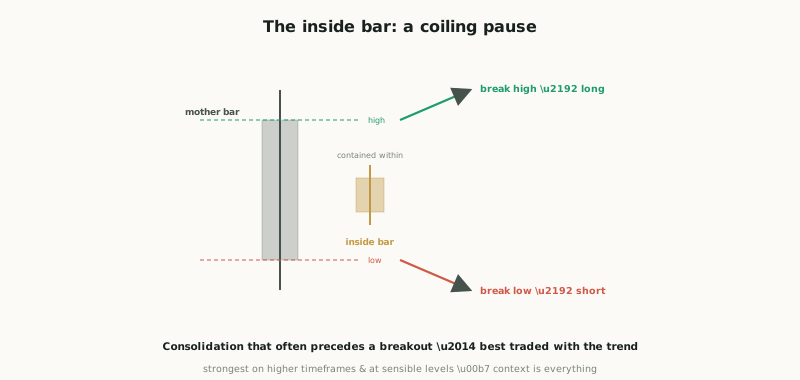
What an inside bar is
An inside bar is a price-action pattern where a candle's entire range (its high to its low) is contained within the range of the previous candle — known as the "mother bar." Visually, the inside bar sits tucked inside the mother bar, making a lower high and a higher low. What it signals is consolidation: a pause, a moment of balance or indecision, and crucially a contraction in volatility — the market taking a breath after a move. This matters because volatility tends to be cyclical: periods of contraction (coiling) are frequently followed by periods of expansion (a breakout). The inside bar thus often precedes a breakout, and conveniently, the mother bar's high and low provide ready-made breakout levels to trade against. The pattern is essentially a small, clean consolidation with built-in trigger levels.
Trading it — continuation and reversal
The trade is a breakout: go long when price breaks above the mother bar's high, or short when it breaks below the low, with a stop placed on the opposite side (beyond the mother bar's other extreme, or the inside bar's). But the context in which the inside bar forms determines what kind of trade it is, as the table shows.
Two contexts for the inside bar
| Context | Continuation inside bar | Reversal inside bar |
|---|---|---|
| Where it forms | Within an established trend | At a key level after an extended move |
| Trade direction | With the trend (break in trend's way) | Against the prior move |
| Logic | A pause before the trend resumes | Exhaustion, then a turn |
| Probability | Higher (the classic use) | Lower — needs strong context |
The continuation setup is the classic, higher-probability use: an inside bar forming within an established trend represents a brief pause or consolidation before the trend resumes, so you trade the breakout in the trend's direction (a bullish-trend inside bar broken to the upside). This aligns the setup with the prevailing momentum — trading with the trend — which is why it's favoured. The reversal setup is lower-probability and demands strong context: an inside bar forming at a key level (major support or resistance) after an extended move can mark exhaustion, with the breakout against the prior move signalling a turn — but this requires the right location and is riskier than the continuation play.
Two practical points sharpen the setup. First, timeframe matters: inside bars are most meaningful on higher timeframes (especially the daily), where they reflect genuine consolidation; on low timeframes they appear constantly and are mostly noise, so the daily inside bar is the trader's-favourite version. Second, and most importantly, context is king. An inside bar in a strong trend at a sensible level is a far higher-quality setup than a random inside bar in choppy, directionless conditions — the pattern itself is just a coil; what gives it an edge is where and when it forms. As with all setups, it's not a guarantee: false breakouts happen (price breaks the mother bar then reverses), so confirmation, a sensible stop, and good location all matter. The honest framing: an inside bar is a candle contained within the prior candle's range (the mother bar), signalling consolidation and volatility contraction that often precedes a breakout. Trade the break of the mother bar's high (long) or low (short): in a trend, as a continuation setup (the classic, higher-probability use — a pause before the trend resumes); at a key level, sometimes as a reversal. Stop beyond the opposite side; it's best on higher timeframes (daily) and noisy on low ones. Context is everything — an inside bar in a strong trend at a good level beats a random one in chop. It's a clean, popular price-action setup, but not a guarantee (false breaks happen) — it needs trend/level context, confirmation, and risk management.
Refining inside-bar trades
Several refinements separate a high-quality inside bar trade from a coin-flip. Location is the first and most important: an inside bar that forms at a significant level — major support or resistance, a trendline, a prior swing point — is far more potent than one floating in no-man's-land, because the level gives the breakout meaning (a continuation inside bar pausing at a broken-and-retested level, or a reversal inside bar coiling at major resistance). The second is the quality of the pattern itself: a tight inside bar (small, well within a decent-sized mother bar) reflects genuine, coiled compression — the tighter the coil, the more energetic the potential release — whereas a sloppy inside bar barely smaller than its mother bar says little. A double (or multiple) inside bar — two or more inside bars in a row — reflects even greater compression and can precede a particularly strong breakout.
On execution, the standard entry is a stop order just beyond the mother bar's high (for longs) or low (for shorts), so you're only triggered if the breakout actually happens; the stop-loss typically sits on the opposite side of the mother bar (a wider but logical invalidation) or, for a tighter risk, just beyond the inside bar itself (accepting more chance of being stopped on noise). Watch out for the "fakey" — a false break of the inside bar that quickly reverses; this trap is itself a recognised, higher-probability reversal setup for alert traders (a failed break in one direction often fuels a real move the other way), so a stop-out isn't always the end of the story. As always, timeframe and trend context dominate: favour daily inside bars in the direction of a clear trend at a sensible level, treat low-timeframe inside bars as mostly noise, and accept that even the best inside bar is a probabilistic setup that will sometimes fail. The disciplined recipe — a tight daily inside bar, with the trend, at a meaningful level, entered on a confirmed break with a logical stop and sound position sizing — is what turns this simple, popular pattern from a random breakout gamble into a genuine, repeatable edge component within a complete approach.
A quick worked example
Picture a pair in a healthy daily uptrend — higher highs and higher lows, price above a rising moving average. After a strong up-day, the next daily candle is small and sits entirely inside the prior candle's range: a classic continuation inside bar, the market pausing to digest its gains. Because the context is a clear uptrend, you favour the long: you place a buy-stop just above the mother bar's high, so you're only triggered if the breakout actually occurs, and a stop-loss below the mother bar's low (your invalidation — if price breaks down through the whole consolidation instead, the bullish read was wrong). If price breaks the high the next day, you're long in the direction of the established trend with a clearly defined, sensible risk, and you might target a measured move or trail behind subsequent structure. Contrast this with a tempting-but-weaker version: the same inside bar appearing in a choppy, directionless market with no trend and no nearby level — here the breakout is little more than a coin flip, and the disciplined trader passes. The example captures the whole lesson: the pattern is mechanical and easy to spot, but its edge lives in the context — trend, level and timeframe — not in the candle shape alone.
An inside bar is a candle fully contained within the previous candle's range (the "mother bar") — signalling consolidation and volatility contraction, which often precedes a breakout. Trade the break of the mother bar's high (long) or low (short), stop on the opposite side. Context defines the trade: a continuation inside bar forms within a trend (trade the breakout with the trend — the classic, higher-probability use); a reversal inside bar forms at a key level after an extended move (trade against the prior move — lower probability, needs strong context). Best on higher timeframes (daily); noisy on low ones. Context is king — a strong-trend inside bar at a good level beats a random one in chop. Not a guarantee (false breaks happen) — needs context, confirmation and risk management.