For Muslim traders, the overnight interest charged or paid on standard forex positions — the "swap" — sits uncomfortably with the prohibition of riba (interest). Islamic, or swap-free, accounts exist to address this. They're a common offering many beginners encounter and wonder about, yet are often poorly explained. Here's what they are, how they work, and — importantly — what to check before assuming "swap-free" means "cost-free." This guide covers Islamic forex accounts: what they are, how brokers structure them, and who they're for.
It's a variant of the standard account types, built around removing the rollover/swap, and the replacement costs tie into the cost of trading.
Key takeaways
Q: What is an Islamic forex account?
A: An Islamic, or swap-free, account is a forex account designed to comply with Islamic finance principles — chiefly by removing the overnight swap (the interest credited or debited on positions held overnight). Because earning or paying interest (riba) is prohibited in Islam, standard accounts that charge swaps can be problematic for observant Muslim traders. Swap-free accounts remove that interest element so trading can be conducted in a more Sharia-compliant way.
Q: How do brokers structure swap-free accounts?
A: They remove the standard overnight interest adjustment. To cover their costs (since they're forgoing or absorbing the financing), brokers typically replace the swap with a fixed administration or holding fee, often charged after a position is held for a number of days, or build the cost into wider spreads or commissions. The exact structure varies a lot by broker, so 'swap-free' does not mean free — there's usually a different cost in its place.
Q: Who are Islamic forex accounts for?
A: Primarily Muslim traders who wish to avoid riba (interest) in line with their faith, though some brokers offer them more widely. They're an option, not an obligation, and whether a particular account or product is genuinely compliant can be a matter of religious interpretation. Anyone seeking certainty about whether a specific broker's swap-free offering meets Sharia requirements should consult a qualified Islamic scholar or a Sharia advisory board, not rely on marketing alone.
What they are
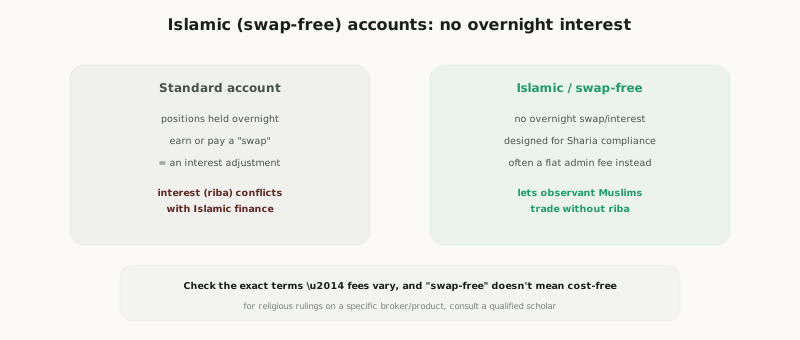
An Islamic, or swap-free, account is a forex account designed to comply with Islamic finance principles — chiefly by removing the overnight swap (the interest credited or debited on positions held overnight). The issue it addresses is specific: in standard forex trading, holding a position past the daily rollover incurs a swap, which is fundamentally an interest adjustment based on the rate differential between the two currencies. Because earning or paying interest (riba) is prohibited in Islam, standard accounts that charge or pay swaps can be problematic for observant Muslim traders — the overnight interest is precisely the element their faith asks them to avoid. Swap-free accounts remove that interest element so that trading can be conducted in a more Sharia-compliant way: positions can be held overnight without the interest-based swap being applied. It's a targeted solution to a specific religious-finance concern, allowing Muslim traders to participate in forex while seeking to honour the prohibition on riba.
Islamic (swap-free) accounts at a glance
How brokers structure them, and who they're for
How do brokers structure swap-free accounts? They remove the standard overnight interest adjustment — but, since the broker is then forgoing or absorbing the financing cost that the swap normally reflects, they need to recover that cost some other way. So brokers typically replace the swap with a fixed administration or holding fee (often charged after a position has been held for a certain number of days, so short-term trades may incur nothing), or they build the cost into wider spreads or commissions. The exact structure varies a lot by broker, which leads to the single most important practical point: "swap-free" does not mean free. There is usually a different cost in its place, and on some accounts (or for long holds) that replacement cost can be comparable to, or even more than, the swap it replaced. So a trader choosing a swap-free account should read the specific terms carefully — what fee replaces the swap, when it kicks in, and how it compares — rather than assuming the account is genuinely cost-free or automatically cheaper (see the cost of trading).
Who are they for? Primarily Muslim traders who wish to avoid riba (interest) in line with their faith — the accounts exist specifically to serve this need — though some brokers offer them more widely (occasionally as a general feature). They're an option, not an obligation, and a couple of honest caveats matter. First, whether a particular account or product is genuinely Sharia-compliant can be a matter of religious interpretation — scholars differ on aspects of forex and CFD trading beyond just the swap (questions of speculation, leverage, and the nature of the contracts themselves), so removing the swap does not automatically make all trading uncontroversially permissible in every interpretation. Second, and following from that, anyone seeking certainty about whether a specific broker's swap-free offering meets Sharia requirements should consult a qualified Islamic scholar or a Sharia advisory board, rather than relying on a broker's marketing claim of being "Islamic" or "Sharia-compliant" (which is a commercial label, not a religious ruling). This site offers general, educational information on what these accounts are and how they work — it is not religious guidance, and questions of religious permissibility are properly answered by qualified scholars, not by a broker or a trading website. With that understood, an Islamic account is simply a swap-free variant that removes the overnight interest, usually replacing it with another fee — a useful option for those who need it, provided they check the real costs and seek proper religious guidance on compliance. The honest framing: an Islamic (swap-free) account removes the overnight swap — an interest (riba) adjustment prohibited in Islam — so observant Muslims can hold positions overnight without that interest. Brokers usually replace the swap with a flat admin/holding fee or wider spreads, which varies a lot, so "swap-free" is not cost-free — read the terms. They're for Muslim traders avoiding riba (an option, not an obligation), but Sharia compliance can be a matter of interpretation extending beyond the swap, so for certainty consult a qualified scholar rather than relying on broker marketing; this is general information, not religious guidance.
Practical considerations and caveats
A few practical points help you navigate swap-free accounts sensibly. First, availability and eligibility vary: not every broker offers an Islamic account, and some that do may require you to request it, provide certain documentation, or meet eligibility criteria — so it's worth confirming before committing to a broker if this matters to you. Second, watch the structure of the replacement fee: many swap-free accounts apply no holding fee for the first few days and only start charging after a position is held for a set period (often aimed at discouraging very long holds), so a short-term trader may pay little or nothing, while a long-term position trader could face meaningful fees — the impact depends heavily on your holding period.
Third, a simple observation: if you don't hold positions overnight, the swap never applies anyway — a pure day trader who closes everything before the daily rollover incurs no swap on a standard account, so the swap-free question is most relevant to those who hold positions overnight or longer. Fourth, be aware that some brokers impose restrictions or anti-abuse rules on swap-free accounts (to prevent traders using them purely to dodge legitimate financing costs on long carry positions), so read those terms too. Finally, the most important caveat bears repeating: the religious permissibility of forex/CFD trading involves considerations beyond just the swap — questions about speculation, leverage, and the nature of the contracts — on which scholars genuinely differ. A broker labelling an account "Islamic" is making a commercial claim, not issuing a religious ruling. So treat this article as general, educational information about how these accounts work, and for any question of whether a specific product is genuinely permissible for you, consult a qualified Islamic scholar or a recognised Sharia advisory board — that is the proper source of religious guidance, not a trading site or a broker's marketing. The honest reminder: practical caveats for swap-free accounts — availability and eligibility vary by broker and may need requesting; the replacement fee often starts only after a few days, so impact depends on your holding period; if you don't hold overnight the swap never applies anyway (most relevant to overnight/longer-term traders); some brokers impose anti-abuse restrictions; and, crucially, religious permissibility extends beyond the swap and scholars differ, so a broker's "Islamic" label is a commercial claim — consult a qualified scholar for genuine guidance, as this is general information, not a religious ruling.
An Islamic (swap-free) account removes the overnight swap — an interest (riba) adjustment prohibited in Islam — so observant Muslims can hold positions overnight without that interest. Brokers usually replace the swap with a flat admin/holding fee (often after a few days) or wider spreads, and this varies a lot — so "swap-free" is not cost-free; read the specific terms (see trading costs). They're for Muslim traders avoiding riba (an option, not an obligation). Note that Sharia compliance can be a matter of interpretation extending beyond just the swap (speculation, leverage, contract type), so for certainty, consult a qualified Islamic scholar or Sharia board — not a broker's marketing label. This is general information, not religious guidance.