Two moving averages, one faster than the other, and a single rule: trade the crossover. The moving average crossover is one of the oldest, simplest, and most widely taught mechanical trend-following strategies — elegant and effective in a sustained trend, frustrating and lossy in a choppy range. Understanding why it behaves so differently in those two environments is the whole lesson, and it teaches a truth that applies to most strategies: an edge is conditional on the market regime. This guide explains the crossover strategy: the rules, the famous golden and death cross, its strengths, and the lag-and-whipsaw weakness that defines how to use it.
It builds directly on moving averages (the indicator), is a classic implementation of trend-following, and is a good first system to study alongside building a trading system.
Key takeaways
Q: What is a moving average crossover strategy?
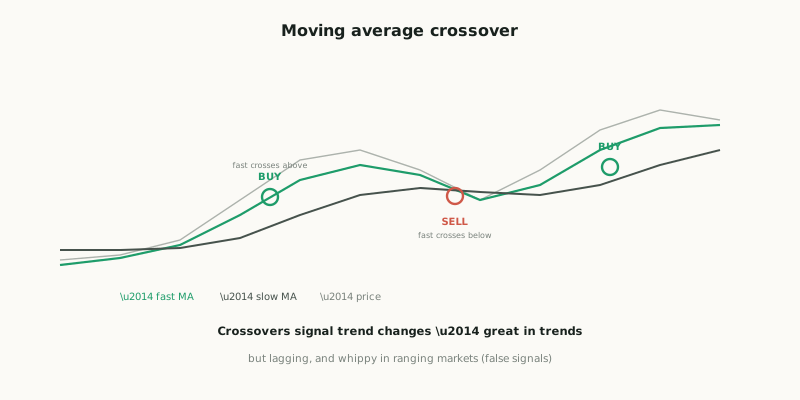
A: It's a trend-following strategy using two moving averages, one faster and one slower. You buy when the faster MA crosses above the slower one (a bullish crossover) and sell or short when it crosses below (a bearish crossover). The crossover is taken as a signal that the trend direction has changed.
Q: What are the golden cross and death cross?
A: They are the most famous versions of the crossover, usually using the 50-day and 200-day moving averages. A 'golden cross' is when the 50 crosses above the 200 (a bullish long-term signal); a 'death cross' is when the 50 crosses below the 200 (a bearish signal). They are widely watched on longer timeframes.
Q: What is the main weakness of the crossover strategy?
A: Lag and whipsaws. Moving averages are based on past prices, so crossovers come after a move has started and ended, giving late entries and exits. Worse, in ranging or choppy markets the MAs cross back and forth repeatedly, generating false signals (whipsaws) and a string of small losses. It works well in trends but poorly in ranges.
The rules and the idea
The moving average crossover strategy uses two moving averages — a faster one (shorter period, reacting quickly to recent price) and a slower one (longer period, smoother and lagging). The rules are simple: buy when the faster MA crosses above the slower MA (a bullish crossover), and sell or exit (or go short) when the faster MA crosses below the slower (a bearish crossover). That's the entire core of the strategy — trade in the direction of the most recent crossover.
The idea behind it is that the crossover signals a change in trend direction. Because the faster MA responds more quickly to recent price than the slower one, when the faster crosses above the slower, it indicates that recent prices have turned up relative to the longer-term average — momentum and the short-term trend have shifted bullish. When it crosses below, the reverse: a shift to the downside. So the crossover is a mechanical way of detecting that the trend has (probably) turned, and the strategy aims to get you positioned in the new trend's direction and ride it. It's fundamentally a trend-following approach — it tries to catch trends and stay in them, exiting when the opposite crossover signals the trend has reversed.
On settings: any two moving-average periods can be used — common pairs include 10/20, 20/50, or 50/200 — with the choice affecting how the strategy behaves. The famous 50/200 version produces the widely-watched golden cross (the 50-period MA crossing above the 200, a bullish longer-term signal) and death cross (the 50 crossing below the 200, a bearish signal), names you'll hear in market commentary. Shorter MA periods give more signals and react faster (catching moves earlier but with more false signals); longer periods give fewer, slower signals (more reliable but later). You can use simple or exponential moving averages (the moving averages guide explains the difference — EMAs react a little faster). There are also variations: using a single MA (price crossing one MA), three MAs, or price crossing an MA — but the two-MA crossover is the classic form.
Strengths and the lag/whipsaw weakness
The crossover's strengths are real and explain its enduring popularity. It's simple (easy to understand and apply), objective and mechanical (the rules are unambiguous, so it's easy to follow, test and automate — a good candidate for algorithmic trading), and it keeps you on the right side of strong trends — in a sustained move, the crossover gets you in and holds you in for much of the trend, which is exactly what a trend-follower wants. In a trending market, the strategy can work well, capturing the meat of directional moves with a clear, hands-off rule set.
The crossover's defining weakness is lag and whipsaws, both rooted in the fact that moving averages are lagging (built from past prices). Because of the lag, crossovers come after a move has already begun (late entries) and after it has ended (late exits) — so you give up the start and end of every move. Worse, in ranging or choppy markets, the two MAs cross back and forth repeatedly as price oscillates, generating a stream of false signals (whipsaws) that produce a string of small losses, as you're whipsawed in and out with no trend to ride. So the strategy works well in trending markets but poorly in ranging ones. There's also an inherent trade-off in the settings: faster MAs are more responsive (earlier signals) but produce more whipsaws; slower MAs whipsaw less but lag more. You can't escape this — only choose your balance.
This weakness dictates how to use the strategy well. The key is to apply it in the conditions where it works (trends) and avoid or filter the conditions where it doesn't (ranges). Practical improvements include adding a trend filter — only taking crossovers in the direction of a higher-timeframe trend, or only when a trend is clearly established — and a ranging filter to avoid trading the strategy in choppy conditions (for example, using the ADX indicator to gauge trend strength and standing aside when ADX shows a weak/ranging market, where whipsaws abound). Combining the crossover with confirmation (other evidence the trend is real) and, always, with risk management (a stop on each trade to cap the whipsaw losses) makes it far more usable than the raw signal alone. The honest framing: the moving average crossover (buy when the fast MA crosses above the slow, sell when below) is a classic, simple, objective, mechanical trend-following strategy that works well in trends but suffers lag (late entries/exits) and whipsaws (false signals, small losses) in ranges. Improve it with trend and ranging filters and confirmation, accept the lag-vs-whipsaw trade-off in the settings, and always use risk management. It's a great teaching strategy and a genuine tool — but, like every strategy, it's conditional (brilliant in a trend, costly in a chop) and not magic. Used in the right conditions with sensible filters and stops, it can be effective; used blindly in all conditions, it bleeds out on whipsaws.
Variations and practical use
The two-MA crossover is the classic form, but several variations are worth knowing. The single-MA version uses price crossing one moving average as the signal (buy when price closes above the MA, sell when below) — simpler still, and a quick read of whether price is above or below its average trend. The three-MA version adds a third (e.g. fast, medium, slow), requiring alignment (all stacked in order) for a stronger trend signal, or using the fast/medium crossover for entries with the slow MA as a trend filter. Some traders also use a moving average as dynamic support or resistance — expecting price to bounce off a rising MA in an uptrend — which is a related but distinct use of the same tool. And the choice between simple and exponential MAs matters at the margin: EMAs weight recent prices more, so they react slightly faster (earlier signals, but a touch more prone to whipsaw) than SMAs.
For practical use, the central decisions are the settings and the filters. There's no universally "best" MA pair — it's the lag-versus-whipsaw trade-off again: shorter periods (e.g. 10/20) give earlier signals but more false ones, longer periods (e.g. 50/200) give later but cleaner signals. Choose to match your timeframe and how much whipsaw you can tolerate, and — importantly — settle on settings via testing rather than curve-fitting to one chart (the building-a-system caution about overfitting applies here: a setting optimised perfectly on past data often disappoints going forward). The single most valuable practical addition is a regime filter so you only trade the crossover when it has an edge: a trend-strength gauge like the ADX (trade crossovers only when ADX shows a real trend, stand aside in the chop) dramatically cuts the whipsaw losses that plague the raw strategy. Combining the crossover with simple confirmation (a higher-timeframe trend in agreement, or price action confirming the move) further filters false signals. And whatever the configuration, every trade needs a stop — the crossover's exit signal can lag badly, so a protective stop caps the damage when a signal fails. Deployed this way — sensible tested settings, a regime filter to avoid ranges, confirmation, and disciplined stops — the humble MA crossover becomes a usable trend-following tool rather than a whipsaw machine. It remains, above all, an excellent learning strategy: simple enough to grasp fully, yet rich enough to teach the conditional, regime-dependent nature of every edge.
The moving average crossover is a simple, mechanical trend-following strategy using two MAs: buy when the faster MA crosses above the slower, sell/short when it crosses below. The crossover signals a trend-direction change. The famous 50/200 version gives the golden cross (50 above 200, bullish) and death cross (50 below 200, bearish). Strengths: simple, objective, easy to test/automate, keeps you in strong trends. Key weakness: lag (late entries and exits, since MAs are lagging) and whipsaws (in ranging markets the MAs cross back and forth, giving false signals and small losses) — so it works well in trends, poorly in ranges. Faster MAs = more responsive but more whipsaws; slower = less whipsaw but more lag. Improve it with trend/ranging filters (e.g. ADX) and confirmation, and always use risk management. Conditional, not magic — best in trending conditions.