Three wins in a row and you feel invincible; three losses and the very same sound system suddenly feels broken. Recency bias — the mind's habit of weighting recent events far more heavily than they deserve — is one of the most pervasive forces in trading psychology, and acting on its distortions is a classic way that otherwise capable traders sabotage themselves. This guide explains recency bias: what it is, how it shows up, why it's costly, and how to counter it by zooming out.
It's one of the core cognitive biases, it's really a failure to respect variance and luck, and it underlies much of the emotional swing between fear and greed.
Key takeaways
Q: What is recency bias in trading?
A: Recency bias is the tendency to overweight recent events and information while underweighting older data and long-run base rates when judging the future. In trading it makes your last few trades and the latest market conditions feel far more significant than they are — driving overconfidence after wins, fear after losses, and the assumption that recent trends or volatility will simply continue.
Q: How does recency bias hurt traders?
A: It causes overconfidence and oversizing after a winning streak, fear and hesitation (or revenge trading) after losses, and 'system-hopping' — abandoning a sound strategy after a normal losing run, or adopting a poor one after a lucky streak. It also leads to extrapolating recent conditions, so traders chase a trend near its top or expect calm to persist right before volatility returns.
Q: How do you counter recency bias?
A: Zoom out. Judge your strategy by its long-run record and a large sample of trades rather than the last few, since short-term results are dominated by variance. Stick to pre-committed rules regardless of recent outcomes, keep your position sizing fixed rather than flexing it with emotion, and remember that market regimes change — recent conditions are not a reliable guide to the future.
What it is and how it shows up
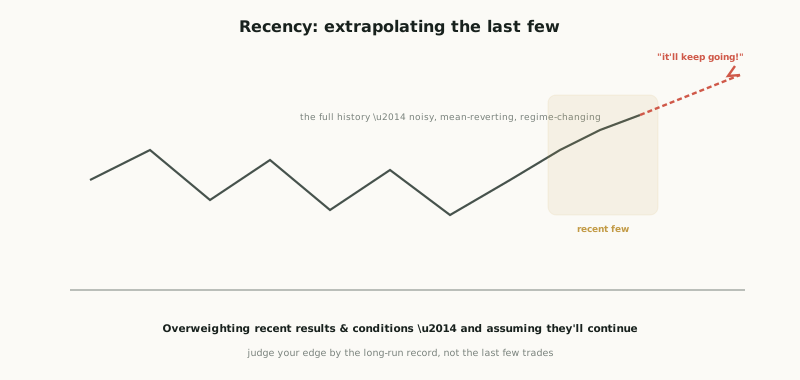
Recency bias is the tendency to overweight recent events and information while underweighting older data and long-run base rates when forming expectations about the future. Recent events are vivid and easily recalled, so the mind treats them as more representative and more predictive than they actually are. In trading, this distortion shows up in several damaging ways. After a winning streak, recency breeds overconfidence: the trader feels "hot," sizes up, loosens discipline and abandons the plan, just as the run is statistically most likely to end (see handling winning streaks). After a losing streak, it breeds fear and hesitation — or its opposite, revenge — tempting the trader to abandon a perfectly sound system at exactly the wrong moment, or to over-trade trying to win it back. It drives extrapolation of recent market conditions: assuming a recent trend will continue (so chasing it near its top), or that recent calm will persist (so being caught out when volatility returns). And it leads to judging a strategy by its last few trades rather than its long-run expectancy — the root of destructive "system-hopping."
Why it's costly, and how to counter it
The deepest damage recency bias does is convince traders to judge their edge by a tiny, noisy sample. A strategy's true quality lives in its long-run expectancy over many trades — but recency makes the last three or five feel decisive. So a trader abandons a genuinely profitable system after a normal losing streak (every positive-expectancy system has them), often switching to a different approach just as the first one was about to revert to form — then abandons that one too at its first rough patch. This "system-hopping" guarantees the trader is always trading the recently lucky method and abandoning the recently unlucky one, which is close to the opposite of what the maths recommends. The cure is to internalise that short-term results are dominated by variance: a handful of wins doesn't prove brilliance and a handful of losses doesn't prove the system is broken. Your edge is only visible over a large sample — so that's the only sample by which to judge it. Pick a sound, tested approach, and give it enough trades to express its true expectancy before drawing any conclusion.
Countering recency bias, then, comes down to deliberately zooming out and pre-committing. Judge your trading by its long-run record — your full equity curve and a large sample of trades — not by how the last few went; reviewing a broad history (rather than the latest result) keeps the base rate in view. Stick to pre-committed rules regardless of recent outcomes: deciding your entries, exits and position size in advance, when you're calm, insulates you from the in-the-moment pull to size up after wins or shrink and hesitate after losses. Keep your position sizing fixed by rule rather than flexing it with recent emotion (which also defends against the related gambler's fallacy). And remember that regimes change: recent trend and volatility are not reliable guides to the future, so resist extrapolating them. Awareness is the constant thread — when you notice yourself feeling invincible or shattered on the back of a short run, that feeling itself is the recency bias talking, and recognising it is what lets you step back to the long-run view. The honest framing: recency bias is overweighting recent events and underweighting the long-run and base rates. In trading it drives overconfidence after wins (oversizing) and fear after losses (abandoning a sound system, revenge), extrapolating recent trends/volatility as if they'll continue (chasing tops, expecting calm to last), and judging a strategy by its last few trades rather than its true expectancy. It's costly because markets change regime and results are noisy — extrapolating recency gets you in at extremes and makes you abandon good systems after normal losing streaks. Counter it by zooming out to the long-run record and base rates, sticking to pre-committed rules regardless of recent results, keeping sizing fixed, and judging your edge over a large sample.
The emotional whiplash of recency
Recency bias isn't only an analytical error — it's the engine of an exhausting emotional cycle that wears traders down and corrodes discipline. A good run lifts mood and confidence to a high (everything feels easy, the next trade can't lose); a bad run drops them to a low (the market feels rigged, every setup looks like a trap). Because the mind overweights the recent, these swings are far larger than the actual results justify — and a trader riding that emotional wave makes their worst decisions at both extremes: over-risking at the euphoric top of a streak (just as reversion looms) and freezing or revenge-trading at the despairing bottom. This is precisely the fear-and-greed cycle viewed through a behavioural lens, and recency is its accelerant. The most concrete danger is the temptation to change position size based on recent emotion — sizing up when hot, abandoning the plan when cold — which converts a noisy run of results into real, lasting damage to the account.
Recency also produces one of the market's most expensive phrases: "this time is different." In a sustained bull run or bubble, recent gains are extrapolated until participants genuinely believe prices can only rise; in a crash, recent losses are extrapolated into conviction that they'll only fall — and both feelings peak, cruelly, near the turning points. The collective version of recency bias is a major ingredient in bubbles and panics alike. Building anti-recency habits is therefore as much emotional hygiene as analytical discipline. Schedule reviews of your full history — your whole equity curve and a large trade sample — rather than reacting to the latest result, so the long-run reality stays salient. Write your rules when calm (position size, entry and exit criteria) and follow them mechanically, so that recent emotion can't renegotiate them mid-flight. Keep risk per trade constant regardless of how the last few went. And learn to treat the feeling itself as data: when you notice an outsized swing of confidence or despair tied to a short run, label it — "that's recency talking" — and consciously widen the frame. The skill isn't to stop feeling the swings; it's to stop acting on them.
Recency across timeframes
A useful refinement: recency bias operates at every timescale, and the shorter the window you stare at, the harder it bites. Watch a one-minute chart and the "recent" that grips you is the last few candles; watch daily results and it's the last few trades; step back to monthly performance and it's the last few months — but at each zoom level, the most recent slice feels disproportionately decisive. This is why traders glued to short timeframes tend to suffer the worst recency-driven whipsaw: every fresh tick is "recent," so confidence and fear lurch constantly. It also points to a simple, powerful defence: deliberately widen the timeframe of your attention and review. Judging your trading on a rolling quarter or year, rather than today's or this week's results, mechanically dilutes the recent few among a much larger sample, restoring the long-run perspective that recency erodes. The same trade record can feel like a crisis viewed over five trades and a non-event viewed over two hundred — and the two-hundred-trade view is the truthful one. Choosing to look through the wider lens is, in itself, an act of resistance against the bias.
Recency bias is overweighting recent events and underweighting the long-run and base rates. In trading it breeds overconfidence after wins (oversizing), fear or revenge after losses, extrapolating recent trends and volatility (chasing tops, expecting calm to last), and — most destructively — judging a strategy by its last few trades rather than its true expectancy, causing "system-hopping" that always trades the recently lucky method and ditches the recently unlucky one. It's costly because short-term results are dominated by variance and regimes change. Counter it by zooming out to the long-run record and base rates, pre-committing to rules regardless of recent results, keeping sizing fixed, and judging your edge over a large sample. When you feel invincible or shattered after a short run — that feeling is the bias; step back to the long view.