
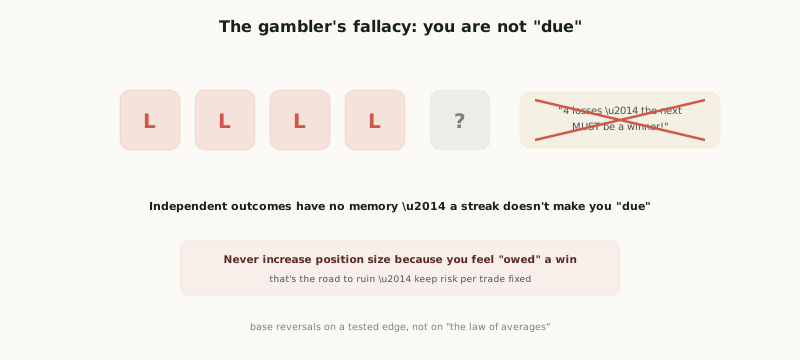
After four losses in a row, the next trade surely must be a winner — right? That seductive sense of being "due" is the gambler's fallacy, and acting on it, especially by increasing your position size, is one of the fastest ways to ruin a trading account. It's a deep misunderstanding of how probability and randomness work, dressed up as intuition. This guide explains the gambler's fallacy in trading: what it is, why it's so dangerous, and the important nuance that separates it from a genuine trading edge.
It's one of the costlier cognitive biases, it pairs dangerously with martingale sizing, and resisting it requires understanding variance and luck.
Key takeaways
Q: What is the gambler's fallacy in trading?
A: The gambler's fallacy is the mistaken belief that if an outcome has occurred more often than usual recently, the opposite is more likely next — in independent events. The classic example is roulette: 'red has come up five times, so black is due.' In trading it appears as 'the market's risen five days, it's due for a fall' or 'I've had four losses, so the next must win' — treating outcomes as if randomness self-corrects in the short run.
Q: Why is the gambler's fallacy dangerous in trading?
A: Because it drives two costly errors. First, edgeless counter-trend trades — fading a move purely because it's 'extended', with no real analytical reason. Second, and far more dangerous, oversizing after a losing streak in the belief that a win is 'due' — increasing risk exactly when you should not. That escalation, akin to a martingale, is one of the fastest routes to catastrophic loss and ruin.
Q: Isn't mean reversion real, though?
A: Yes — and that's the crucial nuance. Markets are not purely memoryless like roulette; genuine mean-reversion and momentum tendencies exist and can be traded with a tested edge. The fallacy is not believing in reversals; it's assuming a reversal is 'due' based only on streak length or 'the law of averages', without any tested analytical reason. A real edge is evidence-based; 'it's due' is just the fallacy in disguise.
What it is
The gambler's fallacy is the mistaken belief that if something has happened more frequently than normal recently, it becomes less likely in the near future (or vice versa) — when the events are independent. The textbook case is roulette: after red comes up five times, players feel black is "due" — but the wheel has no memory, and the odds on the next spin are exactly what they always were. The error is expecting short sequences to "balance out" through some short-run self-correction, a misunderstanding of independence and of the law of large numbers (which says results converge to expectation over a large sample, not that the short run corrects itself). In trading, the fallacy wears familiar clothes: "the market's risen five days straight, it's due for a pullback" (so the trader shorts an uptrend purely on its length); "I've had four losing trades, the next one must be a winner" (so the trader bets bigger); "it can't go any lower, it's due to bounce" (so the trader catches a falling knife). In each, an expectation about the future is built on streak length and a vague appeal to "the law of averages" rather than on any actual evidence.
The dangerous part — and the nuance
The gambler's fallacy is costly in two ways, and the second is genuinely dangerous. The milder error is taking edgeless counter-trend trades — fading a move simply because it looks "extended," with no tested reason to expect a reversal — which bleeds an account through poor-quality trades. The severe error is oversizing after a losing streak: convinced that a win is "due," the trader increases position size on the next trade to "make it back," precisely when they should do no such thing. Your losing streak does not make your next trade more likely to win — if anything, a streak of losses might signal a regime your system dislikes — and scaling up in pursuit of an imaginary reversion is functionally a martingale: a strategy that wins small repeatedly and then suffers one catastrophic loss large enough to wipe out the account. This is one of the fastest known routes to ruin (see risk of ruin). The discipline that defends against it is absolute: treat each trade's outcome as independent for sizing purposes, and keep your risk per trade fixed regardless of recent results. You are never "owed" a win, and the market never settles debts.
There's an important nuance that keeps this from being mistaken for "reversals never happen." Markets are not purely memoryless like a roulette wheel: real mean-reversion and momentum tendencies do exist, driven by genuine market structure, and they can be traded — with a tested edge. So the fallacy is not believing that prices revert or trends continue; it's assuming a reversal (or continuation) is "due" based only on streak length or the "law of averages," without any tested analytical reason. The distinction is everything: a mean-reversion strategy backed by evidence — statistical edge, defined conditions, proper risk — is legitimate trading; "it's gone up five days so it's due to fall" is the fallacy in disguise. The honest test is to ask why you expect the turn: if the answer is a tested edge, fine; if the answer is "it's just due," that's the gambler's fallacy, and it deserves no capital — least of all extra capital. The honest framing: the gambler's fallacy is the mistaken belief that a streak makes the opposite outcome "due" in independent events. In trading it shows as fading a move with no edge because it's "extended," and — dangerously — oversizing after losses because a win is "due." The nuance: markets aren't purely memoryless (real mean-reversion/momentum exist), but the fallacy is assuming a reversal is "due" based only on streak length, without a tested edge; and your losing streak does not make your next trade more likely to win. It's costly because it drives edgeless trades and especially oversizing after losses (a road to ruin). Counter it: treat each trade as independent for sizing (fixed risk, never "I'm due"), base expectations on a tested edge not streak length, and understand the law of large numbers correctly (large samples, not short-run self-correction).
The flip side: the "hot hand"
The gambler's fallacy has a mirror-image twin that's just as costly: the "hot-hand" fallacy, the belief that a streak will continue because you (or the market) are "hot." Where the gambler's fallacy says "I've lost four, a win is due," the hot-hand version says "I've won four, I'm on fire, the next is a near-certainty too" — and it leads to the opposite-but-equally-dangerous behaviour of sizing up after wins, loosening discipline, and feeling invincible (the direct tie to overconfidence and handling winning streaks). Both fallacies spring from the same root error: a misreading of randomness. The human mind is a relentless pattern-detector that refuses to accept that random sequences naturally contain streaks — flip a fair coin enough times and you'll get runs of five or six heads purely by chance, signifying nothing. So the mind invents meaning: the gambler's fallacy reads a streak as "due to end," the hot-hand reads it as "destined to continue," and both are imposing a false narrative on noise.
The unifying lesson is liberating once grasped: streaks are a normal product of randomness, and you should read no inherent meaning into them in either direction. A run of wins doesn't make you skilled or your next trade safer; a run of losses doesn't make you cursed or your next trade likelier to win. (The one genuine exception runs against the hot-hand instinct: a long losing streak might be weak evidence that market conditions have shifted away from what your system likes — a reason to trade smaller or step back, never bigger.) The practical discipline collapses both fallacies into a single rule that the site returns to again and again: keep risk per trade fixed, decided in advance, and immune to recent results. Don't bet more because you feel due; don't bet more because you feel hot. Let your edge express itself over a large sample (the law of large numbers at work) while you hold size steady through the inevitable streaks in both directions. Treat your own sense of "due" or "hot" as a behavioural warning light, not a trading signal.
The one rule that defends against both
If there's a single discipline that neutralises both the gambler's fallacy and its hot-hand twin at once, it's this: fix your risk per trade in advance and never let recent results move it. Both fallacies ultimately try to do the same thing — change your bet size based on a streak (down because you're "due," up because you're "hot") — so a rule that locks size to a constant, decided when you were calm and immune to the emotion of the moment, defeats them both in one stroke. It doesn't require you to stop feeling due or hot; those feelings will come regardless. It just removes your ability to act on them where it matters most: the amount of capital you put at risk. Pair that fixed sizing with a tested edge for your entries (so reversals and continuations are traded on evidence, not on streak length), and the fallacies are left with nowhere to do damage. Each trade becomes an independent expression of your edge at constant risk — which is exactly how a probabilistic game should be played.
The gambler's fallacy is believing a streak makes the opposite outcome "due" in independent events ("five reds, black is due"). In trading: fading a move just because it's "extended" (edgeless), and — the dangerous one — oversizing after losses because a win feels "due." Your losing streak does not make the next trade more likely to win, and scaling up to "make it back" is a martingale — a fast route to ruin. The nuance: markets aren't memoryless like roulette — real mean-reversion/momentum exists — but the fallacy is expecting a turn based only on streak length, with no tested edge. Ask "why do I expect this?": a tested edge is fine; "it's just due" is the fallacy. Treat each trade as independent for sizing, keep risk per trade fixed, and never bet bigger because you feel owed.