A 40% return sounds great — until you learn it came with stomach-churning swings and a drawdown that nearly wiped the account. Raw return tells you only half the story; it says nothing about what you went through to earn it. Risk-adjusted returns fill in the other half, measuring return relative to the risk taken — and they're how serious traders and allocators judge whether performance is genuinely good or merely lucky and dangerous. This guide explains risk-adjusted returns: why they matter, the key ratios (Sharpe, Sortino, Calmar), and their important limitations.
They're the lens for fairly evaluating an equity curve, they connect to the asymmetry explained in the math of drawdowns, and they should be read with the humility of variance and luck in mind.
Key takeaways
Q: What are risk-adjusted returns?
A: Risk-adjusted returns measure how much return a strategy produced relative to the risk it took to produce it — judging performance by return per unit of risk rather than raw return alone. The idea is that a high return achieved with huge volatility or deep drawdowns may be worse, and harder to live with, than a smaller return earned smoothly. Metrics like the Sharpe, Sortino and Calmar ratios quantify this.
Q: What is the Sharpe ratio?
A: The Sharpe ratio is the most widely used risk-adjusted return metric: it divides a strategy's return (above the risk-free rate) by the standard deviation (volatility) of its returns, giving return per unit of total volatility — the higher, the better. Its limitations are that it uses total volatility (penalising upside swings as well as downside) and implicitly assumes roughly normal returns, so it can understate tail risk.
Q: Does a high Sharpe ratio mean a strategy is safe?
A: No. A high Sharpe ratio reflects smooth past returns, but it can be dangerously misleading: strategies that quietly sell tail risk can show excellent Sharpe ratios right up until they suffer a catastrophic loss, because standard volatility measures underestimate fat tails. All these metrics are also backward-looking, so past risk-adjusted performance doesn't guarantee future results. Use them as one lens, not a safety guarantee.
Why return per unit of risk matters
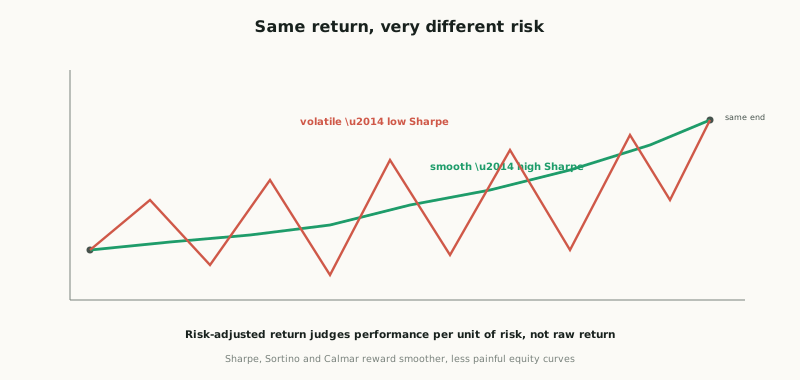
The core principle is simple: judge performance by return per unit of risk, not raw return. Consider two strategies that both turn £10,000 into £14,000 over a year. One does it in a smooth, steady climb; the other lurches violently up and down, at one point halving the account before recovering. They have the same return — but they are not equally good. The smooth one took far less risk, would have been vastly easier to live with psychologically, was less likely to trigger a panic exit or a margin problem, and could more safely be leveraged or scaled. The volatile one flirted with ruin to reach the same place. Risk-adjusted return metrics capture this difference, letting you compare strategies fairly, resist being seduced by headline returns that hide ruinous risk, and think in terms of return efficiency — how much reward you're extracting per unit of risk endured. This is one of the most important shifts in thinking that separates mature traders from beginners dazzled by big percentage gains.
The key metrics
Three ratios dominate, each defining "risk" slightly differently.
| Ratio | Measures risk as | In short |
|---|---|---|
| Sharpe | Total volatility (std dev) | Return per unit of all volatility — the classic |
| Sortino | Downside volatility only | Like Sharpe, but ignores upside swings |
| Calmar | Maximum drawdown | Return relative to worst peak-to-trough loss |
The Sharpe ratio is the most famous: it takes the return above the risk-free rate and divides by the standard deviation (total volatility) of returns — return per unit of total volatility, where higher is better. The Sortino ratio refines this by dividing only by downside deviation (the volatility of negative returns), on the sensible logic that traders don't actually mind upside volatility — a strategy that occasionally jumps sharply higher shouldn't be penalised for it, yet Sharpe does exactly that. The Calmar ratio takes a different angle entirely, dividing return by the maximum drawdown — framing risk as the worst peak-to-trough loss, which speaks directly to the pain (and ruin potential) a trader actually experiences. Each is useful; together they triangulate a strategy's risk-adjusted quality from complementary angles.
The important limitations
These metrics are valuable but must be handled with care, because relying on them naively is genuinely dangerous. The Sharpe ratio uses total volatility (penalising beneficial upside swings) and implicitly assumes returns are roughly normally distributed — which financial returns are not: they have fat tails (extreme events occur far more often than a normal distribution predicts). The consequence is serious: a strategy that quietly sells tail risk — collecting small, steady gains while exposed to rare catastrophic losses — can show a beautiful Sharpe ratio right up until the day it blows up. A high Sharpe is therefore not a guarantee of safety; it can even be a warning sign of hidden tail risk masquerading as smoothness (the connection to black swans and tail risk is direct). Sortino and Calmar address some of this (Sortino focuses on downside; Calmar on actual drawdown), but no single number captures all dimensions of risk. Furthermore, all these metrics are backward-looking — computed on past data — so past risk-adjusted performance doesn't guarantee the future, and they're period-dependent and can be gamed or distorted by short or unrepresentative samples. The honest framing: risk-adjusted returns measure return relative to the risk taken — return per unit of risk — since raw return alone is misleading (high return with huge risk can be worse than a smooth, modest one). Key metrics: Sharpe (return over total volatility — the classic), Sortino (over downside volatility only — a refinement), Calmar (over max drawdown). They let you compare strategies fairly and avoid being seduced by high returns built on ruinous risk. But the limitations are real: Sharpe assumes roughly normal returns and penalises upside while underestimating tail risk (a strategy can show a great Sharpe until it blows up); all are backward-looking (past ≠ future) and period-dependent. Use risk-adjusted metrics as a valuable lens for return efficiency and fair comparison — not as a guarantee of safety; a high ratio is not immunity from risk.
Using risk-adjusted metrics well
Knowing the formulas is easy; using these metrics wisely is what matters. A few principles help. First, use them to compare like with like and to fairly rank strategies or periods — their whole value is letting you see past raw return to ask "how efficiently was this earned, and how painful was the ride?" A strategy with a lower return but a much higher Sharpe or Calmar may be the genuinely better one to trade, because it's smoother, more survivable and more scalable. Second, look at several ratios together rather than fixating on one: Sharpe, Sortino and Calmar each frame risk differently (total volatility, downside volatility, maximum drawdown), and a strategy that looks good on all three is more trustworthy than one flattered by a single favourable metric. Third, demand enough data: a ratio computed over a handful of trades or a single benign market period is close to meaningless, since these metrics are period-dependent and easily distorted by small or unrepresentative samples — the same humility the site urges around variance and luck applies here.
There's also a crucial psychological dimension that makes risk-adjusted thinking practical rather than academic. A smoother equity curve (a higher Sharpe) isn't just statistically elegant — it's far easier to actually trade. Deep, jagged drawdowns test discipline to breaking point, tempting traders to abandon a sound system at the worst moment or to over-leverage in desperation; a steady curve is psychologically sustainable, letting you stick to the plan. In that sense, optimising for risk-adjusted return is partly optimising for your own behaviour. It's also why professional allocators and funds obsess over these ratios: they're allocating capital they must answer for, and a high return achieved through wild swings is, to them, a liability — they prize consistency and capital preservation, which risk-adjusted metrics measure. The honest caution remains the one from above, and it bears repeating because it's where naive users get hurt: a high ratio is not a safety guarantee. Chasing or trusting a high Sharpe without understanding how it was produced can lead you straight into a strategy that's quietly accumulating tail risk — smooth until it isn't. So use risk-adjusted metrics as a powerful lens for comparison, evaluation and self-discipline, computed on ample data and read in combination — while never forgetting that no single number, however sophisticated, fully captures the risk of ruin that lives in the tail.
A simple version for everyday use
You don't need to compute a Sharpe ratio to put this principle to work. The everyday, retail-friendly version is a shift in how you judge your own trading: stop asking only "how much did I make?" and start asking "how much pain did I take to make it?" Concretely, track your maximum drawdown alongside your return — a 20% gain earned with a 10% worst drawdown is a very different (and better) achievement than the same 20% earned with a 40% drawdown, and noticing that difference is most of the benefit. Prefer the approach, the position size and the pair selection that deliver your returns with less violent swings, because the smoother path is both safer and far easier to stick with. And stay suspicious of smoothness that seems too good — unusually steady gains can signal hidden tail risk rather than genuine skill. That instinct — reward per unit of pain, not raw reward, with a wary eye on suspiciously easy returns — captures the heart of risk-adjusted thinking without a single formula, and it's available to every trader from day one.
Risk-adjusted returns judge performance by return per unit of risk, not raw return — because two strategies with the same return aren't equal if one took far more risk (volatility, drawdown) to get there. Key metrics: the Sharpe ratio (return ÷ total volatility — the classic), the Sortino ratio (÷ downside volatility only — doesn't penalise upside), and the Calmar ratio (÷ maximum drawdown). They enable fair comparison and guard against being dazzled by high returns built on ruinous risk. Limitations: Sharpe assumes roughly normal returns and underestimates fat tails — a strategy quietly selling tail risk can post a great Sharpe until it blows up, so a high ratio is not safety; and all are backward-looking (past ≠ future) and period-dependent. A valuable lens for return efficiency — never a guarantee.