Every sharp move on a chart leaves a footprint: a zone where one side — buyers or sellers — decisively overwhelmed the other and price rushed away. Supply and demand trading is the art of finding those zones and betting that price will react there again when it returns. It's a hugely popular methodology, and a genuinely useful lens on the market — with one honest catch: drawing the zones is more art than science. This guide explains supply and demand trading: what the zones are, how to identify them, how they differ from support and resistance, how to trade them, and their subjectivity.
It's a close relative of support and resistance and of the order block concept in smart-money trading, and it's read in the context of market structure.
Key takeaways
Q: What is supply and demand trading?
A: It's a methodology that identifies zones on the chart where a strong imbalance between buyers and sellers caused price to move away sharply — a demand zone where buying overwhelmed selling and price rallied, or a supply zone where selling overwhelmed buying and price dropped. The idea is that unfilled orders may remain at these zones, so price often reacts again when it returns: bouncing from demand, rejecting from supply.
Q: How is supply and demand different from support and resistance?
A: They're related but framed differently. Support and resistance are typically horizontal lines or levels where price has repeatedly turned. Supply and demand are zones (areas, not single lines) defined by where price moved away sharply, reflecting an order imbalance rather than just prior turning points. In practice they often overlap, but supply and demand emphasises the strength of the move away and the idea of unfilled orders waiting in the zone.
Q: Is supply and demand trading reliable?
A: It can be useful, but it's notably subjective — the key caveat. Where exactly to draw a zone, which moves qualify, and how wide to make it are judgement calls, so two traders mark different zones on the same chart. Zones also weaken each time price tests them, and price can blow straight through. It works best with confirmation at the zone, in context with the trend, and with disciplined risk management — not as a mechanical certainty.
What the zones are and how to find them
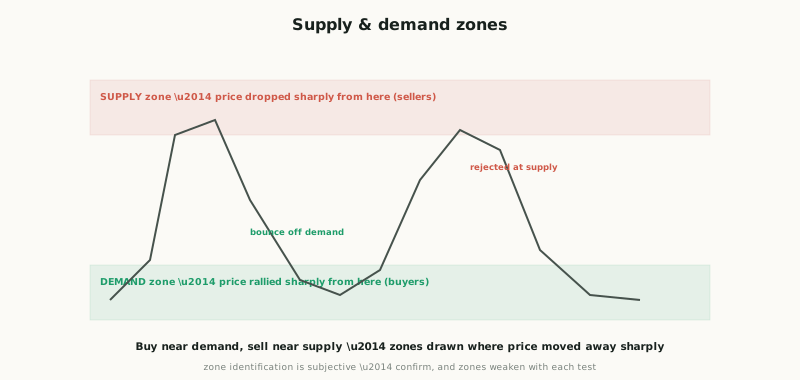
The core idea rests on order imbalance. When price rallies sharply away from an area, it signals that buying overwhelmed selling there — a demand zone. When price drops sharply away from an area, selling overwhelmed buying — a supply zone. The reasoning is that not all the orders at these zones were filled (demand was so strong that price ran before every buyer got filled, and vice versa), so unfilled orders may remain, ready to push price again if it returns to the zone. Hence the strategy: buy near demand, sell near supply.
Identifying zones
To identify a zone, you look for a strong, decisive move away from an area, and mark the origin of that move — the small consolidation or "base" of candles just before price exploded away — as the zone. A demand zone is the base from which a sharp rally launched; a supply zone is the base from which a sharp drop launched. Practitioners distinguish patterns like "drop-base-rally" (demand) and "rally-base-drop" (supply) to formalise this. A key principle is that fresh (untested) zones are considered strongest, because the unfilled orders are presumed still there; each time price returns and tests a zone, some of those orders get filled and the zone weakens, until eventually it may break entirely.
Trading the zones — and the subjectivity caveat
The trading approach is straightforward in principle: when price returns to a fresh demand zone, look to buy (anticipating a bounce), with a stop below the zone and a target at the next supply zone or resistance; when price returns to a fresh supply zone, look to sell, stop above, target the next demand. The zones provide clean, logical stop placement (just beyond the zone, since a move through it invalidates the idea) and often favourable risk-reward (tight stop at a precise zone, larger target across the range). Best practice adds confirmation at the zone (a rejection candle, a pin bar, a shift in short-term momentum) rather than blindly placing a limit order, and trades zones in context with the trend — buying demand in an uptrend, selling supply in a downtrend, is higher-probability than fighting the trend.
How does this differ from plain support and resistance? They overlap heavily — a strong demand zone often is a support area — but the framing differs: support/resistance are usually horizontal lines at prior turning points, while supply/demand are zones (areas with width) defined by the strength of the move away and the idea of unfilled orders, emphasising imbalance over mere price history. It's also closely related to the order block concept in smart-money trading, which is essentially a more specific institutional framing of the same imbalance idea. Now the honest caveat, which is significant: supply and demand trading is notably subjective. Where exactly to draw a zone, which moves are "sharp enough" to qualify, and how wide to make the zone are all judgement calls, so two traders will mark different zones on the same chart — there's no objective formula, unlike a calculated indicator. Zones also weaken with each test and can be blown straight through, especially against a strong trend or on news. So while supply and demand is a genuinely useful way to read where price may react, it is a discretionary framework, not a mechanical certainty, and it demands confirmation, trend context and disciplined risk management. The honest framing: supply and demand trading identifies zones where an order imbalance caused price to move away sharply — a demand zone (price rallied sharply, buyers) or supply zone (price dropped sharply, sellers) — on the theory that unfilled orders remain, so price reacts when it returns (buy near demand, sell near supply). Find zones by marking the base/origin of a strong move away; fresh zones are strongest and weaken with each test. Trade returns to fresh zones with confirmation, in trend context, stop beyond the zone, target the next zone. It overlaps support/resistance (and order blocks) but emphasises imbalance and zones over lines. The key caveat: it's subjective (zones are judgement calls; traders disagree), zones weaken and can break — a useful discretionary framework, not a mechanical certainty; manage risk.
Using zones well
Because supply and demand is so subjective, a handful of disciplines separate useful zone trading from drawing rectangles wherever you please. Prioritise fresh zones: an untested zone, where the presumed unfilled orders are still intact, is considered far stronger than one price has already returned to and partly consumed — so the first touch of a quality zone is the highest-probability reaction, and a zone tested several times is weak and liable to break. Be disciplined about zone width: a zone should be drawn from the genuine base (the consolidation before the explosive move), not stretched arbitrarily wide to "catch" price — a sloppily wide zone will appear to "work" because it covers so much ground, which is self-deception, not analysis. Trade with the trend: buying demand zones in an uptrend and selling supply zones in a downtrend is markedly higher-probability than fading a strong trend at a counter-trend zone, which often gets blown through. Demand confirmation: rather than blindly resting a limit order in a zone, many traders wait for price to reach the zone and show a reaction — a rejection candle, a pin bar, a shift in lower-timeframe momentum — before entering, filtering out zones that simply fail.
Two further habits help. Don't over-mark the chart: a chart cluttered with a dozen zones guarantees price will be "in a zone" most of the time, which renders them meaningless — the discipline is to mark only the clearest, strongest zones (the most explosive moves away, the most obvious bases) and ignore marginal ones. And work from higher timeframes down: zones identified on the daily or 4-hour chart tend to be more significant than those on a 5-minute chart, so a common approach is to mark major zones on a higher timeframe and refine entries on a lower one (a multi-timeframe method). Done this way — fresh, well-drawn zones, traded with the trend and with confirmation, sparingly marked, from higher timeframes — supply and demand becomes a coherent, logical framework for anticipating where price may react, with clean stop placement (just beyond the zone) and good risk-reward. Done sloppily — many wide zones, drawn after the fact, traded against the trend without confirmation — it becomes a way to rationalise almost any trade, which is the trap of any subjective method. The honest reminder: zones are judgement calls that weaken with each test and can break entirely, so confirmation, trend context and risk management aren't optional extras but the very things that make the framework work.
Supply and demand trading marks zones where an order imbalance sent price away sharply: a demand zone (a base price rallied from — buyers) and a supply zone (a base price dropped from — sellers). The theory: unfilled orders remain, so price reacts on return — buy near demand, sell near supply. Find zones by marking the base/origin of a strong move away; fresh zones are strongest and weaken with each test. Trade returns to fresh zones with confirmation, in trend context, stop beyond the zone, target the next zone (clean risk-reward). It overlaps support/resistance and order blocks but emphasises imbalance and zones over lines. Key caveat: it's subjective (zones are judgement calls; traders disagree), and zones weaken and can break — a useful discretionary framework, not a mechanical certainty.