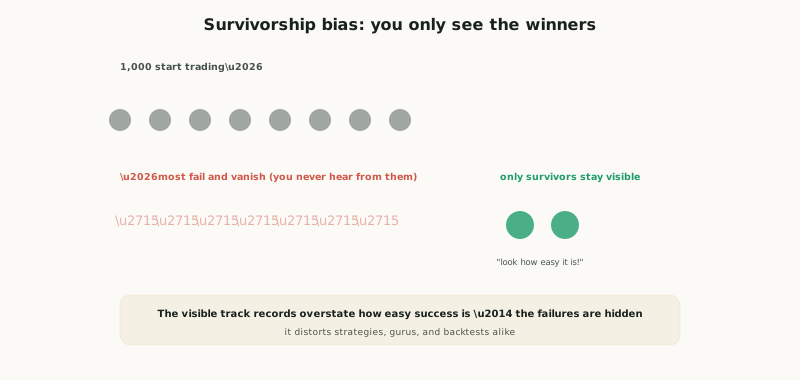
The traders you hear about are the ones who made it. The thousands who blew up and quit don't post their results, write the threads, or sell the courses. This simple, easy-to-miss fact — survivorship bias — systematically distorts your sense of how easy trading is, inflates the apparent skill of visible "gurus," and quietly corrupts backtests and track records too. Recognising it is part of seeing the market — and your own odds — clearly. This guide explains survivorship bias: what it is, how it misleads traders, and how to guard against it.
It works hand-in-hand with variance and luck and overfitting to make trading look easier and more skill-driven than the full picture shows.
Key takeaways
Q: What is survivorship bias?
A: Survivorship bias is the error of drawing conclusions from only the things (or people) that 'survived' a process, while ignoring those that didn't because they're no longer visible. In trading, you mostly see and hear from the successful traders, funds and strategies — the many that failed have quietly disappeared. This makes success look more common and easier to achieve than it really is.
Q: How does survivorship bias affect traders?
A: It distorts your sense of reality in several ways: it makes trading look easier than it is (you see winners, not the silent majority who lost), it inflates the apparent skill of visible 'gurus' (some are just lucky survivors), and it corrupts data — backtests run on indices or fund lists that exclude failed/delisted entries overstate returns, because the losers were removed. It's a pervasive, easy-to-miss source of over-optimism.
Q: How do you guard against survivorship bias?
A: Actively remember the invisible failures: for every visible success, ask how many tried and failed unseen. Be skeptical of track records and 'guru' results, since survivors are over-represented and luck plays a role. Use survivorship-bias-free datasets for backtesting (including delisted/failed instruments). And keep realistic base rates in mind — most traders lose, so assume success is hard and rare, not the norm the visible winners suggest.
What it is
Survivorship bias is the error of drawing conclusions from only the things (or people) that "survived" a process, while ignoring those that didn't — because the failures are no longer visible. The classic illustration comes from WWII: analysts examined returning bombers to see where they were most often hit, planning to reinforce those areas — until a statistician pointed out that they were only looking at the planes that made it back. The bullet holes on survivors showed where a plane could be hit and still survive; the truly fatal areas were on the planes that didn't return and so weren't in the sample. Reinforce where the survivors were not hit. In trading, the same distortion is everywhere: you mostly see and hear from the successful traders, funds and strategies — they're the ones posting profits, giving interviews, selling courses, running the popular accounts — while the many who failed have quietly disappeared (stopped posting, closed their accounts, quit, gone bust). Because the failures are invisible, the visible population is overwhelmingly survivors, which makes success look far more common and easier to achieve than it actually is. You're seeing the bombers that came back, and concluding trading is survivable in places where, in truth, most got shot down.
How it misleads, and how to guard against it
The distortions are pervasive and worth spelling out. It makes trading look easier than it is. Social media, forums and marketing are full of winners — screenshots of huge gains, "I turned £1k into £100k" stories — while the silent majority who lost money say nothing, creating a wildly skewed impression of typical outcomes. The reality (most traders lose money) is hidden behind the visible winners. It inflates the apparent skill of "gurus." Given enough people trading, some will produce spectacular results by luck alone (see variance and luck — with thousands of traders, a few will have huge winning streaks by chance), and those lucky survivors become visible, celebrated, and assumed to be skilled — when some are simply the coin-flippers who happened to flip heads ten times. You can't easily tell skill from luck by looking only at the winners. It corrupts data. This is the subtle one: backtests and analyses run on datasets that have removed failed entries are systematically too optimistic — a backtest on today's index constituents over past decades overstates returns because the companies that went bust or were delisted have been excluded (the index "survived," its failures airbrushed out); a study of currently-existing funds overstates fund returns because the closed, failed ones aren't counted. Any historical analysis that only includes what still exists inherits this upward bias.
Guarding against survivorship bias is largely a matter of deliberately remembering the invisible failures. For every visible success, ask how many tried and failed unseen — mentally restore the missing failures to the picture before judging how "easy" or "common" success is. Be skeptical of track records and guru results: assume survivors are over-represented and that luck contributed, rather than treating every visible winner as proof of a replicable method (a celebrated trader may be skilled, lucky, or both — the visible record alone can't tell you). For data and backtesting, use survivorship-bias-free datasets that include delisted, failed and closed instruments, so your historical results aren't flattered by the silent removal of losers (this connects directly to honest backtesting and avoiding overfit conclusions). And keep realistic base rates in mind: since most traders lose, the sensible prior is that success is hard and rare, not the norm the visible winners imply — which should make you humble about your own odds, rigorous in testing, and conservative in risk. Survivorship bias won't change the market, but seeing through it changes you: less over-confident, less easily impressed by visible winners, and more clear-eyed about the real difficulty of the game. The honest framing: survivorship bias is concluding from only the survivors while the failures — now invisible — are ignored (the WWII bomber lesson). In trading you see the winners (profitable traders, gurus, surviving funds) but not the silent majority who failed and vanished, so success looks easier and more skill-driven than it is. It also corrupts data: backtests on lists that excluded delisted/failed entries overstate returns. Guard against it by remembering the invisible failures, staying skeptical of track records (luck over-represents survivors), using survivorship-bias-free data, and assuming realistic base rates — success is hard and rare.
Where it bites in practice
Survivorship bias isn't an abstraction — it shapes the trading world you actually encounter, and spotting it in the wild is the practical skill. Guru and signal-seller marketing: the educators and signal services you see advertised are, by definition, the ones whose results (or marketing) survived long enough to be selling — and their testimonials feature the winners who succeeded, never the silent many who bought the same course and lost. Social media: the trading content that goes viral is the spectacular win (the screenshot of a 50x return), because losses and quiet failures don't get posted or shared — so the feed presents a relentlessly winning, wildly unrepresentative picture. Prop-firm and challenge results: the "funded traders" showcased are the small fraction who passed, not the large majority who failed the challenge (and paid the fee). "My strategy has worked for two years" anecdotes: among thousands of traders running all sorts of methods, some will have two great years by luck — and those are the ones you hear from. In every case, the failures are invisible, so the visible evidence is hopelessly skewed toward success.
The same bias quietly inflates historical data, which matters for anyone testing ideas. A backtest on the current constituents of an index over past decades flatters returns, because the firms that went bust or were removed have been silently dropped — you're testing on the winners that survived to today. Studies of currently-operating funds overstate average fund performance, since the closed and failed funds aren't in the sample. Even a casual "this pair/strategy has always bounced here" observation can be survivorship-flavoured if the cases where it didn't work have faded from memory. The practical defences follow directly: when you see a visible success, consciously picture the invisible failures behind it and adjust your impression of the odds downward; treat track records, testimonials and viral wins as the survivors they are, heavily discounted for luck and selection; insist on survivorship-bias-free data (including delisted and failed instruments) for any serious backtest; and anchor on the realistic base rate — most who try this lose — which keeps you humble and conservative rather than seduced by the highlight reel. Seeing the hidden failures is what separates a clear-eyed assessment from the comfortable, dangerous illusion the visible winners create. The honest reminder: survivorship bias bites in guru/signal marketing, viral social-media wins, showcased prop-firm passers, and lucky multi-year anecdotes — all of which hide the failures — and it inflates historical data (current-index or surviving-fund backtests drop the losers); defend by picturing the invisible failures, discounting track records for luck/selection, using survivorship-bias-free data, and anchoring on the realistic base rate that most lose.
Survivorship bias is concluding from only the survivors while the failures — now invisible — are ignored (the WWII bomber lesson: reinforce where the returning planes weren't hit). In trading you see the winners (profitable traders, gurus, surviving funds) but not the silent majority who failed and vanished — so success looks easier and more skill-driven than it is, and some celebrated "gurus" are just lucky survivors (see variance and luck). It also corrupts data: backtests on lists that excluded delisted/failed entries overstate returns. Guard against it: remember the invisible failures, stay skeptical of track records, use survivorship-bias-free datasets for backtesting, and keep realistic base rates — most traders lose, so success is hard and rare, not the norm the visible winners suggest.