A strategy that looks perfect on historical data is the most dangerous illusion in trading. Curve-fitting (or overfitting) — tuning a system until it fits the past beautifully — produces backtests that dazzle and live results that disappoint. It's the trap that destroys countless promising-looking strategies, and understanding it is essential to not fooling yourself. This guide explains overfitting: what it is, the warning signs, and how to build more robust systems that actually survive.
It's the great danger lurking behind backtesting and system building, and a cousin of survivorship bias in how it deceives.
Key takeaways
Q: What is overfitting (curve-fitting) in trading?
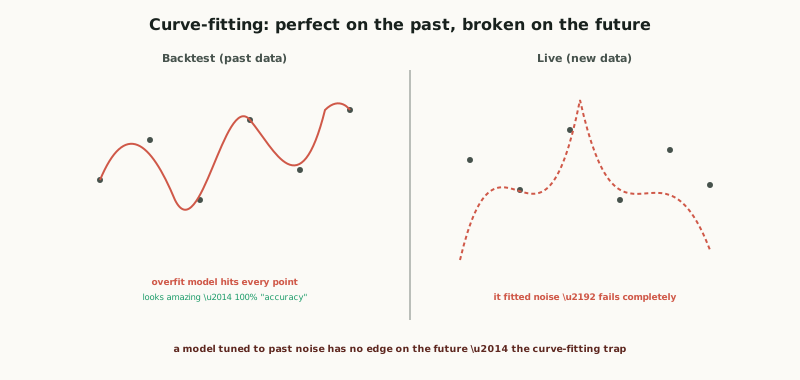
A: Overfitting, or curve-fitting, is when a trading strategy is tuned so closely to historical data that it captures the random noise of the past rather than a genuine, repeatable edge. The result is a system that performs brilliantly in a backtest but fails in live trading, because the specific quirks it was fitted to don't recur. It's the trading version of memorising the answers to one exam instead of learning the subject.
Q: What are the warning signs of an overfit strategy?
A: Red flags include: too many rules, parameters or filters; parameters tuned to oddly specific values; spectacular backtest results that seem too good to be true; performance that collapses with tiny changes to the parameters or test period; and a strategy with no clear, logical reason why it should work. The more a system is optimised to maximise past performance, the more likely it has fitted noise rather than signal.
Q: How do you avoid curve-fitting?
A: Favour simplicity (fewer rules and parameters), insist on a logical rationale for why an edge should exist, and test out-of-sample — reserving data the strategy was never tuned on to check it still works. Techniques like walk-forward testing, parameter robustness checks (does it work across a range of values, not one magic number?), and Monte Carlo analysis help. The goal is robustness, not a perfect backtest.
What it is
Overfitting (curve-fitting) is when a strategy is tuned so closely to historical data that it captures the random noise of the past rather than a genuine, repeatable edge. Here's the crux: any historical price series contains both signal (real, recurring patterns) and noise (random, one-off quirks that will never repeat in the same way). When you optimise a strategy — adjusting its rules, parameters and filters to maximise past performance — you inevitably start fitting it to the noise as well as the signal, because the noise is in the data you're optimising against. Push optimisation far enough and you get a system that fits the historical data almost perfectly — a backtest showing huge returns, a beautiful equity curve, a sky-high win rate — but the "edge" is largely an artefact of fitting random quirks that won't recur. So it works spectacularly on the data it was built on and fails in live trading, where the specific noise it memorised never comes back. The classic analogy: it's like memorising the answers to one specific exam rather than learning the subject — you'll ace that exam (the backtest) and flunk the next one (live trading), because you learned the answers, not the understanding. The cruel irony is that the harder you optimise to make the backtest look good, the more you tend to overfit — so a dazzling backtest is often a warning sign, not a triumph.
Warning signs and how to avoid it
Because overfit strategies are seductive (who doesn't want a backtest showing 90% win rates?), recognising the warning signs is a vital skill. Red flags include: too many rules, parameters or filters (each added degree of freedom is another chance to fit noise — complex systems overfit more easily); parameters tuned to oddly specific values (a stop at "37 pips" or an indicator set to "13.5" that works far better than nearby values is suspicious — real edges aren't usually that fragile); backtest results that seem too good to be true (because they usually are); performance that collapses with tiny changes to the parameters or the test period (a robust edge degrades gracefully, an overfit one shatters); and — perhaps most telling — no clear, logical reason why the strategy should work (if you can't explain the economic or behavioural rationale for the edge, you may have found a coincidence, not a cause). In short: the more a system has been optimised to maximise past performance, the more suspicious you should be that it has fitted noise rather than signal.
Avoiding the trap comes down to a few disciplines, all aimed at robustness over perfection. Favour simplicity: fewer rules and parameters mean fewer chances to overfit, and simple strategies that capture a real, broad edge tend to generalise far better than baroque ones (a recurring theme — elegance beats complexity). Insist on a rationale: only trust an edge you can explain — a logical reason (a behavioural bias, a structural feature, a risk premium) why it should exist and persist. Test out-of-sample: this is the single most important defence — reserve a portion of data the strategy was never tuned on (or test on a later period) and check it still works there; a strategy that shines in-sample but fails out-of-sample is overfit, full stop. Related techniques sharpen this: walk-forward testing (repeatedly optimising on one window and testing on the next), parameter robustness checks (does it work across a range of parameter values, not just one magic number? — a plateau of good results is reassuring, a lone spike is not), and Monte Carlo analysis (stress-testing the results against randomness). Underlying all of it is the right mindset: the goal of strategy development is not a perfect backtest — that's trivially easy to manufacture by overfitting — but a robust edge likely to persist into the unknown future. Be deeply skeptical of your own dazzling backtests, assume some of any historical result is luck (see variance and luck), and optimise for survival in live trading, not for the prettiest historical curve. The honest framing: overfitting (curve-fitting) is tuning a strategy so tightly to past data that it captures noise, not a real edge — producing a dazzling backtest that fails live, like memorising one exam's answers instead of learning the subject. Warning signs: too many rules/parameters, oddly specific values, too-good-to-be-true results, fragility to small changes, and no logical rationale. Avoid it by favouring simplicity, demanding a reason the edge should exist, and above all testing out-of-sample (plus walk-forward, robustness and Monte Carlo checks). Aim for robustness, not a perfect backtest — and treat a stunning backtest as a warning, not a triumph.
Beyond backtests: overfitting yourself
Overfitting isn't only a danger for systematic, coded strategies — discretionary traders overfit too, often without realising it. Every time you tweak your approach in reaction to your last few trades ("that loss means I should add a filter," "I keep getting stopped early, I'll widen everything"), you risk fitting your method to the noise of a tiny, recent sample — the discretionary equivalent of curve-fitting, driven by recency and the human urge to find a pattern in randomness. A handful of trades contains almost no reliable signal (see variance and luck), so constantly re-tuning your rules to fit recent results just chases noise, producing an ever-shifting method that never gives any genuine edge time to express itself. The same instinct shows up as indicator-stacking — piling on more and more indicators and conditions until your charts "explain" every past move, which is simply overfitting by another name (each added indicator is another degree of freedom fitting the past).
The antidote, in both the systematic and discretionary cases, is the same mindset: respect for degrees of freedom and a bias toward robustness and humility. Every parameter, rule, filter or indicator you add is a degree of freedom that lets you fit the past more closely — and therefore a chance to fit noise — so the discipline is to keep your approach as simple as it can be while still capturing a real, explainable edge. Recognise that some of any good result — a winning streak, a great backtest, a profitable month — is luck, and resist the temptation to "lock in" that luck by over-tuning to it. Change your method rarely and deliberately, on the basis of a large sample and a logical reason, not in reaction to the last few trades. And keep the humility that the future will differ from the past in ways no amount of fitting can anticipate — which is exactly why a robust, simple, well-reasoned approach (that you understand and can trust through drawdowns) beats a complex, over-optimised one that merely described a history that won't repeat. The honest reminder: discretionary traders overfit too — re-tuning rules to the last few trades, or stacking endless indicators, is curve-fitting by another name; the defence is to minimise degrees of freedom (keep it simple), accept that some results are luck, change your method rarely and only on large samples with a logical reason, and stay humble that the future won't match the past you fitted.
Overfitting (curve-fitting) is tuning a strategy so tightly to past data that it captures noise, not a real edge — producing a dazzling backtest that fails live, like memorising one exam's answers instead of learning the subject. The harder you optimise, the worse it tends to get — so a stunning backtest is a warning, not a triumph. Warning signs: too many rules/parameters, oddly specific "magic" values, too-good-to-be-true results, performance that collapses with small parameter/period changes, and no logical rationale for the edge. Avoid it: favour simplicity, demand a reason the edge should exist, and above all test out-of-sample (plus walk-forward, parameter-robustness and Monte Carlo checks). Aim for robustness, not a perfect backtest — and stay deeply skeptical of your own results.