The US dollar has a curious habit: it tends to rise at two opposite extremes — when the world is terrified, and when the US economy is booming — while sagging in the muddled middle, when growth is merely so-so. Plotted against the global backdrop, that pattern looks like a smile, and the dollar smile theory is one of forex's most useful macro frameworks for thinking about where the world's reserve currency is headed. This guide explains the dollar smile: what it is, the logic behind each end, and its limits.
It ties together the dollar's safe-haven and reserve-currency roles with risk sentiment and interest rates.
Key takeaways
Q: What is the dollar smile theory?
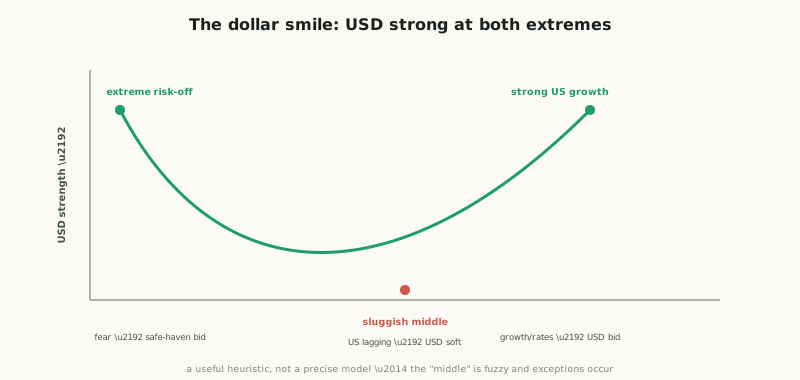
A: The dollar smile theory, popularised by economist Stephen Jen, observes that the US dollar tends to strengthen in two opposite scenarios — during extreme global risk-off (when fear drives a safe-haven bid for dollars) and during strong US economic outperformance (when growth and higher rates attract capital) — while weakening in the sluggish middle, when the US is growing modestly or lagging. Plotted against the global backdrop, this traces a U-shape, or 'smile'.
Q: Why does the dollar strengthen in a crisis?
A: Because of its safe-haven and reserve-currency status. In times of extreme global stress, investors rush to the perceived safety and unmatched liquidity of US dollars and US Treasuries, regardless of how the US economy itself is doing — a 'flight to safety'. This demand pushes the dollar up even when the crisis originates in the US, forming the left side of the smile.
Q: Is the dollar smile theory reliable?
A: It's a useful heuristic rather than a precise model. The logic behind both ends is sound, and the pattern has often held, but it's a simplification: the 'middle' is fuzzy, the dollar's behaviour also depends on relative factors (other central banks, other economies), and exceptions occur. It's best used as a framework for thinking about the dollar's likely bias given the global environment, not a mechanical predictor.
The three zones of the smile
The dollar smile theory, popularised by economist Stephen Jen, maps the dollar's tendency across three states of the global environment.
The dollar smile
The left side of the smile is the extreme risk-off scenario: when the world is gripped by fear — a crisis, a crash, a panic — investors rush to the perceived safety and unmatched liquidity of US dollars and US Treasuries in a "flight to safety," pushing the dollar up. The right side is strong US economic outperformance: when the US economy is booming relative to others, higher growth and the higher interest rates that tend to accompany it attract capital seeking returns, also pushing the dollar up. The middle — the bottom of the smile — is the sluggish scenario: when the US is growing only modestly or lagging other economies, and there's no crisis driving safe-haven demand, the dollar tends to weaken, as capital flows out toward higher-growth, higher-yielding economies elsewhere. Hence the smile: strong at both extremes, soft in the middle.
The logic, and the limits
What makes the theory compelling is that the logic of each end is sound and rests on different drivers. The left side rests on the dollar's unique safe-haven and reserve-currency status — in a true panic, nothing rivals the depth and safety of the US dollar and Treasury market, so the dollar gets bid even when the crisis originates in the US (a striking feature: the dollar can rally during an American financial shock, because the world still flees to it). The right side rests on ordinary capital-flow logic — money chases growth and yield, so a strongly outperforming US with rising rates draws capital in. Crucially, these are two different mechanisms producing the same result (a strong dollar) at opposite ends, with the weakness confined to the in-between state where neither driver is active. For a trader or analyst, the smile is a genuinely useful lens: ask "which part of the smile are we in?" — is the world in fear (left), is the US clearly outperforming (right), or is it a muddled, risk-neutral middle (soft dollar)? — to frame a bias for the dollar and, by extension, for major pairs and the dollar index.
But the limits matter, and the honest framing treats the smile as a heuristic, not a precise model. The "middle" is fuzzy — there's no sharp line between "sluggish" and "strong," and the transitions are gradual and debatable. The dollar's behaviour is also relative: it's not just about the US in isolation but about the US versus other economies and central banks — a "sluggish" US can still see a firm dollar if everyone else is worse, so the smile simplifies a fundamentally relative picture. And exceptions occur: the dollar doesn't always obey the pattern, because many other factors (positioning, intervention, idiosyncratic shocks, shifts in reserve-currency confidence) intrude. So the dollar smile is best used as a framework for thinking about the dollar's likely bias given the global environment — a way to organise the question and form a reasoned lean — rather than a mechanical predictor of dollar direction. Like every theory on this site, it informs a view without guaranteeing an outcome, and it's strongest combined with the broader risk and rate picture and with disciplined risk management. The honest framing: the dollar smile theory (Stephen Jen) observes that the USD tends to strengthen at two opposite extremes — extreme global risk-off (safe-haven flight-to-safety bid) and strong US outperformance (growth and higher rates attract capital) — while weakening in the sluggish middle where neither driver is active, tracing a smile. The two ends rest on different sound mechanisms (haven status; capital chasing growth/yield), and the dollar can even rally during a US-originated crisis. But it's a heuristic, not a precise model: the middle is fuzzy, the dollar's behaviour is relative to other economies, and exceptions occur — so use it to frame the dollar's likely bias given the global backdrop, not as a mechanical predictor; manage risk.
Using the smile in practice
For a trader or analyst, the dollar smile is most useful as the first question in building a view on the dollar: which part of the smile are we in? Start by reading the global risk environment — is the market in fear (a sharp risk-off episode, equities falling, volatility spiking)? That's the left side, and it argues for a firm dollar regardless of US data, as the safe-haven bid dominates. Or is the US economy clearly outperforming, with strong growth and the Fed at or heading to relatively high rates? That's the right side, and it also argues for a firm dollar, as capital chases US growth and yield. Or is it a muddled middle — no crisis, but the US merely plodding along or lagging peers? That's the soft-dollar zone, where the dollar tends to cede ground to higher-growth, higher-yielding currencies. Having located the regime, you have a reasoned bias for the dollar, and by extension a lean on the major pairs and the dollar index — a strong-dollar regime broadly pressures EUR/USD and GBP/USD lower and supports USD/JPY, and vice versa in the soft middle.
Two practical refinements keep this honest. First, remember the relativity: because FX is always a pair, the smile gives you the dollar's own bias, but the actual exchange rate depends on the other currency too — a "right side" strong-dollar lean can still be overwhelmed if the other currency's central bank is hiking even faster, so always weigh the counterpart, not just the dollar. Second, combine the smile with the rate and risk picture rather than using it alone: the smile tells you the structural bias from the global regime, while interest-rate differentials, central-bank trajectories and current positioning fill in the detail and timing. The smile is best as a top-down framing device — it organises the macro backdrop into a coherent dollar thesis — which you then refine with the specifics and, as always, trade with proper risk management rather than betting the farm on a macro narrative. Used this way, it turns the bewildering question "what will the dollar do?" into a structured, answerable one: locate the regime, weigh the counterpart, confirm with rates and risk, and lean accordingly. The honest reminder: use the smile by first identifying which regime you're in (risk-off left, strong-US right, sluggish middle) to set a dollar bias, then always weigh the counterpart currency (FX is relative) and confirm with rate differentials and risk sentiment — a top-down framing device refined with specifics, traded with risk management, not a standalone signal.
What makes the dollar smile endure as a framework is that it captures something genuinely structural about the world's reserve currency: the dollar wins both when investors are fleeing to safety and when they're chasing US strength, losing ground only when neither force is in play. That dual nature is unique to the dollar and explains its sometimes puzzling behaviour — rallying in crises it helped cause, softening in calm despite decent US data. Hold the smile as a lens for that structure, refine it with the specifics, and it will sharpen your read of the dollar more often than not.
The dollar smile theory (Stephen Jen): the US dollar tends to strengthen at two opposite extremes — extreme risk-off (a safe-haven flight-to-safety bid, even in a US-originated crisis) and strong US outperformance (growth and higher rates attract capital) — while weakening in the sluggish middle, where neither driver is active. Plotted, that's a smile: strong at both ends, soft in between. The two ends rest on different sound mechanisms — the dollar's safe-haven/reserve status on the left, capital chasing growth/yield on the right. Use it by asking "which part of the smile are we in?" to frame the dollar's bias. But it's a heuristic, not a precise model: the middle is fuzzy, the dollar's behaviour is relative to other economies, and exceptions occur — so lean on it as a framework, not a predictor, combined with the wider risk and rate picture.