Here's an uncomfortable market truth: you can make money buying something obviously overvalued — as long as you find someone willing to pay even more. That's the greater fool theory, and it explains both how bubbles inflate and why they always, eventually, end in tears for someone. It's a theory about price detached from value, about crowds and timing, and about the brutal arithmetic of musical chairs. This guide explains the greater fool theory: what it is, how it drives bubbles, and why someone is always left holding the bag.
It's the engine behind financial bubbles and manias, closely related to reflexivity and herd mentality.
Key takeaways
Q: What is the greater fool theory?
A: The greater fool theory states that you can profit by buying an overvalued asset — even one you know is overpriced — as long as you can later sell it to someone else (a 'greater fool') willing to pay an even higher price. Under this view, profit comes not from the asset's underlying value but purely from finding a buyer who'll pay more, regardless of fundamentals.
Q: How does the greater fool theory explain bubbles?
A: Bubbles inflate when enough participants buy at ever-higher prices, each expecting to sell to a greater fool before the music stops. Rising prices attract more buyers, who push prices higher still, in a self-reinforcing loop disconnected from fundamental value. The bubble continues as long as greater fools keep appearing — but the supply of new buyers is finite, and when it runs out, prices collapse.
Q: Why is the greater fool theory dangerous?
A: Because someone is always left as the last fool. The strategy relies on selling to a greater fool before the top, but no one can reliably time that, and when buyers run out the price crashes — leaving whoever bought last (and didn't sell) holding an overvalued asset at a heavy loss. It treats a game of musical chairs as a strategy, and by definition not everyone can find a chair.
What it is
The greater fool theory states that you can profit by buying an overvalued asset — even one you know is overpriced — provided you can later sell it to someone else, a "greater fool," willing to pay an even higher price. The defining feature is that profit comes not from the asset's underlying value but purely from finding a buyer who'll pay more, regardless of fundamentals. The "fool" who buys at an inflated price isn't necessarily acting irrationally by their own logic — they may fully intend to sell to a greater fool down the line, pocketing the difference. This is a fundamentally different game from value investing (buy something worth more than its price) or even ordinary speculation grounded in expected fundamentals; here the entire thesis is "it's overpriced, but someone will pay more." It's the logic, spoken or unspoken, behind chasing an asset that's already soared with no fundamental justification — "I know it's expensive, but it'll keep going up because others will keep buying." And for a while, that can actually work — which is precisely what makes it so seductive and so dangerous.
How it drives bubbles — and the last fool
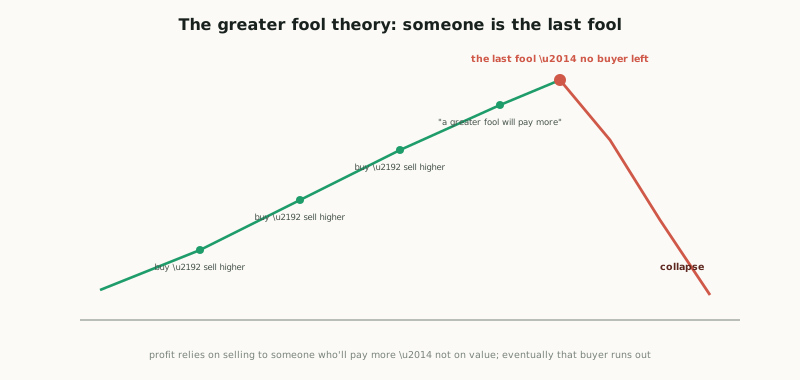
The greater fool theory is the engine of bubbles. A bubble inflates when enough participants buy at ever-higher prices, each expecting to sell to a greater fool before the music stops. The dynamic is self-reinforcing: rising prices attract more buyers (drawn by the gains others are visibly making), whose buying pushes prices higher still, attracting yet more buyers — a feedback loop that drives price further and further from any fundamental anchor (this is where it overlaps with reflexivity and herd mentality, the crowd piling in). During the mania, the greater fool logic appears validated on every trade — everyone who bought and sold made money, because there was always a greater fool right behind them. The euphoria feels like confirmation that the asset "only goes up."
But the theory contains its own doom, and it's simple arithmetic: the supply of greater fools is finite. The chain of ever-greater fools cannot extend forever, because eventually the pool of new buyers willing to pay more is exhausted — and at that moment, there is no greater fool left. Whoever bought last (and hasn't sold) becomes the last fool, holding a wildly overvalued asset with no one to sell to at a higher price — and as soon as it's clear the buyers have run out, the price collapses, often violently, as everyone rushes for the exit at once. This is why the greater fool theory is so dangerous as a strategy: it's a game of musical chairs dressed up as investing, and by definition not everyone can find a chair. The fatal flaw is timing: the strategy relies on selling before the top, but no one can reliably identify the top in advance (the last leg of a bubble often feels the most euphoric and convincing), so the belief that "I'll get out in time" is exactly the belief held by all the fools who didn't. For a trader, the lessons are practical: recognise greater-fool dynamics for what they are (price driven by the expectation of selling higher, not by value), understand that participating is speculation on crowd behaviour and timing, not investing — and that it can work until it abruptly, catastrophically doesn't — and respect that someone always ends up the last fool, so the risk of it being you is real. If you ever do play such a move, do so with eyes open, a tight plan, and — above all — strict risk management, never confusing a greater-fool gamble with a sound investment. The honest framing: the greater fool theory says you can profit buying an overvalued asset — even knowingly — as long as a "greater fool" will later pay more; profit comes from the next buyer, not from value. It drives bubbles via a self-reinforcing loop where rising prices attract buyers who push prices higher, detached from fundamentals — working until the finite supply of greater fools runs out, at which point the price collapses and whoever bought last is the last fool. It's musical chairs as a strategy, and not everyone gets a chair; the fatal flaw is that no one can reliably time the top. Recognise the dynamic, treat any participation as speculation on crowd timing (not investing), and manage risk.
Spotting and surviving greater-fool markets
Because greater-fool dynamics can run for a long time before collapsing, the practical skill is recognising them and deciding how (or whether) to engage. The warning signs are fairly consistent across history. Price detached from any fundamental anchor: when an asset's price can no longer be justified by any reasonable measure of value and the only bullish argument is "it'll keep going up," you're likely in greater-fool territory. "New paradigm" talk: every bubble is accompanied by narratives explaining why the old rules of value no longer apply ("it's different this time," "a new era") — the rationalisation that lets fools feel like visionaries. Mass participation and euphoria: when "everyone" is buying, taxi-driver tips abound, and people with no prior interest pile in (the classic sign of the herd at a top), the pool of remaining greater fools is shrinking. Parabolic price action: a near-vertical, accelerating rise is the visual signature of the final, most euphoric leg — and the most dangerous place to be buying. None of these times the top precisely (markets can stay irrational longer than you can stay solvent), but together they signal that you're playing a greater-fool game, not investing on value.
How to survive such markets comes down to clarity about what you're doing. First, never confuse a greater-fool play with sound investing — be honest that you're speculating on crowd behaviour and timing, not buying value, because that honesty changes how you size and manage the position. Second, if you do participate, have a strict exit plan and use stops: the entire risk is being the last fool, so a pre-defined exit and disciplined risk management are non-negotiable — the bubble's collapse is typically fast and offers little chance to get out gracefully once it starts. Third, size small: treat it as the high-risk gamble it is, never betting more than you can comfortably lose. Many experienced traders simply avoid obvious greater-fool markets altogether, judging the timing risk not worth it; others fade them (betting on the eventual collapse), though that's notoriously dangerous too, since shorting a parabolic move can ruin you before you're proved right (the contrarian's timing problem). The safest stance is usually recognise it, respect it, and don't mistake the easy gains during the mania for skill or for a sound, repeatable strategy. The honest reminder: spot greater-fool markets by their signs — price detached from value, "new paradigm" talk, mass euphoria, parabolic moves — and survive them by being honest you're speculating on timing not investing, using strict exits and stops, sizing small, and accepting that many pros simply avoid them; never mistake mania-era gains for skill.
The greater fool theory: you can profit buying an overvalued asset — even one you know is overpriced — as long as a greater fool will later pay more; profit comes from the next buyer, not from value. It's the engine of bubbles: rising prices attract buyers who push prices higher in a self-reinforcing loop detached from fundamentals, validated on every trade — until the finite supply of greater fools runs out, the price collapses, and whoever bought last is the last fool holding the bag. It's musical chairs dressed as investing, and by definition not everyone gets a chair. The fatal flaw is timing: no one can reliably spot the top, and "I'll get out in time" is what every trapped fool believed. Recognise the dynamic, treat any participation as speculation on crowd timing (not investing), and if you ever play it, do so with a tight plan and strict risk management.