You can control your entries, your risk and your process — but you cannot control whether any single trade wins. The illusion of control is the very human habit of mistaking the second for the first: believing that enough analysis, effort, screen-watching or tinkering can bend an uncertain outcome to your will. It feels productive, even responsible — and it quietly drives some of trading's most costly mistakes. This guide explains the illusion of control: what it is, how it harms traders, and how focusing on the controllable dissolves it.
It's the bias that process-vs-outcome thinking is built to counter, central to dealing with uncertainty and the role of luck.
Key takeaways
Q: What is the illusion of control in trading?
A: The illusion of control is the cognitive bias of overestimating your ability to influence outcomes that are substantially driven by chance. In trading, it shows up as believing that more analysis, more screen time, constant adjustments, or sheer effort can control whether an individual trade wins — when the outcome of any single trade is largely uncertain and outside your control, however good your process.
Q: How does the illusion of control harm traders?
A: It drives over-tinkering and over-trading: constantly adjusting stops and targets, moving stops to avoid a loss, exiting and re-entering, or taking extra trades in a belief that activity equals control. It also fuels frustration and emotional reactions when outcomes don't obey the effort put in. The result is usually worse decisions, higher costs and more stress, all stemming from trying to control the uncontrollable.
Q: How do you overcome the illusion of control?
A: By clearly separating what you can control from what you can't, and focusing entirely on the former. You control your process — entries, risk per trade, position size, stop placement, which setups you take, and how you respond to results — but not the outcome of any single trade or the market's direction. Accepting that uncertainty, defining a plan and following it, and judging yourself on process rather than individual outcomes dissolves much of the illusion.
What it is and how it harms traders
The illusion of control is a well-documented cognitive bias: people consistently overestimate their ability to influence outcomes that are substantially driven by chance. (Classic experiments show people value a lottery ticket they chose more than one they were given, as if choosing improved their odds — it doesn't.) In trading, the bias is everywhere, because the activity feels like it should reward effort and skill the way most endeavours do — yet the outcome of any single trade is largely uncertain and outside your control, no matter how good your analysis. A trader in the grip of the illusion believes that more — more analysis, more screen time, more adjustments, more activity — will control the result, when in reality it controls only the process.
Control what you can, accept what you can't
The harm shows up as a cluster of recognisable, costly behaviours. Over-tinkering: constantly moving stops and targets, nudging the stop further away to "give the trade room" (i.e. to avoid taking the loss the plan called for), exiting and re-entering, or micromanaging an open position — all driven by the feeling that doing something exerts control, when it usually just degrades a sound plan. Over-trading: taking extra trades out of a need to be active, as if activity itself were control, multiplying costs and forcing marginal setups (see overtrading). Emotional reactions: frustration, anger or self-blame when outcomes don't obey the effort put in — "I did everything right and still lost!" — which only makes sense if you believed effort should control the outcome. And superstition: rituals and lucky patterns that feel like control but aren't. The common root is trying to control the uncontrollable, and the common result is worse decisions, higher costs and more stress.
Focusing on what you can control
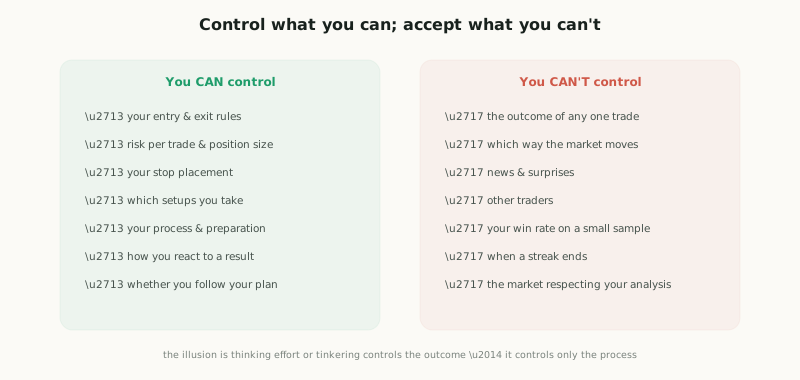
The antidote is simple to state and powerful in practice: clearly separate what you can control from what you can't, and pour your energy entirely into the former. The spec grid above makes the division concrete. You can control your process — your entry and exit rules, your risk per trade and position size, your stop placement, which setups you take, your preparation, and crucially how you respond to a result. You cannot control the outcome of any single trade, the market's direction, the news, other traders, or when a winning or losing streak ends. Once that line is clear, the path forward is to build a sound plan around the controllables and follow it, then judge yourself on whether you executed the process well — not on whether a given trade won (the heart of process-vs-outcome thinking). A trade can be well-executed and lose (good process, unlucky outcome) or badly-executed and win (bad process, lucky outcome); the illusion of control conflates the two, while the disciplined trader keeps them separate.
This reframing is genuinely liberating. Accepting that you can't control outcomes removes the futile struggle, the over-tinkering and the frustration, and replaces them with a calmer focus on doing your job well over a large sample of trades — trusting that a sound process, applied consistently with proper risk management, lets your edge express itself statistically even though any individual result is a coin you can't control. It also makes peace with variance: losses aren't a personal failure to control the market, just the normal noise of an uncertain process. The paradox is that letting go of the illusion of control over outcomes gives you more real control — over your behaviour, your costs and your emotional state — which is the only control that ever actually helps. The honest framing: the illusion of control is overestimating your influence over outcomes driven by chance — in trading, believing more analysis, screen time, tinkering or effort can control whether a single trade wins, when it can't. It drives over-tinkering (moving stops, micromanaging), over-trading (activity as pseudo-control), and frustration when outcomes don't obey effort. The fix: separate what you control (process — entries, risk, sizing, stops, which setups, your reactions) from what you don't (any single outcome, market direction, news, when a streak ends), build a plan around the controllables, follow it, and judge yourself on process not outcome — accepting variance. Letting go of control over outcomes gives you real control over behaviour; manage risk.
Everyday examples
The illusion of control rarely announces itself; it hides inside behaviours that feel entirely reasonable in the moment. Moving a stop further away as price approaches it is a classic — it feels like "managing" the trade, but it's really an attempt to control an outcome by refusing the loss the plan called for, and it usually just turns a small planned loss into a larger one. Watching every tick of an open position, as if vigilance could influence where it goes, is another — the screen-staring feels productive but changes nothing except your stress level. Over-trading after a loss to "make it back" is the illusion in its revenge-trading form: the feeling that decisive action can reassert control over a result that's already gone, when it typically compounds the damage. Endless re-analysis of a setup — adding one more indicator, checking one more timeframe — often masquerades as diligence but is really an attempt to eliminate an uncertainty that cannot be eliminated. And the small superstitions traders develop — a lucky routine, a "feeling" about a trade — are the illusion in its purest form: rituals that create a sense of control over randomness.
Spotting these in yourself is the practical skill, because each one is the illusion of control wearing the costume of responsible trading. The tell is usually an emotional urge to "do something" about an outcome that is, in truth, already out of your hands — the position is on, the risk is defined, and fiddling with it now is the illusion talking. The disciplined response is to notice the urge, name it ("this is me trying to control the uncontrollable"), and return to the plan: the stop is where it belongs, the size was set correctly, and the right action is usually no action — letting the trade resolve as it will and accepting the result. This is genuinely hard, because doing nothing feels like negligence when every instinct screams to intervene; but in trading, the ability to sit on your hands once a trade is properly set is a mark of skill, not passivity. The energy you'd spend trying to control outcomes is far better spent on the things you actually can control — the quality of your next setup, your sizing, your preparation — which is where real edge is built. The honest reminder: the illusion hides in stop-moving, tick-watching, revenge-trading and over-analysis, all of which feel responsible but are attempts to control the uncontrollable; notice the urge, name it, and return to your plan — often the skilled move is to do nothing.
The illusion of control is overestimating your influence over chance-driven outcomes — in trading, believing more analysis, screen time, tinkering or effort can control whether a single trade wins (it can't). It drives over-tinkering (moving stops, micromanaging open trades), over-trading (treating activity as control), and frustration when outcomes don't obey your effort. The fix: cleanly separate what you can control — your process: entries, risk per trade, sizing, stop placement, which setups you take, and your reactions — from what you can't: any single outcome, the market's direction, news, when a streak ends. Build a plan around the controllables, follow it, and judge yourself on process, not outcome, accepting variance. Paradoxically, letting go of control over outcomes gives you real control over your behaviour — the only control that helps.