
How does a central bank decide where to set interest rates? The Taylor rule offers a famous and influential answer: a simple formula linking the policy rate to inflation and the economy's slack. For forex traders — who live and die by interest-rate expectations — it's a valuable lens for anticipating what a central bank might do next, and for judging whether current policy looks too loose or too tight. This guide explains the Taylor rule: what it is, its components, why it matters for forex, and its limits.
It's a framework for the rate-setting that central banks do, feeding directly into the interest rates and inflation dynamics that move currencies.
Key takeaways
Q: What is the Taylor rule?
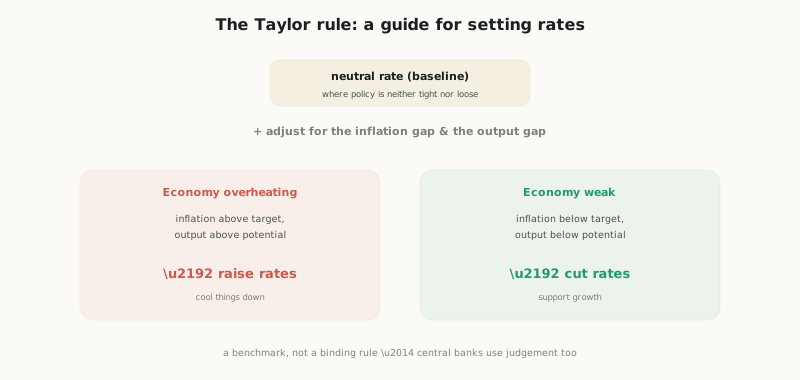
A: The Taylor rule is a monetary-policy guideline, proposed by economist John Taylor, that prescribes where a central bank should set its policy interest rate based on a neutral baseline rate adjusted for two gaps: how far inflation is from its target (the inflation gap) and how far output is from its potential (the output gap). When inflation or output run hot, the rule prescribes higher rates; when they run cold, lower rates.
Q: Why does the Taylor rule matter for forex?
A: Because interest rates are a primary driver of currencies, and the Taylor rule helps traders anticipate central-bank rate decisions. By estimating what the rule prescribes given current inflation and output, a trader can gauge whether a central bank is likely to raise, hold or cut — and whether current policy looks 'too loose' or 'too tight' relative to the benchmark, which shapes expectations that move exchange rates.
Q: Is the Taylor rule actually followed by central banks?
A: Not mechanically. It's a benchmark and a guideline, not a binding rule. Central banks use discretion and consider many factors the formula omits — financial stability, employment nuance, global conditions, forward guidance — and the 'neutral rate' and 'output gap' it relies on are themselves estimated and uncertain. The Taylor rule is best used as a reference point for whether policy is loose or tight, not a precise prediction.
What it is and its components
The Taylor rule, proposed by economist John Taylor in 1993, is a monetary-policy guideline that prescribes where a central bank should set its policy interest rate. The intuition is elegant: start from a neutral rate (one that neither stimulates nor restrains the economy) and then adjust it according to how far two key variables are from where they should be.
The Taylor rule's ingredients
The two adjustments are the heart of it. The inflation gap is how far inflation sits above or below the central bank's target (typically around 2%): if inflation is above target, the rule prescribes a higher rate to cool it; if below, a lower rate. The output gap is how far the economy's actual output is above or below its sustainable potential: if the economy is running hot (output above potential, an overheating boom), the rule prescribes a higher rate; if there's slack (output below potential, a weak economy), a lower rate. Put together, the rule says: policy rate = neutral rate + a response to the inflation gap + a response to the output gap. When both inflation and the economy run hot, the prescribed rate rises well above neutral (tightening); when both run cold, it falls below neutral (easing). It's a clean way of formalising the basic central-bank balancing act between controlling inflation and supporting growth.
Why it matters for forex, and its limits
For a forex trader, the Taylor rule is useful in two related ways. First, as a tool for anticipating rate decisions: since interest rates (and expectations of them) are a primary currency driver, estimating what the rule prescribes given current inflation and output data helps a trader gauge whether a central bank is likely to raise, hold or cut — and a currency tends to strengthen when its central bank is expected to tighten relative to others. Second, as a gauge of whether policy is "behind the curve" or "ahead of it": comparing the actual policy rate to what the Taylor rule suggests reveals whether a central bank's stance looks too loose (actual rate well below the rule's prescription, perhaps risking inflation) or too tight (above it, perhaps risking recession) — a judgement that feeds market expectations about future moves and thus the currency. Because exchange rates are driven by relative monetary policy, comparing the Taylor-rule picture across two countries can frame a view on their pair.
But the limits are essential to respect, and they're significant. The Taylor rule is a benchmark and guideline, not a binding rule — central banks do not mechanically follow it. They exercise discretion and weigh many factors the simple formula omits: financial stability, the nuances of the labour market, global conditions, exchange-rate effects, and forward guidance about the future. Moreover, the rule's key inputs are themselves uncertain estimates: the neutral rate and the output gap (and even "potential" output) cannot be observed directly and are debated by economists, so different assumptions produce different prescriptions — the rule is only as good as the estimates fed into it. There are also many variants of the formula with different weights and inputs. So the Taylor rule is best used as a reference point and a way of thinking about whether policy is loose or tight and where it might head — not as a precise predictor of the next rate decision, and certainly not as a standalone trading signal. Combined with the broader fundamental picture and an awareness that markets price expectations, it's a sophisticated tool for understanding the rate dynamics behind currencies. The honest framing: the Taylor rule prescribes a central bank's policy rate as a neutral baseline adjusted for the inflation gap (inflation vs target) and the output gap (output vs potential) — hot inflation/output → higher rates, cold → lower. It matters for forex because rate expectations drive currencies: it helps anticipate decisions and judge whether policy is too loose or too tight relative to the benchmark, especially compared across countries. But it's a guideline, not a binding rule — central banks use discretion and factors it omits, and its neutral-rate and output-gap inputs are uncertain estimates — so use it as a reference and a way of thinking, not a precise prediction; combine with the wider picture and manage risk.
Using the Taylor rule in practice
A trader doesn't need to compute the formula to the decimal to benefit from Taylor-rule thinking — the value is in the framework. The practical workflow runs roughly as follows. Estimate the prescription: given where inflation sits relative to the central bank's target and how much slack or heat there is in the economy, what does the logic suggest the rate "should" be — higher, lower, or about right? Compare to the actual rate: the gap between what the rule prescribes and where the policy rate actually sits (sometimes called the "policy gap") reveals the stance. If the actual rate is well below the prescription, policy looks loose — the central bank may be behind the curve on inflation, hinting at future hikes (and potential currency support as the market prices them). If the actual rate is above the prescription, policy looks tight — possibly nearing the end of a hiking cycle or risking over-tightening, hinting at eventual cuts. Compare across countries: because exchange rates are driven by relative policy, applying this lens to both currencies in a pair frames a view — the currency whose central bank looks more likely to tighten (or stay tight) relative to the other tends to be favoured.
Two refinements sharpen the practice. First, watch how the inputs are evolving, not just their current level: the Taylor rule is forward-looking in spirit, so a trader tracks whether inflation is accelerating or cooling and whether the output gap is widening or closing, since those trends shift the prescription and thus the likely policy path. Second, and crucially, listen to the central bank itself: because the rule is only a benchmark and the bank uses discretion, what ultimately moves the currency is the bank's own reaction function and communication — so the Taylor rule is best used alongside forward guidance and the tone of policy statements, as a way of judging whether the bank's stated path looks consistent with the economic data or surprisingly loose/tight. Used this way — to gauge stance, anticipate direction, and compare across countries, while deferring to the bank's actual signals — the Taylor rule is a genuinely useful organising framework for the rate expectations that drive forex. Used as a precise predictor of the next decision, it disappoints, because the real-time inputs are uncertain and central banks routinely deviate. The honest reminder: it tells you what policy might warrant and whether the current stance looks loose or tight — a way of thinking, not a forecast — so combine it with the bank's guidance and the wider picture, and manage risk.
The Taylor rule prescribes a central bank's policy rate as a neutral baseline adjusted for two gaps: the inflation gap (inflation vs target) and the output gap (output vs potential). Hot inflation/output → higher rates; cold → lower. It matters for forex because rate expectations drive currencies: it helps you anticipate decisions and judge whether policy looks too loose or too tight versus the benchmark — powerful when compared across two countries for a pair. But it's a guideline, not a binding rule: central banks use discretion and weigh factors it omits (stability, guidance, global conditions), and its neutral rate and output gap inputs are uncertain estimates. Use it as a reference and a way of thinking about policy direction — not a precise prediction or standalone signal; combine with the wider picture.