Long before "smart money concepts" became a social-media staple, Richard Wyckoff was teaching traders to follow the footprints of large operators through a repeating cycle of accumulation and distribution. A century on, his framework still quietly shapes how a great deal of modern technical analysis reads markets. This guide explains the Wyckoff method: the market cycle, the composite operator, Wyckoff's three laws, and how to apply this classic methodology with appropriate caveats.
It's the historical ancestor of modern smart money concepts and market structure analysis, and it leans heavily on volume.
Key takeaways
Q: What is the Wyckoff method?
A: The Wyckoff method is a classic approach to reading markets developed by Richard Wyckoff in the early 20th century. It frames price action as a repeating cycle of four phases — accumulation, markup, distribution and markdown — driven by large operators ('smart money') who accumulate positions at low prices and distribute them at high prices. Traders use it to identify which phase the market is in and align with the large operators rather than against them.
Q: What are Wyckoff's three laws?
A: The law of supply and demand (price rises when demand exceeds supply and falls when supply exceeds demand); the law of cause and effect (a period of accumulation or distribution — the 'cause' — leads to a proportional move — the 'effect'); and the law of effort versus result (a divergence between volume/effort and the resulting price move signals a potential change, for example high volume producing little progress).
Q: Is the Wyckoff method still relevant?
A: Yes — its core ideas underpin much modern market-structure and 'smart money' analysis, and the cycle of accumulation and distribution remains a useful framework. But it's a discretionary, interpretive method: identifying phases and Wyckoff's specific events is subjective and often clearer in hindsight, so it should be applied as a lens combined with confirmation and risk management, not as a mechanical system that predicts turns precisely.
The market cycle and the composite operator
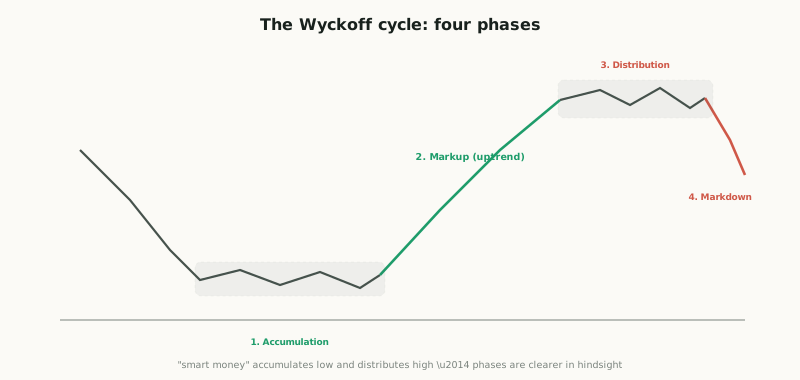
At the heart of the Wyckoff method is the idea that markets move in a repeating cycle of four phases, driven by the actions of large, well-capitalised operators. Wyckoff personified these as the "composite operator" (or composite man) — a mental model encouraging traders to imagine all large-operator activity as one entity who accumulates positions cheaply, marks price up, distributes (sells) at high prices, and lets price mark down — and to align with this operator rather than be the retail trader left holding the bag. The cycle's four phases form the backbone.
| Phase | What happens | Operator is… |
|---|---|---|
| Accumulation | Sideways base after a downtrend | Buying quietly (cheap) |
| Markup | Uptrend | Holding / letting it rise |
| Distribution | Sideways top after the uptrend | Selling quietly (dear) |
| Markdown | Downtrend | Out / short |
Accumulation is a sideways, range-bound base that forms after a downtrend, where the composite operator quietly buys from discouraged sellers without driving price up — building a position cheaply. Markup follows: with supply absorbed, price trends up. Distribution is a sideways top after the uptrend, where the operator quietly sells into eager late buyers without crashing price — offloading the position at high prices. Markdown follows: with demand exhausted, price trends down, completing the cycle. Wyckoff also detailed specific events and structures within the accumulation and distribution ranges — such as the "spring" (a false break below an accumulation range that shakes out sellers before the markup) and the "upthrust" (its distribution-top equivalent) — which are precisely the stop-hunting, liquidity-grabbing moves that modern smart money concepts describe in their own vocabulary.
Wyckoff's three laws, and applying it
Underpinning the cycle are Wyckoff's three laws. The law of supply and demand: price rises when demand exceeds supply and falls when supply exceeds demand — the foundational principle. The law of cause and effect: a period of accumulation or distribution (the "cause," measurable by the size of the trading range) produces a proportional subsequent move (the "effect") — a bigger base implies a bigger move. The law of effort versus result: a divergence between effort (volume) and result (price progress) signals a potential change — for example, heavy volume producing little price movement suggests absorption and a possible turn. These laws, especially effort-vs-result, are why Wyckoff analysis traditionally leans heavily on volume alongside price (a notable challenge in spot forex, where there's no true centralised volume — only tick volume — a caveat worth keeping in mind when applying Wyckoff to currencies).
To apply the method, a trader works to identify which phase the market is in, then aligns accordingly — looking to buy as accumulation completes and markup begins (often entering on a spring or the break of the range), and to sell or stand aside as distribution completes and markdown threatens — essentially trying to position with the composite operator. The honest caveats are important, though. Wyckoff is a discretionary, interpretive method: identifying phases, ranges and specific events is subjective and frequently far clearer in hindsight than in real time, where an "accumulation" can turn out to be a pause before further decline. It's a framework for reading market behaviour, not a mechanical system that pinpoints turns, and it works best combined with confirmation, sound structure reading and disciplined risk management. Its enduring value is conceptual: the cycle of accumulation and distribution, the composite-operator mindset, and the effort-versus-result lens remain genuinely useful ways to think about who is doing what behind price — and they're the foundation on which much of today's market-structure and smart-money analysis is (often unknowingly) built. The honest framing: the Wyckoff method frames markets as a repeating cycle — accumulation (base, operator buying cheap), markup (uptrend), distribution (top, operator selling dear), markdown (downtrend) — driven by a "composite operator" to align with. Its three laws: supply and demand; cause and effect (range size implies move size); and effort vs result (volume-price divergence signals change). Apply it by identifying the phase and positioning with the operator (e.g., buying a spring as accumulation ends). Caveats: it's subjective and clearer in hindsight, leans on volume (problematic in spot forex), and is a discretionary reading framework, not a mechanical predictor — use with confirmation and risk management. Its ideas underpin modern smart-money/structure analysis.
The events within the range
Wyckoff's enduring contribution isn't just the four-phase cycle but the detailed events he identified within the accumulation and distribution ranges — a sequence that, when recognised, helps a trader anticipate the coming markup or markdown. In a classic accumulation range, the textbook sequence runs roughly: a selling climax (a sharp, high-volume capitulation that ends the prior downtrend as panicked sellers are absorbed); an automatic rally (a bounce as selling dries up); a secondary test (a return toward the climax low on lower volume, confirming selling is exhausted); a period of building a base; then the famous spring (or shakeout) — a false break below the range that triggers stops and traps the last sellers before reversing sharply up; followed by a sign of strength (a strong rally out of the range) and a last point of support (a higher low on a pullback) before the markup begins in earnest. Distribution mirrors this at a top — a buying climax, automatic reaction, secondary test, and an upthrust (the spring's evil twin: a false break above the range that traps late buyers) before the markdown. You'll notice that the spring and upthrust are precisely the stop-hunting, liquidity-grabbing false breaks that modern false-breakout and smart-money traders describe in newer language — Wyckoff named them a century ago.
For a trader, these events offer a roadmap: spotting a likely selling climax and secondary test suggests accumulation may be underway; a spring that holds and is followed by a sign of strength is a classic Wyckoff long trigger (buy as the markup begins, with a stop below the spring low); the mirror events flag potential shorts near a distribution top. It's an elegant framework for reading who is doing what behind a range. But the honest caveat must be repeated with force here, because the detailed events make the method look more precise than it is: identifying these events in real time is genuinely difficult and far clearer in hindsight. A "spring" is only confirmed as a spring once price reverses and holds — in the moment, it's indistinguishable from a genuine breakdown that keeps falling, and many apparent accumulation ranges simply resolve downward into continued markdown. So the events are best used as a probabilistic reading framework requiring confirmation (the reversal and sign of strength actually materialising) and strict risk management — never as a guarantee that a range will resolve as the schematic suggests. Treated as a lens for anticipating large-operator behaviour, confirmed by price and contained by risk control, the Wyckoff events are a sophisticated and rewarding addition to a trader's reading; treated as a crystal ball that labels every range in advance, they invite the hindsight illusion. The honest reminder: the schematic is a guide to how accumulation and distribution often unfold, not a script the market is obliged to follow.
Applying Wyckoff to forex
A specific caveat applies when bringing Wyckoff to spot forex: the method traditionally relies heavily on volume (especially the effort-versus-result law), but spot forex is decentralised and has no true centralised volume — only tick volume (the number of price changes), which is a rough proxy, not the real traded volume a stock chart provides. This doesn't make Wyckoff useless in forex, but it does mean the volume-based reads are less reliable here than in markets with genuine volume data. The practical adaptation is to lean more on the price-structure side of Wyckoff — the phases, the ranges, the springs and upthrusts, the sequence of events — while treating tick-volume signals as supporting evidence rather than gospel. The conceptual framework (accumulation and distribution by large operators, the composite-operator mindset) transfers perfectly well to currencies; it's specifically the precise volume analysis that needs a lighter touch. Read Wyckoff in forex as a structural lens, confirmed by price action, and you retain most of its value despite the volume limitation.
The Wyckoff method frames markets as a repeating cycle: accumulation (a base where the "composite operator" buys cheap), markup (uptrend), distribution (a top where the operator sells dear), markdown (downtrend) — the goal being to align with the operator, not against them. Its three laws: supply and demand; cause and effect (the size of the range implies the size of the move); and effort vs result (volume-price divergence flags change). Events like the spring (a shakeout false break) prefigure modern smart money concepts. Caveats: it's subjective and far clearer in hindsight, leans on volume (tricky in spot forex — only tick volume), and is a discretionary reading framework, not a mechanical predictor. Apply it as a lens, with confirmation and risk management.