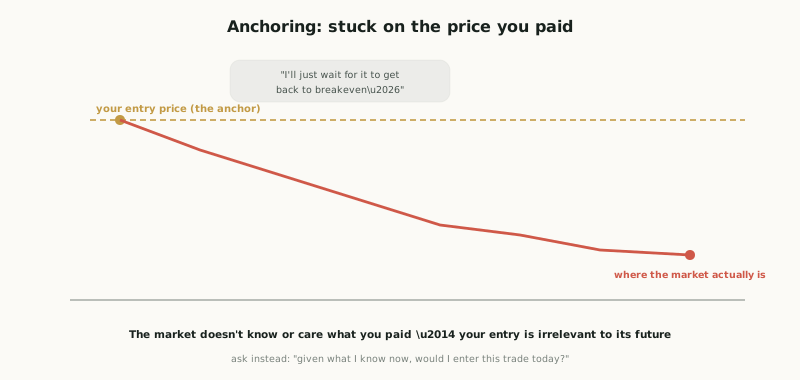
The market has no idea what you paid for your position — and no interest whatsoever in helping you get back to it. Yet traders anchor to their entry price constantly, refusing to sell a loser until it returns to breakeven, judging a trade by where they got in rather than where it's going. That's anchoring bias: one of the most common and costly cognitive biases in trading, and one that quietly traps capital in losing positions. This guide explains anchoring bias: what it is, how it shows up, why it's so costly, and how to think your way past it.
It's one of the core cognitive biases, it feeds directly into the sunk-cost fallacy, and it's amplified by loss aversion.
Key takeaways
Q: What is anchoring bias in trading?
A: Anchoring bias is the tendency to rely too heavily on the first or most salient piece of information — the 'anchor' — when making a decision, and to adjust too little away from it. In trading, the most common anchor is your entry price: judging a trade by where you got in rather than by the market's current reality, which leads to holding losers in the hope of getting back to breakeven.
Q: Why is anchoring to your entry price a problem?
A: Because your entry price is irrelevant to where the market goes next — the market doesn't know or care what you paid. Anchoring to it traps you in losing trades waiting for a breakeven that may never arrive, and distorts your judgement of whether a position is still worth holding. The only rational question is forward-looking: based on what you know now, is this a trade worth being in?
Q: How do you overcome anchoring bias?
A: By focusing on the present and the future rather than your reference points. Ask 'given everything I know now, would I enter this trade today?' — if not, that's a signal to act. Base your decisions on analysis-driven levels (support, resistance, your plan) rather than personal anchors like entry price, pre-define your exits before entering, and journal your trades to catch anchoring patterns.
What it is and how it shows up
Anchoring bias is the tendency to rely too heavily on the first or most salient piece of information — the "anchor" — when making a decision, and to adjust too little away from it as new information arrives. It's a universal human shortcut (the mind latches onto a reference point and judges everything relative to it), and trading offers it many footholds.
Common anchors in trading
By far the most damaging is anchoring to your entry price. Once you're in a trade, the price you paid becomes a powerful psychological reference, and you start judging the position by it: a loser becomes "a trade I'll exit at breakeven" rather than "a trade I should assess on its current merits." You wait for the market to return to your number — a number the market neither knows nor respects. Anchoring to round numbers (treating 1.30 as meaningful simply because it's round), to a recent high or low ("it was 1.35 last week, so 1.25 must be a bargain"), to an analyst's price target, or to your own initial forecast (clinging to your first view and under-weighting new evidence, which links closely to confirmation bias) are all variations on the same error.
Why it's costly, and how to counter it
The reason anchoring is so costly is simple and worth stating bluntly: your entry price is irrelevant to where the market goes next. The market has no memory of your trade and no obligation to return to your breakeven. When you anchor to it, you make decisions for the wrong reason — holding a position not because the analysis supports it but because selling would "lock in" a move away from your anchor. This is precisely how small, manageable losses are allowed to grow into large, damaging ones (the cardinal trading mistake), how capital gets tied up in dead positions waiting for a recovery that may never come, and how profits get taken too early or held too long relative to an arbitrary reference rather than the actual setup. Anchoring also interacts viciously with loss aversion and the sunk-cost fallacy: the entry-price anchor gives the loss-averse mind a comforting story ("it's not really a loss until I sell below breakeven") that justifies holding a losing trade indefinitely.
The antidote is to deliberately shift your frame from backward-looking references to forward-looking analysis. The single most useful question is: "Given everything I know right now, would I enter this trade today?" If the honest answer is no, then the only thing keeping you in the position is the anchor — and that's a signal to act, not to wait. Make your decisions on analysis-driven levels (support and resistance, volatility-based stops, the logic of your plan) rather than personal anchors like your entry price; the market price is the only objective reference that matters. Pre-define your exits before you enter, when you're calm and unbiased — so your "anchor" becomes your plan rather than your fill price — and then honour those exits. And journal your trades (see building a trading routine), watching for tell-tale anchoring language in your own reasoning: "when it gets back to…", "it's cheap because it was higher…", "I just need breakeven…". Catching those phrases is half the battle. None of this makes anchoring vanish — it's a deep-seated human tendency you'll never fully switch off — but awareness plus rules turns the anchor from a trap into, at most, a passing thought you can recognise and override. The honest framing: anchoring is over-relying on the first or most salient reference (the anchor) and under-adjusting. In trading it shows as anchoring to your entry price (holding losers to "get back to breakeven"), to round numbers or recent highs/lows, or to your initial forecast. It's costly because your entry price is irrelevant to the market's future — anchoring to it traps you in losers and distorts judgement. Counter it by thinking forward ("would I enter this today?"), using analysis-based levels not personal references, pre-defining exits before entry, and journaling to catch the pattern.
Anchoring beyond your entry price
While the entry-price anchor is the most damaging, anchoring distorts analysis in subtler ways worth recognising. It warps how you interpret new information: once you've anchored to an initial view or a price target — your own or an analyst's — you tend to under-adjust when fresh evidence arrives, fitting the news to your anchor rather than updating the anchor to the news. A trader who decided "this pair is heading to 1.30" will read every subsequent data point through that lens, dismissing contradicting signals and amplifying confirming ones (the overlap with confirmation bias is total here). Anchoring also colours expectations: the first number you encounter — a recent high, a headline forecast, a level a commentator mentioned — sets an invisible reference that quietly shapes what feels "high" or "low," "expensive" or "cheap," long after it's lost any relevance. Even your profit targets can be anchored to arbitrary round numbers or to "how much I want to make" rather than to what the setup actually offers.
The practical defence against all of these is a deliberate habit of re-anchoring to the present. Periodically force a blank-slate assessment: set aside your prior view, your entry, your earlier target, and ask what the chart and the fundamentals say right now, as if you were seeing them for the first time. Some traders formalise this by writing a fresh thesis for a held position at set intervals — if they can't justify the trade from scratch on current evidence, that's a signal to exit, regardless of where they got in or what they once expected. Treat new information as a reason to re-evaluate, not as something to be reconciled with your anchor; the willingness to update is the mark of good judgement, and anchoring is precisely the failure to update enough. None of this eliminates the pull of reference points — anchoring is wired deep — but a structured forward re-assessment, repeated as a routine, keeps the anchor from quietly steering decisions it has no business steering.
A practical guard: beware the first number
One concrete habit captures much of the defence against anchoring: be wary of the first number you encounter in any situation, because it's the one most likely to become an anchor. Whether it's a price target in an article, a level a commentator names, the rate when you first looked at a pair, or your own initial guess, that first figure exerts a quiet gravitational pull on every judgement that follows. A simple counter, when researching or planning a trade, is to form your own estimate first — decide what you think the chart and fundamentals justify before you read others' targets or opinions — so your view is anchored to your own analysis rather than to whatever number happened to reach you first. The same applies to your own positions: when you catch yourself reasoning from a specific number ("it just needs to get back to…"), pause and ask whether that number reflects anything the market cares about, or merely the first reference your mind latched onto. Naming the anchor is usually enough to loosen its grip.
Anchoring bias is over-relying on the first/most salient reference — the anchor — and adjusting too little. In trading the deadliest anchor is your entry price: judging a trade by where you got in, and holding losers waiting for a breakeven the market never promised. Other anchors: round numbers, recent highs/lows, analyst targets, your first opinion. It's costly because your entry price is irrelevant to where the market goes next — the market doesn't know or care what you paid — so anchoring traps capital in losers and lets small losses grow. Counter it by thinking forward ("given what I know now, would I enter this trade today?"), using analysis-based levels not personal references, pre-defining exits before you enter, and journaling to catch the "I just need breakeven" reasoning. Awareness plus rules turns the anchor into a thought you can override.