"I've already lost so much on this trade, I can't sell now." That single sentence has turned more small, manageable losses into large, account-threatening ones than almost any other thought in a trader's head. It feels like prudence — like refusing to "waste" what you've put in — but it's a reasoning error: the sunk-cost fallacy. This guide explains the sunk-cost fallacy in trading: what it is, how it differs from related biases, why it's so destructive, and how forward-looking thinking and pre-set stops defuse it.
It's a close cousin of anchoring, it's powered by loss aversion, and it's the reasoning behind the dangers of averaging down.
Key takeaways
Q: What is the sunk-cost fallacy in trading?
A: The sunk-cost fallacy is continuing or escalating commitment to something because of resources you've already invested — money, time or effort that can't be recovered — rather than judging it on its future prospects. In trading it means holding (or adding to) a losing position because of the loss already incurred or the research already done, instead of asking whether the trade is worth being in now.
Q: How is the sunk-cost fallacy different from loss aversion?
A: They're related but distinct. Loss aversion is the emotional fact that losses hurt more than equivalent gains feel good. The disposition effect is the resulting behaviour pattern of selling winners too early and holding losers too long. The sunk-cost fallacy is the specific reasoning error of letting already-spent, unrecoverable resources drive a decision that should be based only on future prospects.
Q: How do you avoid the sunk-cost fallacy?
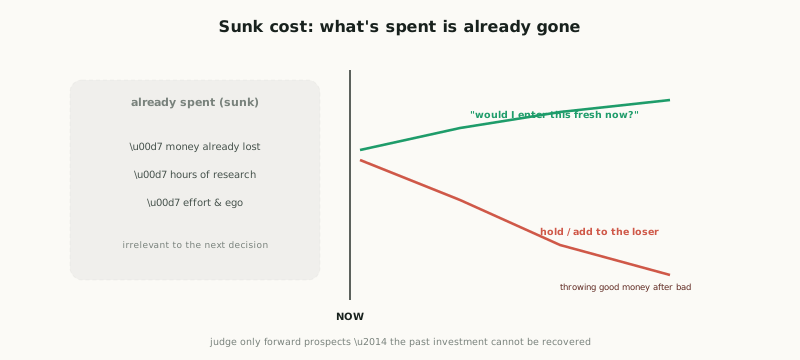
A: Ask only forward-looking questions: 'based on what I know now, would I enter this trade fresh today?' If not, the only thing keeping you in is the sunk cost. Set stop-losses before you enter — when you're unbiased — and honour them, so the in-trade sunk-cost decision is already made. Reframe cutting a loser as preventing a bigger loss, not wasting the existing one, and separate your ego from the trade.
What it is, and how it differs from related biases
The sunk-cost fallacy is continuing or escalating commitment to something because of resources already invested — money, time, effort — that cannot be recovered, rather than judging the decision on its future prospects. The defining truth it ignores is this: the resources you've already spent are gone regardless of what you do next. Whether you hold the losing trade or close it, the loss so far has happened; whether you persevere with the failing strategy or abandon it, the development time is spent. So those past investments are completely irrelevant to the only question that matters going forward — "from here, is this worth doing?" — yet the mind insists on weighing them, producing the urge to "see it through" or "make it back" so the investment "wasn't wasted." In trading this shows up as holding a losing position (or worse, averaging down into it) because of the loss already incurred; staying in a bad trade because of the hours of research you put into the idea; or clinging to a failing strategy because of the time and money invested in building it. In every case, an unrecoverable past cost is being allowed to drive a forward decision — which is precisely the error.
It's worth distinguishing the sunk-cost fallacy from the related biases it travels with, because they're often blurred together. Loss aversion is the underlying emotional fact that losses hurt roughly twice as much as equivalent gains feel good — the raw weighting that makes losses so hard to accept. The disposition effect is the resulting behaviour pattern: selling winners too early and holding losers too long. The sunk-cost fallacy is the specific reasoning error that rationalises the holding — the faulty logic of factoring already-spent resources into the decision. And anchoring to your entry price supplies the reference ("breakeven") around which sunk-cost thinking organises itself. They reinforce one another into a powerful trap: loss aversion makes the loss painful, anchoring fixes attention on breakeven, and the sunk-cost fallacy supplies the justifying story — "I've come this far, I can't quit now."
Why it's so destructive, and how to escape it
The sunk-cost fallacy is destructive because it is the engine of the single most damaging mistake in trading: letting a small, planned loss grow into a large, unplanned one. A loss that should have been cut at a sensible stop is instead nursed — "I've already lost £200, selling now makes it real" — and then averaged into, until a routine setback becomes a serious wound. It ties up capital in dead positions (capital that could be working in better trades), and it keeps traders wedded to broken strategies long after the evidence says move on. The escape is a disciplined shift to forward-looking decision-making. The master question is: "Based on what I know right now, would I enter this trade fresh today, at this price?" If the answer is no, then the only reason you're still in it is the sunk cost — and that's not a reason at all. Set your stop-loss before you enter, while you're calm and unbiased, and then honour it: a pre-committed stop removes the in-trade sunk-cost decision entirely, because you made the call before the bias could take hold (this is a core reason stops exist — see how to set a stop-loss). Reframe the act of cutting a loser: you are not "wasting" the loss by closing — the loss already exists — you are preventing a bigger one, which is a win, not a waste. And separate your ego from the trade: a closed loser is a routine cost of doing business, not a personal failure or an admission you must avoid (the link to ego is direct). Apply the same forward logic to strategies and even to your trading career: judge by future expectancy, not by what you've already poured in. The honest framing: the sunk-cost fallacy is escalating commitment because of resources already invested that can't be recovered, instead of judging on future prospects. In trading it's holding or averaging down on a loser because of the loss already incurred, staying in a bad trade because of research effort, or clinging to a failing strategy because of time invested. It's distinct from loss aversion (the emotional weight) and the disposition effect (the resulting pattern): sunk cost is the specific error of letting already-spent resources drive a forward decision. It's costly because what's spent is gone regardless — only forward prospects matter — and it turns small losses into large ones. Counter it by asking only forward questions ("would I enter this fresh now?"), honouring pre-set stops, reframing a cut loss as preventing a bigger one, and separating ego from the decision.
Sunk cost beyond the single trade
The sunk-cost fallacy operates at every scale of a trading life, not just inside one position — and the larger scales can be the more insidious, because the sunk costs are so much greater. At the strategy level, a trader who has spent months building and refining an approach can cling to it long after the evidence says it doesn't work, reasoning "I've put too much into this to abandon it now" — pouring more time into a method whose forward expectancy is poor, purely to honour the time already spent. At the career level, the trap is graver still: someone who has traded unprofitably for years, taking real financial and emotional losses, can feel unable to step back precisely because of how much they've invested — "I can't quit, look at everything I've sacrificed" — which is the sunk-cost fallacy writ large, keeping a person committed to a path by the very losses that should prompt a clear-eyed reassessment. The cruel logic is identical to the single trade: the years, money and effort are gone regardless, so they cannot rationally bear on the forward question of whether continuing is the best use of time and capital from here.
The healthy reframe, at every scale, is to treat each decision as a fresh forward choice and to recast past investment as education rather than obligation. The months on a failed strategy weren't "wasted" if they taught you what doesn't work — that's tuition, and tuition doesn't obligate you to keep paying. The point isn't that persistence is bad (trading genuinely rewards perseverance through normal drawdowns and the slow learning curve); it's that persistence must be justified by forward prospects, not by backward investment. The honest question scales cleanly: for a trade, "would I enter this fresh now?"; for a strategy, "judged only on its future expectancy, is this worth trading?"; for the career, "setting aside what I've already put in, is continuing the best forward choice for me?" Answering honestly sometimes means cutting a trade, sometimes retiring a strategy, occasionally stepping back from trading itself — and in each case, freeing yourself from the sunk cost is not a defeat but a return to rational, forward-looking decision-making, which is the only kind that ever serves you.
The sunk-cost fallacy is escalating commitment because of resources already invested (money, time, effort) that can't be recovered — instead of judging on future prospects. In trading: holding or averaging down on a loser because of the loss already taken, or clinging to a bad trade/strategy because of the effort spent. It's distinct from loss aversion (the emotional weight) and the disposition effect (the behaviour pattern): sunk cost is the reasoning error of letting spent resources drive the decision. It's destructive because what's spent is gone regardless — it turns small losses into large ones, the cardinal trading sin. Escape it: ask "would I enter this trade fresh now?"; set stops before entry and honour them; reframe cutting a loser as preventing a bigger loss, not wasting the existing one; and keep ego out of it. The past investment is not a reason — only the future is.