Price pushes to a fresh new high — but the oscillator beneath it quietly makes a lower one. That disagreement is divergence, and it hints that the momentum driving the move is fading even as price still climbs. It's one of the most valuable warning signals in technical analysis, and — if traded naively on its own — one of the most notorious traps. This guide explains divergence: what it is, the difference between regular and hidden divergence, which tools spot it, and the crucial caveat that divergence can persist.
It's read using momentum oscillators like the RSI, MACD and stochastic, and like everything it's strongest used with confluence.
Key takeaways
Q: What is divergence in trading?
A: Divergence is when price and a momentum oscillator (such as the RSI, MACD or stochastic) move in disagreeing directions. For example, price makes a higher high while the oscillator makes a lower high. It signals that the momentum behind the move is weakening, hinting at a potential reversal (regular divergence) or, in other configurations, trend continuation (hidden divergence).
Q: What's the difference between regular and hidden divergence?
A: Regular divergence signals potential reversal: bearish regular is a higher high in price but a lower high in the oscillator (fading up-momentum); bullish regular is a lower low in price but a higher low in the oscillator (fading down-momentum). Hidden divergence signals continuation: bullish hidden is a higher low in price with a lower low in the oscillator; bearish hidden is a lower high in price with a higher high in the oscillator.
Q: Is divergence a reliable signal?
A: It's a useful warning, not a reliable standalone signal — and this matters. Divergence can persist for a long time: price can keep making new highs while divergence shows, as momentum wanes and re-accelerates repeatedly before any reversal (if one ever comes). So divergence is a heads-up that momentum is shifting, not a precise timing tool, and it should always be used with confirmation rather than traded alone against the trend.
What it is, and the four types
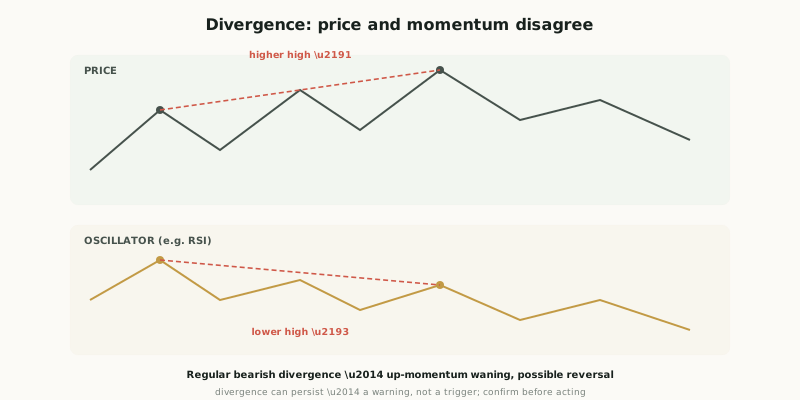
Divergence occurs when price and a momentum oscillator move in disagreeing directions — the indicator failing to "confirm" what price is doing, which suggests the underlying momentum is shifting. There are two families, each with a bullish and bearish form.
| Type | Price | Oscillator | Signals |
|---|---|---|---|
| Regular bearish | Higher high | Lower high | Reversal down |
| Regular bullish | Lower low | Higher low | Reversal up |
| Hidden bullish | Higher low | Lower low | Uptrend continues |
| Hidden bearish | Lower high | Higher high | Downtrend continues |
Regular (classic) divergence warns of a potential reversal. In bearish regular divergence, price makes a higher high but the oscillator makes a lower high — the rally is reaching new heights on weakening momentum, hinting at a turn down. In bullish regular divergence, price makes a lower low while the oscillator makes a higher low — the decline is pressing lower on fading selling momentum, hinting at a turn up. Hidden divergence signals trend continuation and is read in the context of an existing trend. Bullish hidden divergence (in an uptrend) shows price making a higher low while the oscillator makes a lower low — a healthy pullback that suggests the uptrend will resume. Bearish hidden divergence (in a downtrend) shows price making a lower high while the oscillator makes a higher high — suggesting the downtrend will continue. Divergence can be spotted on essentially any momentum oscillator — the RSI and MACD are the most popular, with the stochastic and CCI also common.
Using it well — and why it can persist
Divergence is genuinely useful as a heads-up that the momentum behind a move is shifting — a reason to pay closer attention, tighten a stop, or watch for a reversal setup. But there is one caveat so important it overrides everything else: divergence can persist. Price can keep making new highs (or lows) while divergence shows on the oscillator — sometimes for a very long time — as momentum wanes, re-accelerates, and wanes again, before any reversal arrives, if one ever does. A strong trend can display divergence repeatedly and simply keep going. This is why seasoned traders warn that divergence is not a timing tool, and why trading it blindly counter-trend — shorting every bearish divergence in a roaring uptrend — is a well-known way to suffer a string of losses (the old line that a market "can stay irrational longer than you can stay solvent" applies). The correct use is as a warning that requires confirmation: wait for price itself to do something — a break of a trendline or structure, a reversal candlestick, a move below a swing low — before acting on the divergence, so you're trading the actual turn rather than merely the anticipation of one. Divergence is also somewhat subjective (which swing points you compare affects what you see), reinforcing the need to treat it as one input among several. Used as a heads-up combined with confirmation and confluence, divergence is a valuable addition to the toolkit; used as a standalone trigger, it's a trap. The honest framing: divergence is when price and a momentum oscillator (RSI, MACD, stochastic) disagree. Regular divergence warns of reversal: bearish = price higher high but oscillator lower high (waning up-momentum); bullish = price lower low but oscillator higher low (waning down-momentum). Hidden divergence signals continuation: bullish hidden = price higher low, oscillator lower low; bearish hidden = price lower high, oscillator higher high. It's a useful heads-up that momentum is shifting, but the critical caveat is that divergence can persist — price can keep trending while it shows — so it's NOT a timing tool and must be used WITH confirmation (a reversal candle, a structure break), never traded blindly counter-trend. A valuable warning, not a trigger; manage risk.
Using divergence in practice
Putting divergence to work well is a disciplined, multi-step process — precisely because the signal alone is unreliable. A sound sequence runs roughly as follows. First, establish context: know the trend and where price sits within it, because that determines whether you're even looking for a reversal (regular divergence) or a continuation (hidden divergence), and divergence at a significant level (a major support/resistance zone, a trendline, a prior high) is far more meaningful than divergence in the middle of nowhere. Second, spot the divergence on your chosen oscillator — comparing the same swing points on price and the indicator — and be honest about whether the disagreement is clear or whether you're forcing it by cherry-picking swings. Third, and most importantly, wait for confirmation: divergence is the heads-up, not the trigger, so you hold off until price itself acts — a break of a trendline or short-term structure, a reversal candlestick at the level, a move through a swing point. Fourth, define risk: place your stop beyond the recent extreme (the higher high that formed the bearish divergence, say), so that if price simply continues — the persistence problem — you're out for a controlled loss.
A concrete example makes the sequence vivid. Suppose a pair has been falling and reaches a major support zone; price prints a lower low, but the RSI prints a higher low — regular bullish divergence, hinting that selling momentum is exhausting right at support. The undisciplined trader buys immediately on the divergence and gets run over if the downtrend resumes. The disciplined trader instead waits: they watch for price to confirm by, say, breaking the minor downtrend line or closing above the previous swing high, then enters long, placing the stop just below the recent low and the support zone, and targets the next resistance. The divergence flagged the opportunity; the confirmation timed it; the stop contained the risk if the flag was false. This is the template for using divergence soundly, and it directly addresses the failure modes: the persistence problem (handled by waiting for confirmation and stopping out if wrong), the subjectivity (handled by demanding clear, same-swing divergence at a meaningful level), and the temptation to trade it counter-trend in isolation (handled by requiring price confirmation). Used this way — as one input that initiates a watch, confirmed by price and contained by risk management — divergence adds genuine edge; used as a standalone reason to fade a trend, it remains the trap that catches countless traders. The honest reminder stands: it warns, it does not time, and price always has the final say.
Which oscillator should you use?
A common question is which indicator is "best" for spotting divergence — and the honest answer is that it matters less than people think. The RSI is probably the most popular choice and works well; the MACD (particularly its histogram) is also widely used and some prefer it for trending markets; the stochastic and CCI are common too. They're all momentum oscillators, and divergence on any of them conveys the same essential message — that the force behind a price move is fading. What matters far more than the specific tool is consistency and not indicator-shopping: pick one oscillator you understand, learn how divergence looks on it, and apply it consistently, rather than flicking between indicators until one happens to show the divergence you were hoping to find (a classic confirmation-bias trap). It's also unwise to clutter a chart with several oscillators hunting for any divergence on any of them — that manufactures signals rather than finding them. One well-understood oscillator, applied consistently and confirmed by price, beats a screen full of them.
Divergence is when price and a momentum oscillator (RSI, MACD, stochastic) disagree. Regular divergence warns of reversal: bearish = price higher high, oscillator lower high (waning up-momentum); bullish = price lower low, oscillator higher low. Hidden divergence signals continuation: bullish hidden = price higher low, oscillator lower low; bearish hidden = price lower high, oscillator higher high. The critical caveat: divergence can persist — price can keep trending while it shows, for a long time — so it is not a timing tool. Treat it as a warning that momentum is shifting, and act only with confirmation (a reversal candle, a break of structure or a trendline), never blindly counter-trend. A valuable heads-up combined with confluence — a trap when traded alone; manage risk.