Few beginner questions are asked more often — or answered worse online — than "do I pay tax on forex?" The honest answer is the one the hype-merchants skip: it depends, heavily, on where you live, how you trade, and your personal circumstances. This guide gives the general picture of forex and tax, uses the UK as an illustrative example, and — importantly — explains why you should get proper professional advice rather than rely on a website. None of what follows is tax advice.
It connects directly to the vehicle you trade (which strongly affects tax) and to keeping good records via a trading journal.
Key takeaways
Q: Do you pay tax on forex trading?
A: In most countries, profits from forex trading are taxable, but exactly how depends on your jurisdiction, the vehicle you trade and your personal status. Profits might be treated as capital gains, as income, or (for some products in some countries) be tax-free for individuals. Because the rules vary so much and change over time, this is general information only — you should check your own tax authority's rules and consult a qualified professional.
Q: How is forex taxed in the UK?
A: As a general example only: in the UK, spread betting profits are typically free of capital gains tax for individuals (because it's classed as betting), while CFD and spot forex profits are generally subject to capital gains tax, and in some circumstances trading could be treated as taxable income. Allowances, rates and rules change and depend on your circumstances, so confirm the current position with HMRC guidance and a professional.
Q: Do I need to keep records of my forex trades for tax?
A: Yes — good record-keeping is essential almost everywhere. Keep clear records of your trades, profits, losses, dates and the vehicle used, as your tax authority will generally expect you to report and substantiate your trading results. A trading journal and your broker's statements help, and accurate records make filing far easier and protect you if your return is ever questioned. A tax professional can advise on exactly what to keep.
Why it depends
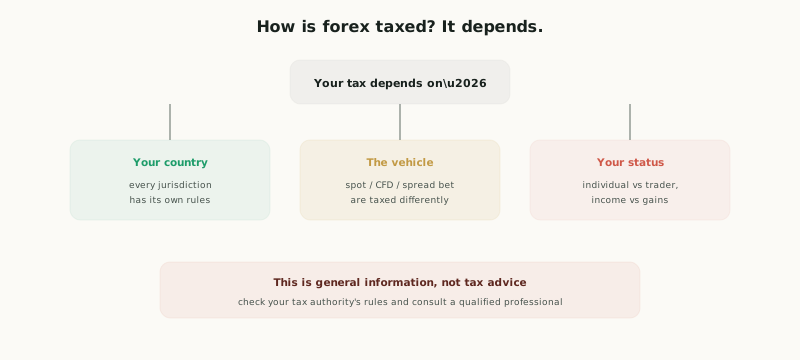
There's no single global answer to forex taxation, because three things shape it. Your country: every jurisdiction has its own tax system and its own treatment of trading profits — what's true in the UK may be entirely different in the US, Australia, India or anywhere else. The vehicle you trade: as covered in ways to trade forex, the product matters — spot FX, CFDs, spread betting and futures can be taxed quite differently even in the same country. Your status and circumstances: whether your trading is treated as occasional investing or as a trade/business, your other income, your residency, and your total gains all affect the outcome — profits might be taxed as capital gains, as income, or (for certain products in certain places) be tax-free for individuals. In most countries, trading profits are taxable in some form, but the how varies enormously, which is exactly why generic online answers are so often wrong for any specific person.
Using the UK as an illustrative example (general information, not advice, and subject to change): UK spread betting profits are typically free of capital gains tax for individuals, because spread betting is classed as betting rather than investing — a major reason it's popular with UK retail traders. CFD and spot forex profits, by contrast, are generally subject to capital gains tax, and in some circumstances frequent, business-like trading could be treated as taxable income. Allowances, rates and thresholds change from year to year and depend on your overall situation. This UK sketch shows how much the vehicle alone can change the tax picture — but it's only an example, and even within the UK your personal position can differ.
Records, and why to consult a professional
This article is general information only and emphatically not tax (or legal) advice — and that caveat genuinely matters here, more than almost anywhere on this site. Tax rules are complex, jurisdiction-specific, dependent on your personal circumstances, and they change over time, so no website can tell you what you will owe. Getting it wrong has real consequences (underpaying can mean penalties; overpaying is money wasted), and the stakes rise as your trading grows. The responsible approach is twofold: check your own tax authority's official guidance (for example HMRC in the UK, the IRS in the US) for the current rules that apply to your situation, and — especially as profits or complexity grow — consult a qualified tax professional (an accountant or tax adviser) who can assess your specific circumstances. A professional can confirm how your chosen vehicle and status are treated, what allowances apply, and how to file correctly. Treat the cost of good tax advice as part of the cost of trading seriously, not an optional extra.
Whatever your jurisdiction, one practical habit applies almost universally: keep good records. Maintain clear, organised records of your trades, profits, losses, dates and the vehicle used, because your tax authority will generally expect you to report and substantiate your trading results. Your trading journal and your broker's account statements are invaluable here — accurate records make filing far easier, ensure you claim any losses or allowances you're entitled to, and protect you if a return is ever questioned. Start this habit early, even when amounts are small, so you're not scrambling to reconstruct a year's trading at tax time. To summarise honestly: in most countries forex profits are taxable, but how depends on your country, your trading vehicle, and your personal status — profits may be taxed as capital gains, as income, or (for some products, like UK spread betting for individuals) be tax-free. The UK example shows how much the vehicle alone can change things, but it's only an example. Because rules vary, are complex, and change, this is general information, not advice: check your tax authority's guidance and consult a qualified professional, and keep good records of everything from the start. Don't take tax guidance from forums or hype — get it from the official rules and a professional who knows your situation.
Common tax questions to research
While the specifics are for your tax authority and a professional, it helps to know the questions that commonly arise, so you can research them for your situation. The first is income versus capital gains: many jurisdictions tax occasional, investment-style trading as capital gains (often with an annual allowance and specific rates), but may treat frequent, systematic, business-like trading as income (taxed differently, sometimes at higher rates but with different deductions). Which category you fall into can depend on how often you trade, whether it's your main activity, and your jurisdiction's tests — a genuinely consequential distinction worth clarifying. The second is the treatment of losses: in many systems, trading losses can be offset against gains (and sometimes carried forward to future years) to reduce your tax — but the rules are specific, and claiming losses correctly requires good records, so don't assume and don't miss out. The third is your status and residency: where you're tax-resident, your other income, and your overall circumstances all feed in.
Different countries also take genuinely different approaches — the UK example (spread betting typically CGT-free for individuals, CFDs/spot generally subject to CGT) is just one model; other countries have their own systems, some with special regimes for certain instruments, others treating most trading as ordinary income, and a few with very favourable or very strict treatment. This variety is exactly why a generic answer is useless for any specific person, and why the two anchors remain: check your own tax authority's official guidance and consult a qualified professional for your circumstances. On the practical side, the universal habit is meticulous record-keeping from day one: log every trade's date, instrument, size, entry/exit and profit or loss, keep your broker's annual statements, and retain anything your authority might require — your journal doubles as a useful tax record. Good records make filing straightforward, ensure you claim allowances and loss offsets you're entitled to, and protect you if questioned. The bottom line for a beginner: don't ignore tax (it's a real obligation in most places once you're profitable), don't take tax guidance from forums or hype, start keeping records immediately, and get professional advice as your trading grows — treating it as part of trading responsibly. The honest reminder: research the common questions — income vs capital gains, how losses are treated, your status/residency — for your own jurisdiction; approaches vary widely by country; and the anchors stay the same: check official guidance, consult a professional, and keep meticulous records from the start. This is general information, not tax advice.
A final word of encouragement amid the caveats: tax shouldn't be a source of dread, just a responsibility to handle properly. Most traders find that once they understand their jurisdiction's basic treatment and keep tidy records, the actual compliance is manageable — and the cost of a good accountant, once you're trading meaningful sums, is money well spent for the peace of mind and the allowances correctly claimed. Build the habits early, get advice suited to your situation, and tax becomes a routine part of trading rather than a looming worry. Just remember, one more time: the specifics here are for your tax authority and a professional, not a website.
Whether and how you pay tax on forex depends on three things: your country (every jurisdiction differs), the vehicle you trade (spot/CFD/spread bet/futures are taxed differently), and your status (capital gains vs income vs, for some products, tax-free). In most countries trading profits are taxable in some form. UK example (general, not advice): spread betting is typically CGT-free for individuals, while CFDs and spot forex are generally subject to CGT. Because the rules are complex, jurisdiction-specific and change, this is general information, not tax advice: check your tax authority's official guidance (e.g. HMRC, the IRS) and consult a qualified professional, especially as profits grow. And keep good records of all trades from the start — your journal and broker statements make filing and substantiating far easier.