Most beginners assume "trading forex" is one single thing. It isn't. There are several different vehicles for accessing the same underlying currency moves — spot FX, CFDs, spread betting, futures — each with its own mechanics, costs, regulation and tax treatment. Knowing the difference matters, because it affects what you pay, how you're taxed, and what's even available to you where you live. This guide explains the main ways to trade forex, how they compare, and the risk warning that applies to all of them.
It builds on how brokers work and the role of leverage, and connects directly to forex and tax.
Key takeaways
Q: What are the main ways to trade forex?
A: Retail traders typically access forex through four vehicles: spot FX (trading the exchange rate directly, usually leveraged), CFDs (contracts for difference, where you trade the price change without owning the currency), spread betting (betting a stake per point of movement, available mainly in the UK and Ireland), and futures (standardised exchange-traded contracts, more used by professionals). All let you speculate on currency moves, but with different mechanics, costs and tax treatment.
Q: What's the difference between CFDs and spread betting?
A: Both are leveraged derivatives that let you profit from price moves without owning the underlying currency, and they're very similar in practice. The main differences are structural and tax-related: with a CFD you trade a contract sized in units, while with spread betting you bet a stake per point of movement. In the UK, spread betting profits are often free of capital gains tax for individuals while CFD profits are typically subject to it — though tax treatment varies and isn't advice.
Q: Which way of trading forex is best for beginners?
A: There's no single 'best' — it depends on your country, goals and the tax and regulatory environment. Most retail beginners use spot FX, CFDs or (in the UK) spread betting via a regulated broker, as these are accessible with small accounts. The crucial point is that all of these are leveraged products carrying high risk — most retail accounts lose money — so understanding the risks and choosing a properly regulated provider matters far more than the specific vehicle.
The four vehicles compared
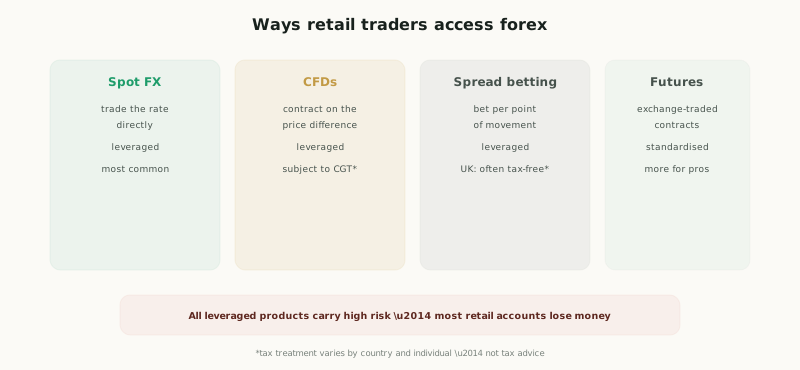
Each vehicle lets you speculate on currency price moves, but they differ in how they're structured. The table compares the essentials.
| Vehicle | How it works | Notes |
|---|---|---|
| Spot FX | Trade the rate directly, leveraged | Most common retail route |
| CFDs | Contract on the price difference | No ownership; often subject to CGT* |
| Spread betting | Bet a stake per point of movement | UK/Ireland; often tax-free for individuals* |
| Futures | Standardised exchange-traded contracts | Centralised; more used by professionals |
Spot FX is the most common retail route: you trade the exchange rate directly, typically with leverage, through a forex broker — buying or selling a currency pair to profit from its movement. CFDs (contracts for difference) are derivatives where you trade a contract on the price difference between when you open and close, without owning the underlying currency — leveraged, flexible, and widely offered. Spread betting (available mainly in the UK and Ireland) is structurally similar but framed as a bet: you stake an amount per point of movement, with profit or loss scaling by how far price moves — also leveraged. Futures are standardised, exchange-traded contracts to exchange currency at a set price and date; they're centralised and transparent but generally more used by professionals and larger traders than retail beginners. CFDs and spread betting are by far the most common ways UK retail traders speculate on forex, with spot FX accounts also widespread; the key practical differences between CFDs and spread betting are largely structural and tax-related rather than functional.
The risk warning, and choosing
Before any comparison of which vehicle suits you, one point overrides everything: all of these are leveraged products that carry high risk, and most retail accounts lose money. This isn't a throwaway disclaimer — it's the standard, regulator-mandated warning precisely because it's true: the large majority of retail traders using leveraged forex/CFD products lose, often because leverage magnifies losses as readily as gains. So whichever vehicle you choose, the priority is understanding the risk and applying serious risk management — the vehicle is far less important than how you manage the risk within it. Leverage means you can lose money rapidly, and on some products potentially more than you deposit (though many regulated brokers now offer negative balance protection limiting losses to your account balance — worth checking).
As for choosing, there's no universally "best" vehicle — it depends on your country (spread betting is a UK/Ireland thing; availability and regulation differ everywhere), your goals, and the tax and regulatory environment. For most retail beginners, the practical choice is spot FX, CFDs, or (in the UK) spread betting via a properly regulated broker, all of which are accessible with small accounts. The tax angle is a genuine consideration — famously, UK spread betting profits are often free of capital gains tax for individuals while CFD profits are typically subject to it — but tax rules vary by jurisdiction and individual circumstances and can change, so treat that as a factor to research rather than a rule (see forex and tax, and note this is general information, not tax advice). Far more important than the vehicle is choosing a regulated, reputable broker (see choosing a broker and beware scams), understanding the leverage risk, and starting small with sound risk management. The honest framing: retail traders access forex through spot FX (trade the rate directly, leveraged — most common), CFDs (contract on the price difference, no ownership, often subject to CGT), spread betting (bet per point, UK/Ireland, often tax-free for individuals), and futures (standardised exchange-traded, more for pros). CFDs and spread betting are very similar, differing mainly in structure and tax. All are leveraged and high-risk — most retail accounts lose money — so risk management matters far more than the vehicle. There's no single best choice; it depends on country, goals and tax/regulation. Prioritise a regulated broker, understanding leverage, and starting small — and treat tax as something to research (not advice), not a given.
Choosing for your situation
Since there's no universally best vehicle, the practical question is which suits your situation — and a few factors guide the choice. Your country is often decisive: spread betting is essentially a UK and Ireland product, so it's simply not an option in much of the world, while CFDs are widely available but actually restricted or banned for retail traders in some jurisdictions (the US, for instance, heavily restricts retail forex/CFD trading and routes much activity through regulated futures and specific FX brokers). So your first filter is what's legally available and properly regulated where you live. Your goals and style matter too: most retail speculators trading smaller accounts gravitate to spot FX, CFDs or spread betting because they're accessible with modest capital and flexible sizing, whereas futures suit larger, more professional traders comfortable with standardised contract sizes and exchange mechanics. And the tax angle, while a real consideration (the UK spread-betting-vs-CFD difference being the classic example), should be researched for your own circumstances rather than assumed — see forex and tax, remembering that's general information, not advice.
But here's the point that matters most, and it's easy to lose amid the vehicle comparison: the choice of broker and the quality of regulation matter far more than the choice of vehicle. Whichever product you trade, you're trusting a provider with your money, so the priority is selecting a reputable, well-regulated broker (regulated by a respected authority, segregating client funds, with a solid track record) over any consideration of spot-versus-CFD-versus-spread-bet — a great vehicle with a dodgy, unregulated broker is a recipe for disaster, while a sound regulated broker makes any of the mainstream vehicles workable (see choosing a broker and beware scams, which often masquerade as brokers). Equally, the leverage and risk are common to all these products, so your risk management — sizing small, using stops, the 1% rule — is what actually determines your survival, not the vehicle label. So the sensible decision process is: check what's available and regulated in your country, pick a reputable regulated broker, understand the leverage risk, consider the tax position for your circumstances, and start small — with the specific vehicle being the last and least important decision, not the first. The honest reminder: choose your vehicle by what's legally available and regulated in your country, your goals, and (researched, not assumed) the tax position — but remember the broker's quality and regulation, and your own risk management, matter far more than which of spot/CFD/spread-bet/futures you pick.
In short, don't over-think the vehicle. For most beginners, the realistic options come down to spot FX, CFDs or (in the UK) spread betting through a regulated broker, and the differences between them — while real, especially on tax — are far less important than getting the fundamentals right: a trustworthy regulated provider, a clear understanding that leverage cuts both ways, small position sizes, and disciplined risk management. Pick the mainstream vehicle that's available and sensible for your country and tax position, then put your real energy into learning to trade well within it. The vehicle is the container; how you trade is what fills it.
Retail traders access forex through four main vehicles: spot FX (trade the rate directly, leveraged — most common), CFDs (a contract on the price difference, no ownership, often subject to CGT*), spread betting (bet a stake per point — UK/Ireland, often tax-free for individuals*), and futures (standardised, exchange-traded, more for professionals). CFDs and spread betting are very similar, differing mainly in structure and tax. The overriding point: all are leveraged and high-risk — most retail accounts lose money — so risk management matters far more than which vehicle you pick. There's no single "best"; it depends on your country, goals and the tax/regulatory setup. Prioritise a regulated, reputable broker, understanding leverage, and starting small. *Tax treatment varies by jurisdiction and individual — research it (see forex and tax); this isn't tax advice.