
Central banks don't just change interest rates — they talk about what they intend to do next. This "forward guidance" can move currencies as powerfully as the rate decisions themselves, because markets price the expected future, not just the present. Understanding it explains why a currency can lurch on words alone — a speech, a statement, a shift in tone — with no actual change in policy. This guide explains forward guidance: what it is, why the currency moves on the guidance rather than the action, and why credibility is everything.
It's a core part of how central banks and monetary policy work, sits alongside the hawkish vs dovish spectrum, and drives central-bank divergence.
Key takeaways
Q: What is forward guidance?
A: Forward guidance is communication by a central bank about its likely future monetary policy — signalling, for example, that it expects to keep rates low for a long time, or that further hikes are coming. By shaping market expectations of future policy, the central bank can influence financial conditions and the currency now, without necessarily changing rates today. It became a prominent tool after the 2008 crisis, when rates were already near zero.
Q: Why does the currency move on guidance rather than the actual decision?
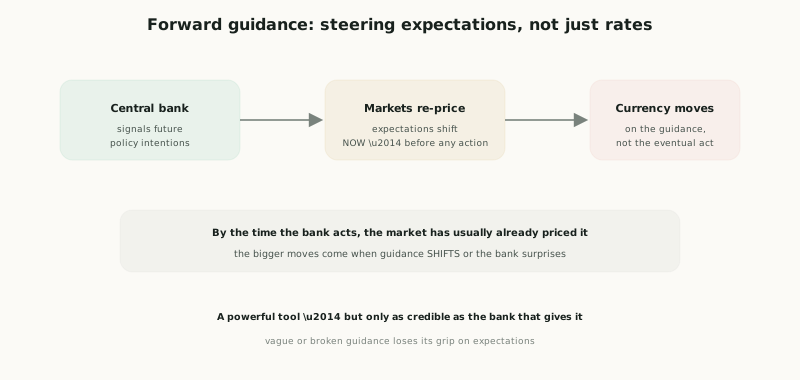
A: Because markets are forward-looking and price in expectations ahead of time. If a central bank clearly signals a coming rate hike, traders adjust their positions immediately, so by the time the hike actually happens it's already largely 'priced in' and may cause little further movement. The bigger currency moves tend to come when guidance shifts, when the bank surprises the market, or when the actual decision differs from what was guided.
Q: What makes forward guidance effective or ineffective?
A: Credibility. Guidance works only if markets believe the central bank will follow through — a credible bank can steer expectations with words alone. If a bank's guidance proves unreliable, is too vague, or is repeatedly broken, markets stop trusting it and it loses its power. Overly conditional or 'data-dependent' guidance can also leave markets guessing. The tool is only as strong as the institution's reputation behind it.
What it is
Forward guidance is communication by a central bank about its likely future monetary policy — signalling, for example, that it expects to keep rates low for a long time, that further hikes are coming, or that policy will respond to certain conditions. The purpose is to shape market expectations of future policy so the bank can influence financial conditions and the currency now, without necessarily changing rates today. It became a prominent tool after the 2008 crisis, when policy rates were already near zero and couldn't easily be cut further — so central banks turned to words (promising to hold rates low, or to do "whatever it takes") to provide further stimulus and steer markets when the conventional lever was exhausted. In effect, forward guidance lets a central bank act on the economy through expectations: by credibly telling markets what it will do, it changes behaviour today.
Why the currency moves on the guidance
The reason forward guidance is so powerful comes down to a fundamental truth about markets: they are forward-looking and price in expectations ahead of time. If a central bank clearly signals a coming rate hike, traders don't wait for the hike — they adjust their positions immediately, buying the currency in anticipation of the higher rates to come. So by the time the hike actually happens, it's already largely "priced in," and the decision itself may cause little further movement (or even a counter-move, if the market had expected more). This is why a currency can rally hard on a speech or a change of wording while barely reacting to the eventual rate change — the information (the shift in expected policy) arrived with the guidance, not the act. It also explains the trader's adage to "buy the rumour, sell the fact": the move happens as expectations form, and the confirmed event can be an anticlimax. The practical consequence is that the biggest currency moves around central banks tend to come not from decisions that match expectations, but from shifts in guidance, from the bank surprising the market (saying something more hawkish or dovish than expected), or from the actual decision differing from what was guided. To read central-bank effects on currencies, you have to think in terms of expectations versus reality: what was already priced, and how the new information changes the expected path — not the headline number alone.
Why credibility is everything
Forward guidance has one absolute prerequisite: credibility. It works only if markets believe the central bank will follow through on what it signals — a credible bank can steer expectations (and the currency) with words alone, because traders treat its guidance as a reliable forecast and act on it. But if a bank's guidance proves unreliable — it guides one thing and does another, or its forecasts are repeatedly wrong — markets stop trusting it, and the guidance loses its power (words from a bank that doesn't follow through move nothing). This is why central banks guard their credibility so carefully: it's the entire foundation of the tool. There are subtler failure modes too. Guidance that is too vague or overly conditional — hedged with so many caveats, or so dependent on incoming data ("we'll be data-dependent"), that it commits to nothing — can leave markets guessing, which both blunts its steering effect and can increase volatility as traders react to every data point trying to infer the bank's intentions. There's a genuine tension here: explicit, committal guidance steers powerfully but ties the bank's hands (awkward if conditions change), while flexible, conditional guidance preserves the bank's freedom but steers weakly — so central banks constantly balance commitment against flexibility. For traders, the upshot is to watch the guidance closely, to gauge how credible and how committal it is, and to remember that the market's reaction depends on how the guidance changes expectations relative to what was already believed. As with all fundamental analysis, this is context for understanding why currencies move, not a precise timing signal — guidance can shift suddenly, banks can surprise, and the interplay of expectation and reality is complex — so combine it with sound risk management and respect that central-bank communication, while hugely important, is just one (powerful) input. The honest framing: forward guidance is a central bank communicating its likely future policy to steer market expectations — and through them, financial conditions and the currency — now, prominent since 2008's near-zero rates. Because markets are forward-looking and price expectations ahead of time, the currency moves on the guidance itself (the action, once it matches, is largely priced in), so the biggest moves come from shifts and surprises in guidance, judged against what was already expected. And it all rests on credibility: guidance works only if markets believe the bank will follow through; vague, over-conditional or broken guidance loses its grip.
Types and forms of guidance
Forward guidance comes in several forms, and the form matters because it determines how firmly the bank is committing and how markets parse it. Calendar-based (time-contingent) guidance ties policy to a date — "we expect to keep rates low until at least [a given period]" — which is simple but rigid (awkward if the economy changes before the date). State-based (threshold) guidance ties policy to economic conditions instead — "rates will stay low until unemployment falls below X% or inflation rises above Y%" — which is more flexible and arguably more credible (it responds to the economy, not the calendar), at the cost of being harder for markets to pin down. Qualitative / open-ended guidance uses words about the likely path ("rates will rise gradually," "patient," "data-dependent") without firm commitments. And many banks publish projections — most famously the Federal Reserve's "dot plot" of individual policymakers' rate forecasts — which markets scrutinise intently as a window into the expected path.
Economists also distinguish Odyssean from Delphic guidance: Odyssean guidance is a genuine commitment (the bank "ties itself to the mast," promising to follow a path even if tempted to deviate), which steers powerfully precisely because it binds; Delphic guidance is merely a forecast of what the bank expects to do (like the Delphic oracle's prophecy), which informs but doesn't commit. The distinction matters because a commitment moves markets more than a forecast — and markets work hard to tell which they're being given. The drift toward "data-dependent" language in recent years is essentially a move toward flexible, Delphic guidance, which preserves the bank's freedom but reintroduces uncertainty (markets must now react to every data point to infer the bank's likely move, which can raise volatility around releases). For traders, the practical skill is to read the form: is the guidance committal (Odyssean) or just a forecast (Delphic)? Calendar, threshold or vague? And how does the latest communication change the expected path versus what was priced? The honest reminder: forward guidance comes in forms — calendar-based (tied to a date), state-based (tied to thresholds like unemployment/inflation), qualitative/open-ended, and projections like the Fed's dot plot — and economists distinguish Odyssean (binding commitment, steers powerfully) from Delphic (mere forecast, informs only); the shift to flexible "data-dependent" guidance preserves the bank's freedom but reintroduces uncertainty, so read which form you're given and how it changes the expected path.
Forward guidance is a central bank communicating its likely future policy to steer market expectations — and through them, financial conditions and the currency — now (prominent since 2008's near-zero rates left words as a key lever). Because markets are forward-looking and price expectations ahead of time, the currency moves on the guidance itself; by the time the bank acts, a matching move is largely priced in. So the biggest moves come from shifts and surprises in guidance, judged against what was already expected (think expectation vs reality, not the headline alone — "buy the rumour, sell the fact"). And it all rests on credibility: guidance steers only if markets believe the bank will follow through — vague, over-conditional ("data-dependent") or broken guidance loses its grip. Powerful context, not a timing signal — combine with risk management.