
A regular stop-loss makes you a promise — to get you out — but not a promise about what price. When a market gaps (jumps with no trading in between), a normal stop can fill far worse than its level, handing you a loss bigger than you signed up for. A guaranteed stop-loss order closes that hole: it caps your loss at exactly the price you chose, gap or no gap — for a price. This guide explains guaranteed stops: how they work, how they differ from a regular stop, what they cost, and when they're worth it.
It's the answer to the gap risk and slippage that a normal stop-loss can't fully protect against.
Key takeaways
Q: What is a guaranteed stop-loss order?
A: A guaranteed stop-loss order (GSLO) is a stop that your broker guarantees will execute at exactly the price you set, no matter how far or fast the market moves — even through a gap. Unlike a regular stop, which becomes a market order and can fill well beyond your level in a gap or fast move (slippage), a GSLO caps your loss precisely at the chosen price.
Q: How much does a guaranteed stop cost?
A: A GSLO costs an extra premium, charged by the broker for taking on the gap risk. The premium is often built into a slightly wider spread on the order or charged as a separate fee, and is sometimes only payable if the guaranteed stop is actually triggered. The exact cost varies by broker and instrument, and tends to be higher on more volatile or gap-prone markets.
Q: When is a guaranteed stop worth it?
A: When protection against gap risk matters more than the cost — for example holding positions over weekends or major scheduled events (central-bank decisions, elections, data releases) where violent gaps are possible, or trading volatile or less-liquid instruments. For routine intraday trading in deep, liquid markets where gaps are rare, the premium is often an unnecessary expense. It's insurance: valuable against tail events, a drag if over-used.
How it works versus a regular stop
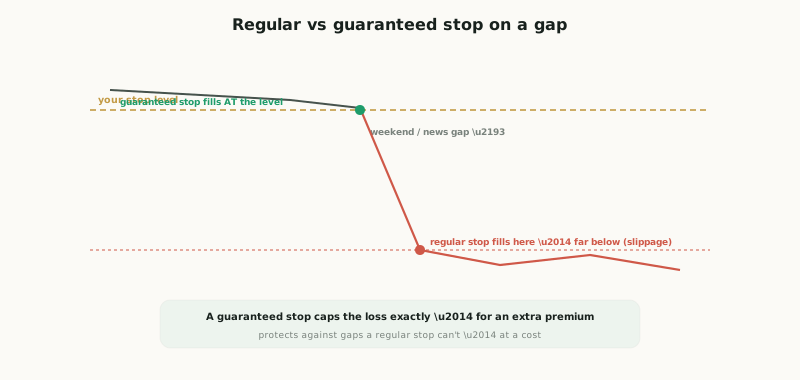
To see the value, recall how a regular stop behaves. A standard stop-loss is not a guarantee of price — it's an instruction that, once your level is reached, becomes a market order to exit at the next available price. In a calm, liquid market that price is usually very close to your level. But in a gap (a weekend re-open, a news shock) or a fast, thin market, the "next available price" can be far worse — your stop fills well beyond its level, a phenomenon called slippage. So a regular stop limits your loss most of the time, but not in exactly the tail scenarios where protection matters most. A guaranteed stop-loss order (GSLO) removes that uncertainty: the broker guarantees execution at precisely your chosen price, however far or fast the market jumps — even straight through a gap — by taking the slippage risk onto themselves.
| Regular stop | Guaranteed stop | |
|---|---|---|
| Fills at your level? | Usually — not in a gap | Always, exactly |
| Slippage risk | Yes (can fill far worse) | None — broker absorbs it |
| Gap protection | No | Yes |
| Cost | Free (normal spread) | Extra premium |
The cost, and when it's worth it
That guarantee isn't free — the broker is selling you insurance against gap risk, and charges a premium for it. The premium may be built into a slightly wider spread on the guaranteed order, charged as a separate fee, or in some models only payable if the GSLO is actually triggered — it varies by broker and instrument, and tends to be higher on more volatile or gap-prone markets (precisely because the broker's risk is greater there). So the practical question is always cost versus benefit: is the protection worth the premium for this trade?
The answer depends on your exposure to gap risk. A GSLO is genuinely valuable when a violent gap is a real possibility and the consequences would be serious: holding over weekends (when forex gaps from Friday close to Sunday/Monday open on news while the market's shut), holding through major scheduled events (central-bank decisions, elections, key data releases that can gap a market), trading volatile or less-liquid instruments, or running a position large enough that a bad gap would do real damage. In those situations, the premium buys certainty against exactly the tail events a regular stop can't handle — and it's the only stop that can cap your loss when price gaps through your level. Conversely, for routine intraday trading in deep, liquid markets where gaps are rare and slippage is typically tiny, paying the premium on every trade is usually an unnecessary drag on returns — you'd be insuring against an event that rarely occurs, and the cumulative cost would erode your edge. The sensible approach treats the GSLO as targeted insurance: deploy it for the genuinely gap-prone situations (weekends, big events, volatile or large positions), and rely on a well-placed regular stop the rest of the time. As with all insurance, it's valuable against the rare disaster and wasteful if over-bought. And note the limits: a GSLO protects against gaps and slippage, not against being wrong — it caps a loss at your level, but you still take that loss, so it's no substitute for sound entries, sizing and the 1% rule. The honest framing: a guaranteed stop-loss order (GSLO) executes at exactly your chosen price no matter how the market moves — even through a gap — unlike a regular stop, which becomes a market order and can fill far worse (slippage) in gaps or fast markets. The broker charges a premium (wider spread or fee, sometimes only if triggered) for absorbing that risk. It's worth it when gap risk is real and serious — holding over weekends or major events, volatile/illiquid markets, large positions — and an unnecessary cost for routine intraday trading in liquid markets where gaps are rare. Targeted insurance: valuable against tail events, a drag if over-used — and it caps the loss, it doesn't stop you being wrong.
When to use one — and the alternatives
It helps to be concrete about when a GSLO earns its premium, and what else achieves similar protection. The classic case for a guaranteed stop is the weekend hold: forex gaps from Friday's close to Sunday/Monday's open on news that breaks while the market is shut, so a position carried over the weekend faces genuine gap risk that only a GSLO can fully cap. The same logic applies to holding through major scheduled events — a central-bank rate decision, an election result, a big data release — where a violent gap is a real possibility. Beyond timing, a GSLO makes sense on volatile or less-liquid instruments (where slippage on a regular stop can be severe) and on large positions (where even a modest gap translates into a painful sum). In each case you're paying a small, certain premium to remove a small-probability but potentially large loss — a sensible insurance trade.
But a GSLO isn't the only way to manage gap risk, and the alternatives are often cheaper or simpler. The most basic is to reduce position size ahead of known gap risk — a smaller position means a smaller loss even if a gap blows through a regular stop, achieving partial protection for free (just less of it). Simpler still is to close or trim positions before the weekend or a major event entirely, sidestepping the gap risk rather than insuring against it — a common discipline among shorter-term traders who simply don't hold through the riskiest windows. More sophisticated traders may use options or other hedges to cap downside, though that adds complexity and cost. There's also a practical note: availability varies — guaranteed stops are offered by many but not all brokers, are more common in some regulatory regions than others, and their exact terms (premium structure, minimum distance from price) differ, so check what your broker actually offers. The sensible synthesis: match the tool to the risk — for routine intraday trading in liquid markets, a well-placed regular stop and sound sizing suffice; for genuine gap exposure (weekends, big events, volatile or large positions), either reduce/close the exposure or pay for a GSLO, choosing whichever balances protection and cost best for the situation. The honest reminder: a GSLO is targeted gap insurance — valuable for weekends, events, volatile markets and large positions — but reducing size or closing before the risk are valid, cheaper alternatives, and availability and terms vary by broker, so match the tool to the actual exposure.
One last framing keeps the GSLO in its proper place: it's insurance, not a crutch. It removes a specific, narrow danger — the gap that blows through a regular stop — but it does nothing to improve your entries, your edge, or your sizing, and it still hands you the full (capped) loss when you're wrong. Used to plug a real gap-risk hole in an otherwise sound process, it's valuable; used to justify holding reckless positions through events "because the stop is guaranteed," it's a false comfort. The guaranteed stop protects the price of your exit, never the wisdom of your trade.
A guaranteed stop-loss order (GSLO) fills at exactly your chosen price — even through a gap — because the broker absorbs the risk. A regular stop becomes a market order and can fill far worse in a gap or fast market (slippage), so it protects you most of the time but not in the tail events that matter most. The GSLO costs an extra premium (wider spread or a fee, sometimes only if triggered), higher on volatile markets. Treat it as targeted insurance: worth it when gap risk is real and serious — holding over weekends or major events, volatile or illiquid markets, large positions — but an unnecessary drag for routine intraday trading in deep, liquid markets. It caps the loss at your level; it does not stop you being wrong — so it complements, never replaces, sound sizing and the 1% rule.