Look at any chart and the right trade seems obvious — of course it was going to bounce there, anyone could see that breakout coming. That feeling is hindsight bias: the mind rewriting the past as predictable. It's one of the most pervasive and sneaky cognitive distortions in trading, because it operates silently — quietly corrupting how you learn from trades and inflating your confidence in ways that hurt. This guide explains hindsight bias: what it is, why it's so harmful, and how to guard against it.
It's a core cognitive bias, a major enemy of honest process-based learning, and a close relative of self-attribution bias.
Key takeaways
Q: What is hindsight bias in trading?
A: Hindsight bias is the tendency to see past events as having been predictable or obvious after they've happened — the 'I knew it all along' effect. In trading, it makes a completed price move look inevitable ('obviously it was going to break out there'), when in reality the outcome was genuinely uncertain at the time. The mind rewrites the past as more predictable than it actually was.
Q: Why is hindsight bias harmful for traders?
A: It corrupts learning and breeds overconfidence. By making past moves seem obvious, it tricks you into thinking you (or your analysis) should have caught them, leading to harsh self-criticism over 'missed' trades that weren't actually clear at the time. It also inflates confidence — if everything looks predictable in hindsight, you overestimate your ability to predict the future, leading to oversized positions and sloppy analysis.
Q: How do you guard against hindsight bias?
A: Record your reasoning before the outcome is known — a trading journal that captures what you actually thought and why at the time, so you can later compare it with reality honestly rather than through a rewritten memory. Acknowledge the genuine uncertainty that existed at each decision point, judge past decisions on the information available then (not the outcome), and stay humble about how 'obvious' anything really was in advance.
What it is
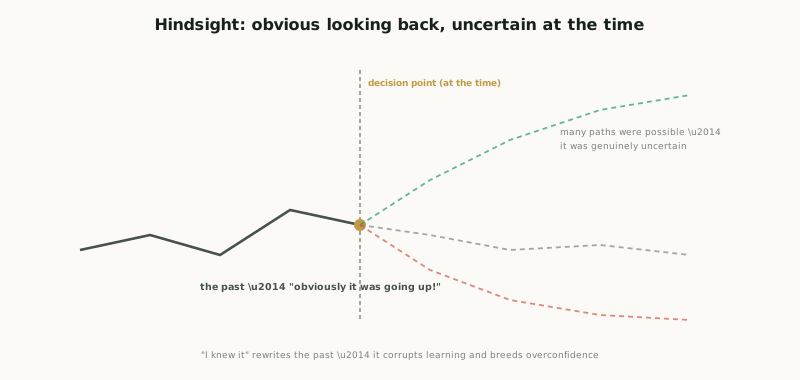
Hindsight bias is the tendency to see past events as having been predictable or obvious after they've happened — the famous "I knew it all along" effect. In trading, it makes a completed price move look inevitable: you study a chart after the fact, see that price bounced cleanly off a level and rallied, and feel that it was obviously going to do that — when, in reality, at the moment of decision the outcome was genuinely uncertain, with several plausible paths the price could have taken. The crucial point is the asymmetry of information: looking back, you know which path actually happened, and your mind retroactively treats that one realised outcome as if it had been the clearly likely one all along, erasing the real uncertainty that existed in the moment.
Hindsight bias at a glance
Why it's harmful, and how to guard against it
Hindsight bias does two distinct kinds of damage. First, it corrupts learning. By making past moves seem obvious, it tricks you into believing you (or your analysis) should have caught them — leading to harsh, unfair self-criticism over "missed" trades that weren't actually clear at the time. You berate yourself for not buying the obvious bottom, when the "obvious bottom" only became obvious after price rallied; in the moment, it looked like it might keep falling. This poisons the learning process: instead of honestly assessing whether your decision was good given what you knew, you judge it against a fantasy in which the outcome was foreseeable, drawing the wrong lessons ("I need to catch these obvious moves") from a premise that's false. Second, it breeds overconfidence. If, in hindsight, everything looks predictable, you come to overestimate your ability to predict the future — "the market is readable, I can see these moves coming" — which leads to overconfidence, oversized positions, and sloppy analysis (why be rigorous if it's all so obvious?). The bias literally manufactures false evidence of your own predictive skill, since your rewritten memories are full of moves you "saw coming" but didn't actually call in advance.
Guarding against hindsight bias rests on one powerful principle: record your reasoning before the outcome is known. This is the single best defence, and it's why a proper trading journal is so valuable — by writing down what you actually thought and why, at the time (your analysis, your expected scenarios, your uncertainty), you create an honest record that your memory cannot later rewrite. When you review it after the outcome, you can compare your real, contemporaneous reasoning with what happened, rather than through the distorting lens of a memory that now "knew" the answer. This makes learning honest: you can see whether your decision was sound given the information available then, which is the only fair standard (the heart of process-over-outcome thinking — judge the decision, not the result). Beyond journaling, the mindset defences are: actively acknowledge the genuine uncertainty that existed at each decision point (remind yourself that many paths were possible, even though one happened); judge past decisions on the information available at the time, not on the outcome you now know; and stay humble about how "obvious" anything really was in advance — if it were truly obvious, everyone would have traded it and the move wouldn't exist. A useful habit is, before a trade resolves, to explicitly note the range of things that could happen and roughly how likely each seems; this anchors you in the real uncertainty and makes the later "it was obvious" feeling easier to dismiss. Seeing through hindsight bias keeps your learning truthful and your confidence calibrated — you stop punishing yourself for not predicting the unpredictable, and stop fooling yourself that you can. The honest framing: hindsight bias is seeing past moves as obvious or predictable after the fact — the "I knew it all along" illusion that erases the real uncertainty that existed at the time. It harms you twice: it corrupts learning (false self-criticism over "missed" trades that weren't clear in the moment, drawing wrong lessons) and breeds overconfidence (everything looks predictable, so you overrate your forecasting and oversize). Guard against it by recording your reasoning before outcomes are known (a journal), acknowledging the genuine uncertainty at each decision, judging decisions on the information available then (not the result), and staying humble about how "obvious" anything truly was.
The journal as the antidote
Because hindsight bias works by rewriting your memory, the only reliable defence is to fix your reasoning in writing before the outcome is known — which is what makes the trading journal the single most powerful tool against it. A journal entry written at the time of the trade should capture your actual thesis (why you took the trade), the scenarios you saw as possible (and roughly how likely each felt), your confidence level, and your invalidation point (what would prove you wrong). Crucially, this record is immune to later rewriting: when you review it after the outcome, you confront what you genuinely thought — including the uncertainty and the scenarios that didn't happen — rather than the airbrushed "I knew it" version your memory now offers. This turns review from a self-deceiving exercise into an honest one.
With that honest record, you can do the most important piece of real learning: separate the quality of the decision from the quality of the outcome. The four combinations matter — a good decision can produce a bad outcome (an unlucky loss on a sound trade), and a bad decision can produce a good outcome (a lucky win on a reckless trade) — and hindsight bias blurs exactly this distinction, tempting you to praise lucky wins and condemn unlucky losses, learning the wrong lessons from both. A journal lets you judge the decision on its own merits, given what you knew at the time (the essence of process over outcome): you can recognise a well-reasoned trade that simply lost as a good trade to repeat, and a reckless trade that happened to win as a bad habit to stop — the opposite of what hindsight bias would have you conclude. This is how you build calibrated confidence (grounded in your real, recorded hit rate, not a memory inflated by hindsight) and genuine skill. The broader posture is humility about market predictability: if you find yourself thinking past moves were obvious, remind yourself that if they truly were, everyone would have traded them and the move wouldn't exist — the market's moves look inevitable only in the rear-view mirror. Stay humble about what's knowable in advance, let your written record (not your memory) be the judge, and your learning stays truthful. The honest reminder: the journal is the antidote — record your thesis, scenarios, confidence and invalidation before the outcome, so your memory can't rewrite them; then separate decision quality from outcome quality (good decisions can lose, bad ones can win), judging each trade on what you knew at the time to build calibrated confidence and real skill, while staying humble that moves look obvious only in hindsight.
Hindsight bias is seeing past moves as obvious or predictable after the fact — the "I knew it all along" illusion that erases the real uncertainty that existed at the time (when many paths were genuinely possible). It harms you twice: it corrupts learning (unfair self-criticism over "missed" trades that weren't clear in the moment, teaching the wrong lessons) and breeds overconfidence (if everything looks predictable, you overrate your forecasting and oversize). Guard against it: record your reasoning before the outcome is known (a journal your memory can't rewrite), acknowledge the genuine uncertainty at each decision, judge decisions on the information available then not the result (process over outcome), and stay humble about how "obvious" anything truly was — if it were, the move wouldn't exist.