
When you win, it's your skill. When you lose, it's bad luck, or the market's fault, or the news. That comforting asymmetry has a name — self-attribution bias — and it's one of the most insidious obstacles to becoming a better trader, precisely because it feels so reasonable in the moment. By systematically hiding your real mistakes from you and flattering your skill, it quietly ensures you never learn what you most need to. This guide explains self-attribution bias: what it is, why it's so damaging, and how honest review breaks it.
It's the enemy of genuine improvement, a driver of overconfidence, and the reason process-vs-outcome thinking and a journal matter so much.
Key takeaways
Q: What is self-attribution bias?
A: Self-attribution bias (or self-serving bias) is the tendency to attribute successes to your own skill and ability, while attributing failures to external factors like bad luck, the market or others. In trading, it means taking personal credit for winning trades while blaming losses on circumstances beyond your control — a comforting but distorting asymmetry in how you interpret your own results.
Q: Why is self-attribution bias dangerous for traders?
A: Because it blocks learning and inflates overconfidence. If every win confirms your skill and every loss is dismissed as bad luck, you never honestly examine your mistakes — so they repeat — and you steadily overestimate your ability, often leading to oversizing and excessive risk. It also prevents you from recognising when wins were simply luck, so you can't tell genuine edge from a fortunate streak.
Q: How do you counter self-attribution bias?
A: By judging trades on process rather than outcome and reviewing both wins and losses honestly. Ask of every trade — win or lose — 'did I follow my plan, and was the decision sound given what I knew?' A trading journal is the key tool, because it forces you to record the reasoning and confront whether a win was skill or luck and whether a loss was bad luck or your error. Honest, systematic review breaks the asymmetry.
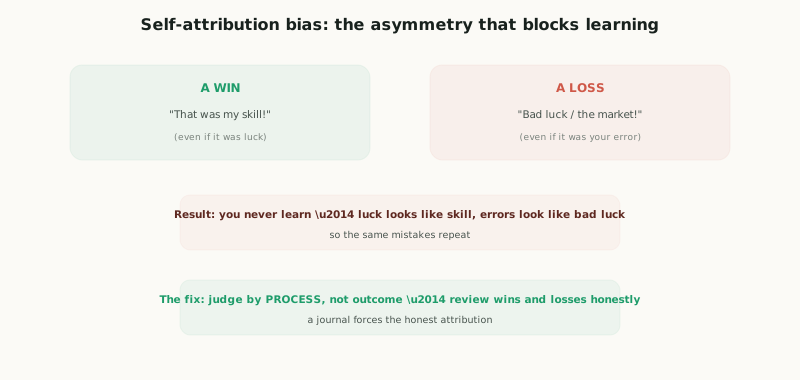
The asymmetry that blocks learning
Self-attribution bias (also called self-serving bias) is the tendency to attribute successes to your own skill and ability, while attributing failures to external factors — bad luck, the market, the broker, the news, anything but yourself. It's a universal ego-protecting mechanism (it feels good to take credit and avoid blame), and in trading it produces a damaging asymmetry in how you interpret your own results.
| Outcome | Biased attribution | The truth might be… |
|---|---|---|
| A win | "My skill and analysis!" | Sometimes just luck |
| A loss | "Bad luck / the market!" | Sometimes your error |
| The effect | Skill confirmed, errors dismissed | No honest feedback |
| Over time | Overconfidence, repeated mistakes | No improvement |
The danger is what this asymmetry does to feedback. Learning requires honestly connecting decisions to results — but self-attribution bias severs that link in both directions. Because every loss is dismissed as bad luck, you never examine the losing decisions that were actually errors, so those mistakes repeat indefinitely. And because every win is credited to skill, you can't tell when a win was simply luck — so you mistake a fortunate streak for genuine edge, and steadily overestimate your ability. That inflated confidence then tends to drive oversizing and excessive risk, often right before variance delivers a reckoning. In short, the bias simultaneously prevents you from fixing your weaknesses and fools you about your strengths — a doubly corrosive combination that can keep a trader stuck, or worse, for years.
How honest review breaks it
The cure is honest, systematic review judged on process rather than outcome. The key shift is to evaluate every trade — win or lose — by asking: "Did I follow my plan, and was the decision sound given what I knew at the time?" This decouples the quality of the decision from the result, which is exactly what self-attribution bias conflates. It forces uncomfortable but vital admissions: a winning trade where you broke your rules and got lucky should be flagged as a process failure (a "bad win" that will hurt you if repeated), while a losing trade where you followed a sound plan should be accepted as a good decision with an unlucky outcome (nothing to fix). This is the heart of process-vs-outcome thinking, and it's the only way to extract real learning from your results.
The single most effective tool is a trading journal, because it forces the honest attribution that the bias resists. By recording your reasoning before each trade and reviewing it after against the result, the journal confronts you with the truth: was that win actually the skilled setup you planned, or did you fluke it? Was that loss genuinely bad luck, or did you ignore your own rules? Writing it down makes self-deception much harder, because the contemporaneous record won't let you retroactively rewrite a sloppy win as skill or a careless loss as misfortune. Over time, this disciplined review re-establishes the decision-to-result feedback loop the bias severs — you start learning from your real mistakes (so they stop repeating) and recognising luck for what it is (so your confidence stays grounded). A trusted mentor, trading partner or community can help too, offering the outside perspective that punctures self-serving stories. None of this eliminates the bias — it's deeply human — but awareness plus honest review keeps it in check, which is the difference between a trader who improves and one who merely accumulates flattering excuses. The honest framing: self-attribution bias is crediting wins to your skill and blaming losses on bad luck or the market — a comforting asymmetry that severs the link between decisions and results. It blocks learning (errors dismissed as luck, so they repeat) and inflates overconfidence (luck mistaken for skill), often driving oversizing. Counter it by judging every trade — win or lose — on process ("did I follow a sound plan?"), flagging lucky wins that broke the rules and accepting unlucky losses from good decisions, and above all keeping a journal that forces honest attribution. Awareness plus honest review, not denial, keeps it in check; manage risk.
Streaks, ego and the danger zone
Self-attribution bias is at its most dangerous after a winning streak, because that's when its two effects — dismissing losses and crediting wins — compound into genuine peril. During a good run, the bias whispers that every win was your skill (when some were surely the market simply being kind), and your sense of your own ability inflates with each one. This is precisely how a normal run of good variance gets misread as proof of mastery, breeding the over-confidence that leads traders to increase size, loosen their rules and take liberties — right before variance turns and delivers a painful, often outsized, loss. The cruel symmetry is that the bigger the ego inflation during the streak, the harder the fall when reality reasserts, and the bias then kicks in again to blame that fall on "bad luck," protecting the inflated self-image and preventing the lesson from landing. It's a near-perfect mechanism for keeping a trader overconfident and unteachable.
The ego dimension is what makes this so stubborn. Self-attribution bias exists largely to protect the ego — it feels good to be skilled and bad to be wrong — so fighting it means being willing to let your ego take honest hits (see ego and trading). The traders who improve are those who can hold their self-image loosely enough to say "that win was mostly luck" and "that loss was my mistake," which is uncomfortable precisely because it deflates the ego the bias is trying to inflate. Practical defences for the danger zone: be extra sceptical of your skill during winning streaks (the very time you feel most skilled is when you should most question it), hold size constant rather than letting success inflate it (countering the parallel house-money urge), and lean hard on your journal to keep score honestly — reviewing whether your recent wins actually followed your process or whether you've been getting lucky and loosening up. Treating both wins and losses as data to learn from, rather than verdicts on your worth, is what keeps the ego from turning a hot streak into the setup for a blow-up. The honest reminder: the bias peaks after winning streaks, inflating ego and confidence into oversizing right before variance turns — so be most sceptical of your skill when you feel best, hold size constant, and use your journal to keep honest score, holding your self-image loosely enough to admit luck and error alike.
One final perspective makes the effort worthwhile: of all the biases, self-attribution is perhaps the one that most directly determines whether a trader improves over years or stagnates. Two traders with identical raw ability will diverge dramatically depending on whether they honestly attribute their results — the one who confronts their real errors compounds skill, while the one who explains every loss away repeats the same mistakes indefinitely, often blaming the market the whole way down. Because the bias is universal and ego-driven, it never fully goes away; it requires ongoing vigilance, a willingness to be wrong, and the humility to credit luck. That humility is uncomfortable, but it's the price of genuine progress — and the traders who pay it are the ones still standing, and still learning, years later.
Self-attribution bias credits wins to your skill and blames losses on bad luck or the market — a comforting asymmetry that severs the link between decisions and results. It blocks learning (errors dismissed as luck, so they repeat) and inflates overconfidence (luck mistaken for skill), which then drives oversizing and excess risk. Counter it by judging every trade — win or lose — on process: "did I follow a sound plan, given what I knew?" Flag the lucky wins that broke your rules (bad process) and accept the unlucky losses from good decisions (nothing to fix). A trading journal is the key tool — it forces honest attribution the bias resists. You can't delete the bias, but awareness plus honest review keeps it from quietly stopping you ever improving.