
A pound of hard-won starting capital and a pound of profit you made last week are exactly the same money — they spend identically, they're lost identically. But the mind stubbornly insists on treating them differently, guarding the first carefully while gambling the second freely. That quirk is mental accounting, and its most dangerous form — the "house-money effect" — is why so many traders give their winnings straight back to the market. This guide explains mental accounting: what it is, the house-money trap, and why every pound deserves the same rules.
It's a classic behavioural-finance bias, closely tied to handling winning streaks and the over-confidence that follows a profitable run.
Key takeaways
Q: What is mental accounting in trading?
A: Mental accounting is the tendency to treat money differently depending on where it came from or which mental 'account' it sits in, rather than recognising that money is fungible — a pound is a pound regardless of source. In trading, it shows up as treating original capital cautiously but recent profits recklessly, or viewing different trades or accounts as separate pots with different risk rules.
Q: What is the house-money effect?
A: The house-money effect is a form of mental accounting where people take bigger risks with money they've recently won, treating it as 'the house's money' rather than their own — a phrase borrowed from gambling. In trading, after a run of profits, a trader may oversize and take reckless trades with those gains, as if losing them wouldn't really hurt, and frequently gives the hard-won profits straight back.
Q: How do you avoid mental accounting errors?
A: By recognising that money is fungible and applying the same risk rules to every pound in your account, regardless of whether it's original capital or recent profit. Treat your account as a single total, size every trade by the same risk percentage of that total, and resist the urge to 'gamble with winnings'. Recent profits are your money, earned through risk — they deserve the same protection as your starting capital.
What it is, and the house-money trap
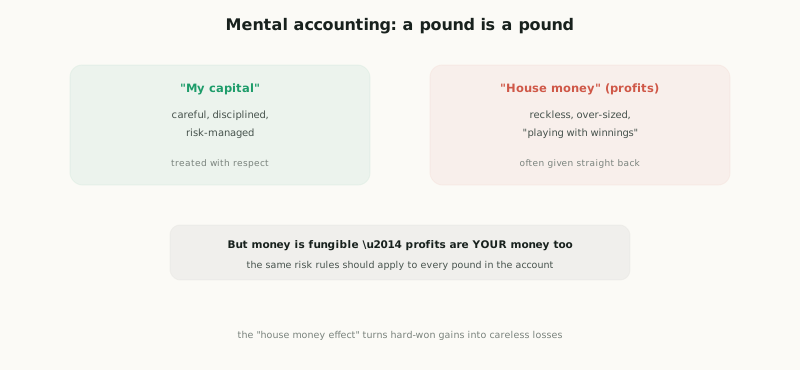
Mental accounting is the tendency to treat money differently depending on its source or which mental "account" we file it under — rather than recognising the basic financial truth that money is fungible: a pound is a pound, with the same value and the same consequences if lost, regardless of where it came from. The brain loves to label money, and in trading those labels distort risk-taking. The most dangerous example is the house-money effect: after a run of profits, traders mentally reclassify those gains as "the house's money" (a phrase straight from the casino) rather than their own, and start taking bigger, looser, more reckless risks with them — oversizing, chasing marginal trades, abandoning their rules — on the unspoken feeling that "it's only my winnings, losing it wouldn't really hurt." The result is depressingly common: the trader gives the hard-won profits straight back, often in a few careless trades that undo weeks of disciplined work. The flip side appears too — traders guard their original capital obsessively while treating profits as play money, or treat different trades and accounts as separate pots with different rules — but the house-money effect is the costly one, because it directs the most reckless behaviour at money that is every bit as real and as hard-won as the rest.
Why every pound deserves the same rules
The fix follows directly from the truth the bias denies: money is fungible, so every pound in your account deserves the same risk rules, whether it's original capital or last week's profit. Concretely, this means a few disciplines. Treat your account as a single total, not as "capital" plus "winnings" — there's just your balance, and a loss of profits hurts exactly as much as a loss of starting capital (indeed, those profits represent real risk you already took to earn them). Size every trade by the same risk percentage of that total balance — the 1% rule applied consistently means your position sizes scale gently with the account but your risk discipline never changes, regardless of whether you're up or down on the week. And resist the "gamble with winnings" impulse directly: when you notice the thought "it's only profit, I can take a flyer," recognise it as the house-money effect talking, and remember that those winnings are your money, earned through risk, deserving the same protection as everything else.
This connects closely to handling winning streaks, because the house-money effect is most virulent after a run of wins — exactly when over-confidence and a sense of invincibility compound the urge to take liberties with the gains. The disciplined response to a profitable streak is the opposite of what the bias suggests: keep sizing and risk constant (or even ease off if you notice yourself getting loose), bank the progress, and resist the feeling that you're now "playing with the casino's chips." A useful mental reframe is to periodically reset your sense of the account — today's balance is simply your capital now, full stop; there is no separate "winnings" pot, only the single number you must protect. Traders who internalise that a pound is a pound stop the all-too-common cycle of grinding out gains carefully and then surrendering them recklessly, and instead let their profits actually accumulate. As with every bias, awareness is the first defence: noticing the house-money thought is most of the battle. The honest framing: mental accounting is treating money differently by its source or mental "account" rather than recognising money is fungible (a pound is a pound). Its dangerous form is the house-money effect — taking reckless, oversized risks with recent profits as if they were "the house's money," not your own, and giving the winnings straight back. The fix: treat your account as a single total, size every trade by the same risk % of that total (the 1% rule), and resist gambling with winnings — profits are your money, earned through risk, deserving the same protection. Especially vigilant after winning streaks, when the effect peaks; manage risk.
Other forms of mental accounting
The house-money effect is the most dangerous form, but mental accounting distorts trading in several other ways worth recognising. Treating separate accounts or strategies as separate pots: a trader might run a "safe" account carefully and a "fun" account recklessly, or mentally ring-fence one strategy's losses from another's gains — but it's all one pool of capital, and a loss in the "fun" pot spends exactly like any other. Break-even-itis: fixating on a reference point (usually your entry price) and treating "getting back to break-even" as a special goal — holding a loser far too long just to avoid closing it below entry, or refusing a perfectly good exit because it's "not quite back to where I bought." The market has no memory of your entry price; only the current decision matters, yet mental accounting makes that arbitrary reference point feel sacred (it overlaps closely with the sunk-cost fallacy and the disposition effect). Treating realised and unrealised P&L differently: feeling a paper loss is "not real until I close it" (so refusing to cut it) while treating paper gains as already spent — when both are equally real marks-to-market on your actual wealth.
The thread running through all of these is the same error the house-money effect commits: partitioning money that is actually one fungible whole, and applying different, usually worse, decision rules to the different mental compartments. The unifying fix is correspondingly simple: collapse the compartments. There is one account, one total balance, and one set of risk rules that applies to every pound and every position equally — no special "winnings," no sacred break-even price, no "safe" versus "fun" capital, no difference between realised and unrealised in how you assess risk. Each trading decision should be made on its current merits — "given where price is now and what I know now, is holding this position the right risk?" — not on where you entered, which pot the money came from, or whether the P&L is booked. This single-account, single-ruleset discipline strips away the arbitrary labels the mind imposes and forces the consistent, rational treatment of capital that good risk management requires. It's a quietly powerful reframe, because so many costly trading mistakes — holding losers to break-even, gambling with profits, ring-fencing reckless sub-accounts — dissolve once you genuinely internalise that a pound is a pound, wherever it sits and however it's labelled. The honest reminder: beyond house money, mental accounting shows up as treating separate accounts/strategies as separate pots, break-even-itis (fixating on your entry price), and treating paper losses as "not real" — all partitioning one fungible pool; collapse the compartments into one account with one ruleset, and judge every position on its current merits, not its label or entry price.
The reframe is ultimately about respect for your capital as a single whole. Every pound in the account — whether it arrived as your deposit or as last week's profit — was either saved or earned through risk, and all of it can fund your future trading or be carelessly lost. Treating it as one undivided pool, governed by one consistent set of rules, is simply taking your own money seriously. The traders who do this protect their gains and compound them; those who mentally partition their capital tend to leak it back through whichever compartment they've labelled expendable.
Mental accounting is treating money differently by its source or mental "account," rather than recognising money is fungible — a pound is a pound. Its dangerous form is the house-money effect: after profits, taking reckless, oversized risks with the gains as if they were "the house's money," not your own — and giving the winnings straight back. The fix: treat your account as a single total (no separate "winnings" pot), size every trade by the same risk % of that total (the 1% rule), and resist the "it's only profit" impulse — your profits are your money, earned through risk, deserving the same protection as your starting capital. Be especially vigilant after winning streaks, when the effect peaks. Internalise that a pound is a pound, and you stop grinding out gains only to surrender them carelessly.