"Is forex trading gambling?" is a fair question — and the honest answer is uncomfortable, because it depends entirely on how it's done. Approached one way, forex trading is skilled speculation, closer to how a casino runs its business than to how a punter plays the tables. Approached another way, it's pure gambling — and often worse, because the leverage lets you lose faster. The difference isn't the market; it's the trader. This guide gives an honest answer: what separates trading from gambling, when forex genuinely becomes a bet, and how to stay on the right side of the line.
It's closely tied to realistic expectations, it depends on risk management, and the behaviours that tip it into gambling are core beginner mistakes.
Key takeaways
Q: Is forex trading gambling?
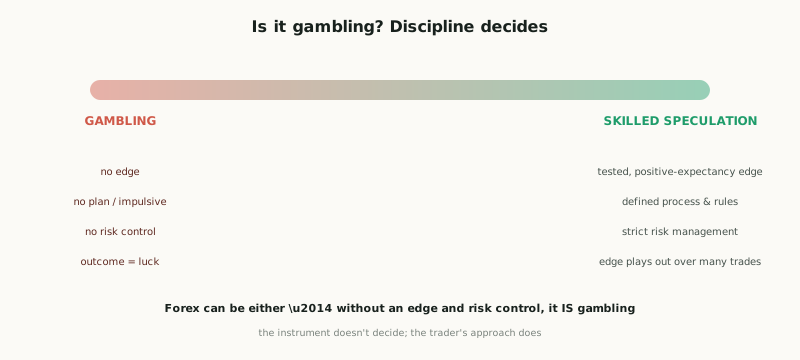
A: It can be either. Forex trading done without an edge, a plan or risk control — betting on price direction and hoping — is functionally gambling. Done with a tested, positive-expectancy approach and strict risk management, where an edge plays out over many trades, it's skilled speculation, closer to how a casino (not a gambler) operates. The instrument doesn't decide which it is; the trader's approach does.
Q: What's the difference between trading and gambling?
A: The core difference is edge and risk control. A gambler plays games with negative expected value and no control over the odds, relying on luck. A skilled trader operates a tested approach with positive expectancy, manages risk so no single trade can ruin them, and lets that edge express itself over a large sample of trades. Discipline, process and risk management are what separate the two.
Q: When does forex trading become gambling?
A: When it loses the features that distinguish skilled speculation: trading without a tested edge, with no plan, on impulse or tips; risking too much per trade or oversizing to 'win it back'; chasing losses (revenge trading); and treating outcomes as luck rather than the product of a process. These behaviours, plus the dopamine-driven thrill some chase, are also the warning signs of problem gambling.
What separates the two
The line between trading and gambling comes down to two things: an edge and risk control. A gambler plays games with negative expected value — the odds are stacked against them, they have no control over those odds, and they rely on luck, which is why, over time, the house wins. A skilled trader operates more like the house than the punter: they have a tested, positive-expectancy approach (an edge that, over many trades, is expected to make money), they manage risk so that no single trade — or run of losses — can ruin them, and they let that edge express itself over a large sample rather than staking everything on one outcome. The presence or absence of those features is what decides the matter, and notice that the instrument is irrelevant: you can gamble on stocks, and you can speculate skilfully on currencies. Forex isn't gambling because it's forex; it becomes gambling when it's done without an edge, without a plan and without risk control. The same chart, the same pair, the same broker can host either activity — the deciding variable is the human operating the account.
When it becomes gambling — and how to stay on the right side
It's worth being concrete about when forex trading crosses into gambling, because the warning signs are recognisable and often overlap with the signs of problem gambling. Forex is being gambled when there's no tested edge — trading on hunches, tips, or a guru's signal without understanding why; when there's no plan and entries are impulsive; when risk is uncontrolled — risking too much per trade, or oversizing to "win it back" after losses (the gambler's fallacy and revenge trading in action); and when outcomes are treated as luck rather than as the product of a repeatable process. There's also an emotional tell: trading chiefly for the thrill — the dopamine hit of action and the rush of a win — rather than for the disciplined application of an edge. That thrill-seeking is precisely the psychology of gambling, and it's worth taking seriously: trading can become a genuine behavioural addiction, with the high leverage and round-the-clock access making it especially potent. If trading is causing you to chase losses, risk money you can't afford, hide activity from people close to you, or feel an uncontrollable compulsion to be in the market, those are red flags worth pausing on, and support is available (in the UK, organisations such as GamCare offer help).
Staying on the right side of the line is, encouragingly, the same as simply trading well. Develop or adopt a tested approach with a genuine edge rather than betting on hunches. Manage risk rigorously — small fixed risk per trade, sensible position sizing, so no single trade can do serious harm (see risk management). Follow a defined process and judge yourself by process, not single outcomes, accepting that any one trade is uncertain while the edge plays out over many. Keep a journal so your trading is accountable and evidence-based. And monitor your motivation: if you're chasing excitement rather than executing a plan, that's the gambling instinct, and naming it is the first step to overriding it. Done this way, forex trading is a legitimate skilled endeavour, no more "gambling" than running a probability-based business; done the other way, it's a fast and leveraged route to the losses that gambling reliably produces. The honest framing: forex trading can be either gambling or skilled speculation — the instrument doesn't decide, the trader's approach does. Without a tested edge, a plan, or risk control — trading on impulse, oversizing, chasing losses, seeking the thrill — it IS gambling (and the leverage lets you lose faster), and can become a genuine addiction. With a tested positive-expectancy edge, strict risk management, a defined process, and outcomes judged over many trades, it's a legitimate skilled endeavour, closer to running the house than playing the tables. Stay on the right side by trading an edge, managing risk, following a process, and watching your motivation — and seek support if trading shows signs of compulsion.
Trading like the house, not the punter
The casino analogy is worth taking further, because it captures the right mental model precisely. A casino doesn't gamble — it runs a business built on a small, reliable edge applied across an enormous number of bets, under strict limits, with the mathematics guaranteeing that the edge dominates luck over time. The individual gambler, betting into that same game, faces negative expectancy and is at the mercy of variance. A skilled trader's job is to be the house, not the punter: to operate a positive-expectancy approach, repeated many times at controlled risk, so that — just as for the casino — a genuine edge expresses itself reliably over a large sample even though any single trade is uncertain. This reframing changes everything about how you treat results. You stop caring intensely about whether this trade wins (the casino doesn't agonise over a single hand) and start caring about whether your process has a real edge and whether you're applying it consistently at sensible size. Individual outcomes become noise; the edge over many trades is the signal.
What operationalises this — what actually keeps you on the house's side of the line — is the unglamorous discipline the site returns to throughout. Expectancy: knowing your approach has positive expected value, ideally tested rather than assumed (see expectancy and win rate). Risk control: small, fixed risk per trade so that no single loss, and no normal losing streak, can take you out before the edge plays out — the casino sets table limits for exactly this reason. Repetition with consistency: applying the same process across a large number of trades, rather than betting big on a few "sure things." And emotional detachment from single results: accepting wins and losses alike as individual draws from a process whose edge only shows over time. A gambler seeks the thrill of the individual bet; the house seeks the quiet inevitability of the long run. Choosing to think and act like the house — edge, limits, repetition, patience — is the difference between trading as a skilled endeavour and trading as an expensive, leveraged form of gambling. The instrument never decides which you're doing; this discipline does.
A note on problem gambling
Because forex can shade into gambling — and because its leverage and round-the-clock access make it potent — it's worth taking the wellbeing side seriously and without judgement. Trading can become a genuine behavioural compulsion for some people, and the warning signs mirror those of problem gambling: chasing losses, risking money you can't afford to lose, an inability to stop or stay away from the market, trading to escape stress or low mood, lying to others about your activity, or feeling that the action matters more than the outcome. If any of that feels familiar, it's a signal to pause and seek support rather than to push on — there's no shame in it, and stepping back is a sign of strength, not failure. In the UK, organisations such as GamCare (and the National Gambling Helpline) offer free, confidential help, and similar services exist elsewhere. Looking after yourself always comes before any trade.
Is forex trading gambling? It can be either — the instrument doesn't decide, the trader's approach does. It IS gambling when done without an edge, a plan or risk control: trading on hunches, impulsive entries, oversizing, chasing losses to "win it back," and trading for the thrill — and the high leverage lets you lose faster, with a real risk of behavioural addiction. It's skilled speculation when you have a tested, positive-expectancy edge, strict risk management (small fixed risk so no trade can ruin you), a defined process, and you judge by process over many trades — operating more like the house than the punter. Stay on the right side by trading an edge, managing risk, following a process, and watching your motivation. If trading feels compulsive or you're chasing losses, pause — support is available.