A trade can end as a winner having first plunged deep into the red — or end as a loser after nearly reaching its target. The final result tells you almost nothing about the journey in between, and that journey is where a lot of useful information hides. Maximum adverse excursion (MAE) and its twin, maximum favourable excursion (MFE), measure those hidden paths — and analysed across many trades, what they reveal can meaningfully sharpen your stops and targets. This guide explains MAE and MFE: what they are, how they help, and the danger of misusing them.
They're trade-analysis tools that refine stop placement and targets, drawn from a well-kept trading journal.
Key takeaways
Q: What is maximum adverse excursion?
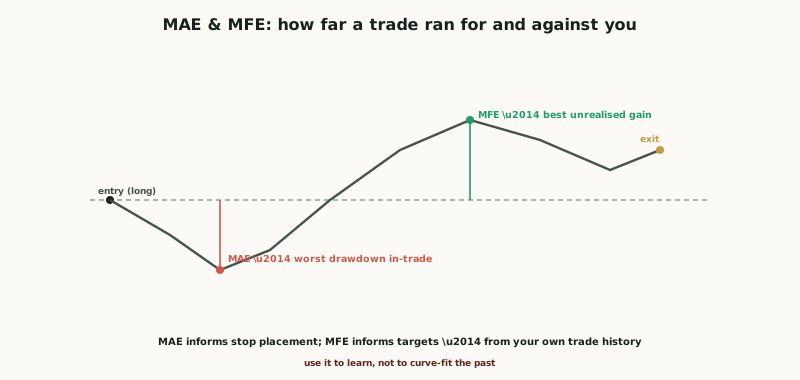
A: Maximum adverse excursion (MAE) is the largest unrealised loss a trade experienced while it was open — the worst it went against you before you exited, regardless of whether the trade ultimately won or lost. Its counterpart, maximum favourable excursion (MFE), is the largest unrealised profit the trade reached. Together they describe the full journey a trade took between entry and exit, not just the final result.
Q: How do MAE and MFE help a trader?
A: By revealing whether your stops and targets fit how your trades actually behave. If winning trades rarely go more than a small distance against you (low MAE), your stop may be wider than it needs to be; if trades regularly reach a large MFE before you exit for less, you may be leaving profit on the table and could extend targets or trail stops. Analysed across many trades, they help calibrate stop and target placement to real behaviour.
Q: What is the danger of using MAE and MFE?
A: Over-optimisation, or curve-fitting. It's tempting to tune your stops and targets to perfectly fit past MAE/MFE data, but that optimises for history that won't repeat exactly, producing settings that look ideal in the past and fail in future. MAE/MFE analysis should guide sensible, robust adjustments — not precise tuning to past trades — and should always be combined with sound trade logic and risk management.
What MAE and MFE measure
Maximum adverse excursion (MAE) is the largest unrealised loss a trade experienced while open — the worst it went against you before you exited — regardless of whether the trade ultimately won or lost. Maximum favourable excursion (MFE) is the mirror: the largest unrealised profit the trade reached at its best point. Together they describe the full range of a trade's journey between entry and exit, capturing information the final P&L hides. A trade that closed for a modest +10 pips might have an MFE of +60 (it was deep in profit before giving most back) and an MAE of −15 (it dipped against you first) — three quite different numbers telling a richer story than "+10" alone. Recorded across many trades (ideally via your journal or backtest data), these excursions reveal patterns in how your trades actually behave.
How to use them to calibrate stops and targets
The practical value lies in matching your stops and targets to real behaviour rather than guesswork. On the stop side, MAE is the key: look at the MAE of your winning trades — if your winners rarely go more than, say, 15 pips against you before working out, then a 50-pip stop is wider than it needs to be (you could tighten it, risking less per trade and improving risk-reward, without cutting many winners short). Conversely, if you find winners regularly dip 30 pips against you before turning, a 20-pip stop is too tight — it's stopping you out of trades that would have won, and needs more room. On the target side, MFE is the guide: if your trades routinely reach an MFE far larger than where you actually exit (you take +10 but they regularly run to +50), you're leaving profit on the table, suggesting you could extend targets, scale out, or use a trailing stop to capture more of the move. If trades rarely exceed your target's MFE, your targets are realistic. Used this way, MAE/MFE analysis turns vague hunches about "stops too tight" or "exiting too early" into evidence drawn from your own trades — a genuinely powerful refinement loop, and a favourite of systematic traders who can compute these across large datasets.
But there's a serious danger that must temper all of this: over-optimisation, or curve-fitting. Because MAE/MFE data shows exactly how past trades behaved, it's tempting to tune your stops and targets to fit it perfectly — setting the stop at the precise level that would have kept every past winner while cutting every past loser fastest, and the target at the exact average MFE. This is a trap: you'd be optimising for a specific history that will not repeat exactly, producing settings that look flawless on past data and fail on new trades (the classic over-fitting failure that also plagues backtesting). The market's future excursions will differ from its past ones, and a stop tuned to the last 100 trades' MAE to the pip is fragile. The correct use is to draw broad, robust lessons — "my stops are systematically too tight," "I exit winners far too early" — and make sensible, generous adjustments, rather than precise tuning to historical extremes. Keep changes grounded in trade logic (the stop should still sit where the idea is genuinely wrong) and a healthy buffer, treat MAE/MFE as a guide not a formula, and always combine it with sound risk management. The information is valuable; the temptation to over-fit it is what turns a useful tool into a liability.
Approached with that discipline, MAE and MFE are an excellent way to let your own trading data tell you whether your stops and targets fit reality — a feedback loop that, over time, can materially improve your risk-reward and reduce needless stop-outs and premature exits. The honest framing: maximum adverse excursion (MAE) is the worst a trade went against you while open; maximum favourable excursion (MFE) the best it went for you — together describing the trade's journey, not just its result. Use MAE (especially of winners) to calibrate stops — if winners rarely go far against you, your stop may be too wide; if they dip a lot first, too tight — and MFE to calibrate targets, spotting when you exit far short of where trades run. The key danger is over-optimisation: don't curve-fit stops and targets to past MAE/MFE, which fails on new trades; draw broad, robust lessons and make sensible adjustments grounded in trade logic, treating it as a guide not a formula, always with risk management.
A practical MAE/MFE workflow
To actually use MAE and MFE, you need to collect the data and analyse it robustly. The collection step lives in your trading journal (or backtest output): for every trade, record not just entry, exit and result, but the worst price it reached against you (MAE) and the best it reached for you (MFE), expressed in pips or in R-multiples (multiples of your initial risk), which makes trades comparable regardless of size. Over a meaningful sample — ideally many dozens of trades — patterns emerge. The classic analysis is a scatter plot: plot each trade's MAE against its outcome (win/loss), and you'll often see a threshold beyond which trades rarely recover — if almost no winners ever exceeded an MAE of, say, 1R against you, that suggests a stop a little beyond 1R captures nearly all winners while cutting losers efficiently. Similarly, plotting MFE shows how far trades typically run, informing where targets or trailing stops should sit to capture the bulk of the move without giving too much back.
The discipline is to extract robust conclusions, not precise ones. Look for broad tendencies and use percentiles rather than exact extremes — "80% of my winners never went more than 1.2R against me" is a robust, actionable finding; "the optimal stop is exactly 1.17R because that maximised past profit" is curve-fitting that won't survive contact with new trades. Build in a buffer (set the stop somewhat beyond the level the data suggests, not exactly on it) so normal variation doesn't undo you, and re-check the analysis periodically as conditions and your strategy evolve, rather than treating one calibration as permanent. Keep the changes anchored in trade logic too — MAE/MFE should refine stops and targets that already make structural sense, not override them with pure data-fitting. Done this way, the workflow becomes a steady feedback loop: trade, record MAE/MFE, analyse periodically, make modest evidence-based adjustments, repeat — gradually tuning your stops and targets toward what your trades actually do, while the buffer and percentile thinking keep you safely on the robust side of the over-optimisation line. The honest reminder: collect MAE/MFE in R-multiples in your journal, analyse with scatter plots and percentiles over a decent sample, draw broad conclusions with a buffer, keep it anchored in trade logic, and revisit periodically — a disciplined feedback loop, never a one-time curve-fit.
Ultimately, MAE and MFE embody a healthy principle: let your own data, rather than guesswork or hope, tell you how your trades behave — while never forgetting that past behaviour only loosely predicts future behaviour. Held in that balance, the analysis is one of the more powerful self-improvement tools available to a systematic trader, quietly revealing whether you choke your winners with tight stops or surrender profit with early exits. Treat it as a mirror for learning, keep your adjustments broad and buffered, and it will steadily sharpen your stops and targets without luring you into the curve-fitting trap.
Maximum adverse excursion (MAE) is the worst a trade went against you while open; maximum favourable excursion (MFE) is the best it went for you — together describing a trade's journey, not just its final result. Use MAE of your winners to calibrate stops (winners rarely going far against you → stop too wide; winners dipping a lot first → stop too tight) and MFE to calibrate targets (trades routinely running far past where you exit → you're leaving profit). The key danger is over-optimisation: don't curve-fit stops and targets to past MAE/MFE — settings tuned perfectly to history fail on new trades. Draw broad, robust lessons and make sensible, buffered adjustments grounded in trade logic, treating MAE/MFE as a guide, not a formula — and always alongside sound risk management.