When a session opens, the first flurry of trading carves out a range — a battle line between buyers and sellers as the day's positioning gets established. The opening range breakout (ORB) strategy waits for one side to win that battle, then rides the momentum that follows the break. It's a clean, rules-based way to trade session momentum, and a close relative of the popular London breakout. This guide explains the opening range breakout: the setup, why it suits active sessions, how to handle false breaks, and how it applies to 24-hour forex.
It's a specific form of breakout trading, closely related to the London breakout strategy, and often improved by trading the retest.
Key takeaways
Q: What is the opening range breakout strategy?
A: It's a breakout strategy that trades the break of the price range established during a session's opening period — for example, the first 15, 30 or 60 minutes after a major session opens. The high and low of that period form the 'opening range'; a break above it triggers a long, a break below it a short, on the logic that a decisive break signals directional momentum for the session.
Q: What is the best opening range period to use?
A: Common choices are the first 15, 30 or 60 minutes, and there's no single correct value — a shorter range gives earlier but noisier signals, a longer one is more reliable but later. In 24-hour forex the range is usually anchored to a major session open (London or New York) rather than a single daily open. Test what suits your pair and session.
Q: How do you handle false breakouts?
A: False breakouts — where price breaks the range then reverses — are the main risk. Traders reduce them by requiring confirmation (a candle close beyond the range, momentum, or retest) rather than entering on the first touch, by trading only in active sessions where breaks are more likely to follow through, and by placing a stop on the other side of the range so a failed break is cut quickly.
The setup
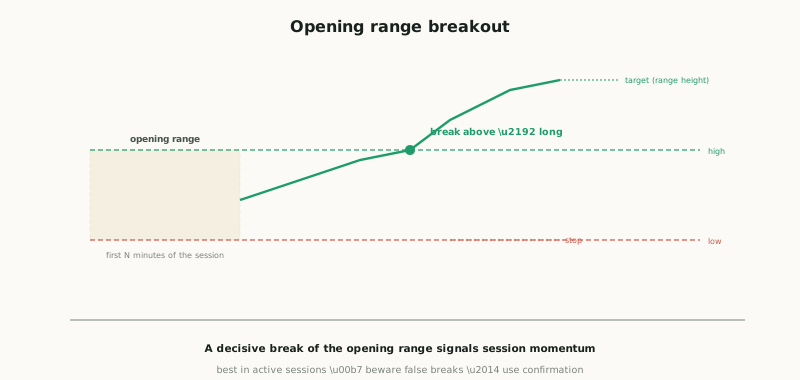
The opening range breakout trades the break of the price range established during a session's opening period. The mechanics are straightforward, summarised below.
The ORB setup
First, define the opening range — the high and low of the first N minutes after the session opens (common choices are 15, 30 or 60 minutes; the choice matters, as a shorter range gives earlier but noisier signals and a longer one is later but more reliable). Then enter on the break: buy when price breaks above the range high, or sell when it breaks below the range low — ideally with confirmation (a candle close beyond the range, supporting momentum, or a successful retest) rather than on the first touch. Place your stop on the other side of the range (or a sensible distance inside it), so a failed break is cut quickly. And set a target — commonly a multiple of the range's height (a "measured move"), a fixed reward-to-risk multiple, or a trailing stop to ride a strong run. The whole logic rests on the idea that the opening range represents an initial equilibrium, and a decisive break of it signals that one side has taken control and momentum is likely to carry in that direction for the session.
Conditions, false breaks, and forex
The ORB's effectiveness depends heavily on conditions. It works best in active, volatile sessions — around the London and New York opens, when liquidity and momentum surge and breaks are more likely to follow through — and poorly in quiet, low-volatility periods, where breaks tend to fizzle. The main risk is the false breakout: price breaks the range, triggers entries, then reverses back inside, trapping breakout traders. This is why confirmation matters (waiting for a close beyond the range, or a retest that holds, rather than the first poke), why trading only in active sessions helps, and why a tight stop on the other side of the range is essential — so a false break costs little. Notably, a failed breakout can itself become a signal: a break that fails and reverses sharply sometimes leads to a strong move the other way (a "failed-break" or trap setup), which more advanced traders watch for.
In forex, an important wrinkle is "which open?" Because the FX market trades 24 hours, there's no single daily opening bell as in stocks; so the ORB is usually anchored to a major session open — most commonly the London open (the most liquid and volatile, which is why the dedicated London breakout strategy is essentially an ORB on the London session), or the New York open — or sometimes to the daily candle open. The session-anchored version is generally most productive, since it aligns the strategy with the bursts of volatility that make breakouts work. As with any strategy, the ORB is a framework, not a guarantee: false breaks happen, it needs the right (volatile) conditions, and its edge comes from disciplined, consistent execution — clear range definition, confirmation, a stop, and a sensible target — not from the pattern alone. Backtest and demo it on your specific pair and session before trading it live, and apply sound risk management on every trade. The honest framing: the opening range breakout trades the break of the high/low range set in a session's opening period — long above the range, short below, ideally with confirmation, a stop on the other side, and a target a multiple of the range. It works best in active, momentum-rich sessions (London/NY opens) and poorly in quiet markets, with false breakouts its main risk (use confirmation). In 24-hour forex it's anchored to a major session open. It's a clear, rules-based momentum strategy — but not a guarantee: false breaks happen, it needs volatile conditions, and edge comes from disciplined execution and risk management. Backtest and demo for your pair and session first.
Refining the strategy
Several refinements separate a crude ORB from a disciplined one. The most important is how you confirm the break. Rather than entering the instant price ticks past the range, many traders wait for a candle to close beyond the level (filtering out brief pokes), or for a retest — price breaking out, pulling back to the broken level, and holding it before continuing (the retest approach), which offers a tighter stop and confirmation that the break is genuine, at the cost of occasionally missing the fastest moves. Some add a momentum or volume filter (a strong, expanding breakout candle is more convincing than a limp one), bearing in mind the forex tick-volume caveat. The choice of opening-range period is itself a refinement: a 5–15 minute range gives earlier signals with more false breaks, while a 30–60 minute range is slower but more reliable — worth testing for your pair and session.
Equally important is filtering by conditions. The ORB thrives on volatility, so favour it during the high-energy windows around the London and New York opens and be wary in quiet, rangebound periods where breaks fizzle. Many traders also avoid taking an ORB straight into a major scheduled news release (where a violent two-way spike can stop you out either way) unless that's a deliberate plan. A useful added filter is the higher-timeframe trend: taking ORB breaks in the direction of the prevailing daily trend (longs above the range when the daily is bullish) tends to improve the odds versus fading it. Finally, managing the trade matters as much as entering it: with a target based on the range height (a measured move) you might bank partial profit there and trail the rest to capture a strong session run, while moving your stop to break-even once the move is underway to protect capital. None of these turns the ORB into a sure thing — false breaks remain the cost of doing business — but together they tilt a simple, sound idea toward consistency: clear range, confirmed break in favourable conditions, sensible stop, and a managed exit, repeated with discipline and tracked in your journal so you can refine the specifics for your market.
Variations to suit your market
The ORB is really a family of related strategies, and matching the variant to your market matters. Day traders of European pairs often run a London-open ORB (essentially the London breakout), defining the range in the first part of the London session when EUR and GBP pairs are most active. Those focused on USD pairs or who trade later may prefer a New York-open ORB. Some traders use the range of the quiet pre-session (for example, the Asian session range for a London-open trade) as the levels to break, on the logic that an active session breaking the prior quiet range signals fresh directional intent. Others anchor to the daily candle open for a simpler, swing-oriented version. There's no single "correct" variant — the right choice depends on which pairs you trade, when you're at the screen, and what your testing shows works for your market. The common thread across all of them is identical: define a meaningful range, wait for a confirmed break in favourable conditions, risk-manage the entry with a stop on the other side, and let the session's momentum do the work — a simple, adaptable framework you tailor to your own pairs and schedule.
The opening range breakout (ORB) trades the break of the range set in a session's opening period: define the high and low of the first N minutes (commonly 15/30/60); go long on a break above, short below — ideally with confirmation (a close beyond, or a retest), not the first touch; stop on the other side of the range; target a multiple of the range height or trail. It works best in active sessions (London/NY opens) and poorly in quiet markets; its main risk is the false breakout (use confirmation, a tight stop — and a failed break can itself be a signal). In 24-hour forex, anchor it to a major session open (the London breakout is an ORB on London). It's a framework, not a guarantee — backtest/demo for your pair and session, and manage risk every trade.