Almost every chart you've seen plots price against time — each candle or bar represents a fixed interval. Renko charts throw time away entirely: a new "brick" appears only when price moves a set amount, regardless of how long that takes. The effect is a remarkably clean, noise-filtered view of trend — with some important trade-offs you need to understand. This guide explains Renko charts: how they work, what they're good for, and their key limitations.
They share the noise-smoothing goal of Heikin Ashi but take a more radical approach, and they recast familiar support and resistance and structure in a cleaner form.
Key takeaways
Q: What are Renko charts?
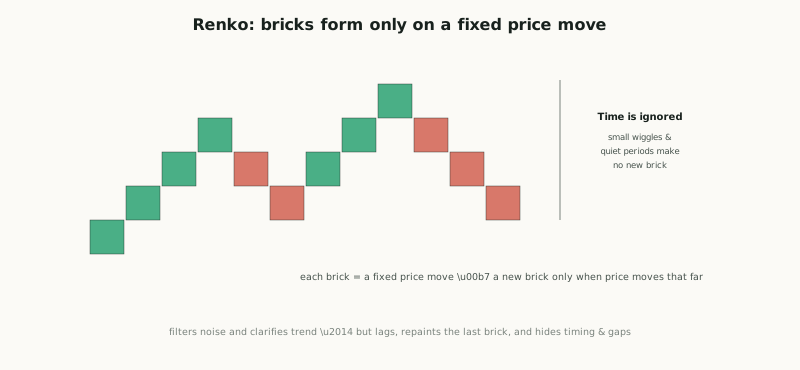
A: Renko charts are a type of chart made of 'bricks' of a fixed price size, where a new brick is added only when price moves by that amount in either direction. Unlike candlestick or bar charts, Renko ignores time entirely — a quiet hour and an active hour both produce bricks only if price actually moves the brick size. The result is a smoothed, staircase view that emphasises price movement over time.
Q: What are Renko charts good for?
A: Their main strength is filtering out noise and clarifying trend. Because small fluctuations that don't complete a brick are ignored, choppy minor movements disappear, making trends, support and resistance, and breakouts visually cleaner. Many traders find trend direction and key levels easier to read on Renko than on time-based charts, and use them to stay in trends and avoid being shaken out by minor wiggles.
Q: What are the limitations of Renko charts?
A: Several. Renko lags, because a brick only completes after price has already moved the brick size. The most recent brick can 'repaint' (appear then disappear if price reverses before completing). All timing information is lost, so you can't see how long a move took or when it happened. Gaps and exact highs/lows are hidden. And the brick size is a parameter that changes the picture, inviting over-optimisation. Renko complements time-based charts rather than replacing them.
How they work
Renko charts (from the Japanese renga, meaning brick) are built from bricks of a fixed price size — say, 10 pips. A new brick is added only when price moves by that amount in either direction: move up by the brick size, draw an up-brick (typically green); move down by the brick size, draw a down-brick (typically red). The radical part is that time is ignored entirely. On a candlestick chart, a quiet hour and a frantic hour each produce one candle; on a Renko chart, that quiet hour might produce no bricks (price didn't travel the brick size) while the frantic hour produces several — bricks appear based purely on price movement, not the clock. Bricks are also conventionally drawn in neat diagonal steps, each new brick offset from the last, never sharing a column. The consequence is a staircase view that strips out the dimension of time and small fluctuations, leaving only meaningful price moves of at least the brick size. Choose a larger brick to filter more (smoother, slower) or a smaller brick to capture more detail (more responsive, noisier) — the brick size is the key setting, sometimes fixed in pips or tied to the ATR for a volatility-adaptive version.
What they're good for
Renko's central strength is filtering noise and clarifying trend. Because small fluctuations that don't complete a brick are simply ignored, the choppy minor movements that clutter time-based charts disappear, and what remains is a clean sequence of bricks that makes the underlying trend visually obvious — a run of green up-bricks is plainly an uptrend, a run of red down-bricks a downtrend, and a reversal shows clearly when the colour flips. Many traders find trend direction, support and resistance levels, and breakouts markedly easier to read on Renko than on a busy candlestick chart, because the noise that obscures those features on time-based charts is gone. This makes Renko popular for staying in trends: by ignoring minor wiggles, it helps traders avoid being emotionally shaken out of a good trend by every small retracement — you only "see" a reversal when price actually moves a full brick (or several) against you, which filters out the noise-level pullbacks. Simple trend strategies (e.g. trade in the direction of the prevailing brick colour, exit on a colour change) become visually clean on Renko, and chart patterns and trendlines often appear tidier.
The limitations
But Renko's elegance comes with real trade-offs that you must respect, or it will mislead you. It lags: a brick only completes after price has already moved the full brick size, so by the time a new brick (or a reversal) prints, the move is already underway — Renko confirms trend rather than catching it early. The last brick can "repaint": the most recent, still-forming brick can appear and then disappear if price reverses before completing it, which can deceive traders watching in real time (the current brick isn't final until the price move is fully made). All timing information is lost: you cannot see how long a move took, when it happened, or which session it occurred in — a fast crash and a slow grind covering the same distance look identical in bricks, which matters for anyone who cares about time, sessions or the pace of a move. Gaps and exact highs/lows are hidden: Renko smooths over price gaps and doesn't show the true intrabar extremes, so the precise high or low of a move can be obscured. And the brick size is a parameter that changes the whole picture — different brick sizes produce different signals on the same data, which invites over-optimisation (tuning the brick size to fit past data, a curve-fitting trap).
The honest conclusion is that Renko is a useful complementary lens, not a replacement for time-based charts. Its noise-filtering genuinely helps with seeing trend and key levels, and many traders keep a Renko chart alongside their candlesticks for exactly that clarity. But its lag, repainting, lost timing and parameter sensitivity mean it should be combined with normal charts and other analysis — use Renko to clarify the trend picture, then check the time-based chart for the timing, the exact levels, and the context Renko hides. As with every tool here, it describes price in a particular way rather than predicting it, the brick size shouldn't be over-fitted, and it works best paired with confirmation and disciplined risk management. Treated as one clarifying view among several — not a magic noise-free oracle — Renko earns its place. The honest framing: Renko charts are built from fixed-size bricks, adding a new brick only when price moves that amount, ignoring time entirely — so quiet periods and small wiggles produce no brick. This filters noise and makes trend, levels and breakouts visually cleaner, helping traders stay in trends without being shaken out by minor pullbacks. But the trade-offs are real: it lags (bricks complete only after the move), the last brick can repaint, all timing/session information is lost, gaps and exact highs/lows are hidden, and the brick size is a parameter that invites over-optimisation. Use Renko as a complementary trend-clarifying lens alongside time-based charts, confirm with other analysis, and manage risk.
Using Renko well
To get value from Renko without being misled, a few practical points help. First, brick size selection is the central decision and shapes everything: a fixed brick size (e.g. 10 pips) is simple and consistent but doesn't adapt to changing volatility, while an ATR-based brick (sizing the brick to a multiple of the ATR) adapts to the market's volatility — bigger bricks when volatile, smaller when calm — which many prefer for robustness. Crucially, resist over-fitting the brick size: don't tune it to make a backtest look perfect, because a brick size optimised to past data will likely fail on new data; pick a sensible value tied to the instrument's typical movement and stick with it. Second, understand reversals: in the traditional Renko, a reversal requires price to move two bricks' worth in the opposite direction (to print an opposite-coloured brick), which is part of what filters noise but also adds lag — know how your platform defines reversals so you're not surprised.
Third, use Renko for what it's good at and lean on other charts for the rest. It excels at trend clarity and level identification, so use it to answer "what's the trend, and where are the key levels?" — then switch to a time-based chart for timing, exact entries, the pace of moves, and session context, all of which Renko hides. Simple Renko strategies (trade in the direction of brick colour, exit on a colour change or after N opposite bricks) work as a clean trend-following overlay, but should be confirmed and combined with structure rather than traded blindly — and always remember the real-time repaint on the forming brick, so wait for bricks to complete before acting. Held as a complementary, trend-clarifying view — not a standalone, noise-free oracle — with a sensibly-chosen, un-over-fitted brick size and proper risk management, Renko is a genuinely useful addition. The honest reminder: choose a sensible brick size (fixed or ATR-based) without over-fitting it, know how reversals are defined (often a two-brick move), use Renko for trend and levels while relying on time-based charts for timing and context, wait for bricks to complete (mind the repaint), and confirm with other analysis.
Renko charts are built from fixed-size bricks, adding a new brick only when price moves that amount — ignoring time entirely, so quiet periods and small wiggles produce no brick. This filters noise and makes trend, levels and breakouts visually cleaner, helping traders stay in trends without being shaken out by minor pullbacks. But the trade-offs are real: it lags (bricks complete only after the move), the last brick can repaint, all timing/session info is lost, gaps and exact highs/lows are hidden, and the brick size is a parameter that invites over-optimisation. Treat Renko as a complementary trend-clarifying lens alongside time-based charts — not a replacement — confirm with other analysis, avoid curve-fitting the brick size, and manage risk.