You set a careful stop just below the obvious low — and price spikes down precisely to it, takes you out, then reverses and runs without you. It feels personal, as if the market could see your stop. Stop-loss hunting is one of trading's most infuriating experiences, it's extremely common, and — crucially — it's largely avoidable once you understand why it happens. This guide explains stop-loss hunting: what it is, whether it's deliberate, and how to place stops so you're not the easy target.
It's a direct consequence of where liquidity pools, closely tied to false breakouts, and it's really a lesson in better stop placement.
Key takeaways
Q: What is stop-loss hunting?
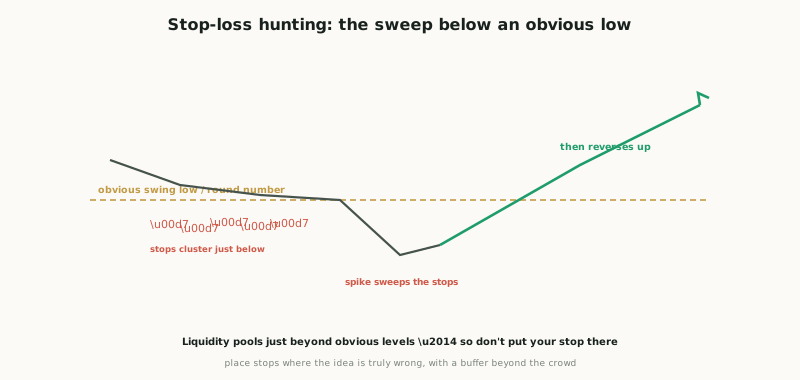
A: Stop-loss hunting refers to price moving to levels where many traders' stop-losses are clustered — just beyond obvious support, resistance, round numbers or swing highs and lows — triggering those stops before reversing. Whether driven by deliberate action from large participants seeking liquidity or simply the natural behaviour of markets around obvious levels, the effect is that stops in predictable places get swept out.
Q: Is stop-loss hunting real manipulation?
A: It's a mix, and the distinction matters less than the practical lesson. Sometimes large participants do deliberately push price toward clustered stops to access the liquidity those orders provide (a 'liquidity grab'). Often, though, it's simply the natural result of obvious levels attracting clustered orders that get triggered when price tests them. Either way, stops placed in predictable spots are vulnerable — so the response is the same regardless of intent.
Q: How do you avoid stop-loss hunting?
A: Don't place your stop at the obvious spot where everyone else's sits. Place it where your trade idea is genuinely invalidated, with a buffer beyond the crowded level so a routine sweep doesn't catch you, or use a volatility-based distance (such as an ATR multiple) rather than a tick beyond a round number. Avoid stops that are both obvious and tight, and accept that no placement is immune — the goal is to reduce vulnerability, not eliminate it.
Why it happens
Stop-loss hunting happens because stops cluster in predictable places. Traders are taught to put stops just beyond obvious levels — a tick below a clear support or swing low, a few pips above resistance, just past a round number like 1.2000 — and because so many traders use the same obvious levels, their stops pile up in the same narrow zones. Those clusters of stop orders are a pool of liquidity: a sell-stop below support, once triggered, becomes a market sell order, so a whole cluster of them represents a burst of selling waiting to be set off (and buy-stops above resistance, a burst of buying). Price is drawn to these pools for two reasons. Sometimes it's deliberate: large participants, who need liquidity to fill big orders, push price toward the obvious cluster to trigger the stops and trade against the flood of orders they release (a "liquidity grab" or "stop run"). Often it's simply natural: obvious levels attract orders, and a normal test of the level trips the clustered stops without anyone engineering it. The debate over how much is deliberate manipulation versus organic market behaviour is endless — but, importantly, the practical lesson is identical either way: stops placed in predictable, crowded spots are vulnerable to being swept, and the fix doesn't depend on intent.
How to place stops to avoid it
The solution follows directly from the diagnosis: don't put your stop where everyone else's sits. A few principles help. Place the stop where your idea is genuinely wrong, plus a buffer: rather than tucking it a single tick beyond the obvious level (right in the cluster), give it room — place it far enough beyond the crowded zone that a routine sweep of the obvious stops doesn't reach yours, at a point where price trading there really does invalidate your trade. Use volatility-based distances: setting the stop at, say, an ATR-multiple beyond the level (rather than a fixed tick beyond a round number) places it according to how much the market actually moves, naturally putting it past the obvious cluster. Avoid the worst combination — a stop that is both obvious (at the textbook spot) and tight (with no buffer) — which is precisely the easy target. And respect position sizing: giving the stop more room means a wider stop, which (under the 1% rule) means a smaller position — a worthwhile trade-off, since a slightly smaller position that survives the sweep beats a larger one that gets shaken out before the move.
Two honest caveats. First, no stop placement is immune — the goal is to reduce vulnerability, not eliminate it, and you'll still occasionally be swept; that's part of trading, and it's why sizing and process matter more than any single stop. Second, beware over-correcting into no stop at all or absurdly wide stops to "avoid the hunt" — that simply trades a small, controlled risk (occasional sweep) for a catastrophic one (an unbounded loss), the opposite of risk management. The skill is the balance: stops with enough buffer to avoid the obvious cluster, but still tight enough to define and cap the risk, sized so that being swept now and then is merely annoying rather than damaging. There's also a useful flip side — understanding stop clusters makes you a better trader generally: the same liquidity pools that hunt your stops are the false breakouts you can trade, fading the sweep once it reverses. The honest framing: stop-loss hunting is price moving to where stops cluster — just beyond obvious support/resistance, round numbers and swing points — triggering them before reversing, whether by deliberate liquidity grabs or the natural pull of obvious levels (the lesson's the same either way). Avoid it by placing stops where your idea is truly wrong with a buffer beyond the crowd, using volatility-based distances, and never combining obvious with tight — accepting wider stops mean smaller positions. No placement is immune, and over-widening or removing stops just swaps a small risk for a catastrophic one; the skill is balance, sized so a sweep is annoying, not damaging.
The myth and the reality
It's worth puncturing a common piece of trader folklore, because believing the dramatic version of stop-hunting leads to bad decisions. The myth is that "the market" — or specifically your broker — can see your individual stop and is personally targeting it. For the vast majority of traders, that's not what's happening. In the deep, decentralised forex market, your single retail stop is a drop in an ocean; no large participant is hunting you. What's really occurring is the clustered-liquidity dynamic already described: lots of traders put stops in the same obvious places, and price gravitates to those pools — not to your order specifically, but to the crowd's orders, of which yours happens to be one. There's a nuance worth knowing about broker models: a pure "A-book" broker (which passes your trades to the market) has no incentive to hunt your stop, while the theoretical concern about a "B-book" broker (which takes the other side of your trade) is more about conflict of interest in general than literal stop-targeting — and reputable, regulated brokers are constrained here. The practical point is that whether you attribute a sweep to a deliberate liquidity grab by big players or to organic crowd behaviour, the cause is structural, not personal.
This reframing matters because it points to a constructive response rather than paranoia. If you believe the market is out to get you, you might do destructive things — remove stops entirely (catastrophic), switch brokers fruitlessly, or trade erratically out of mistrust. If you understand it's clustered liquidity, you do the productive things instead: place stops with a buffer beyond the crowd, size for the occasional sweep, and — the real edge — use the phenomenon. Because sweeps of obvious levels are so common, the reversal after a sweep is a tradeable setup: the false breakout is precisely a stop-sweep that fails and reverses, and traders who recognise "price just grabbed the obvious liquidity below support and snapped back" can trade with the move rather than being its victim. So the mature view of stop-hunting is neither denial ("it doesn't exist") nor paranoia ("they're after me") but structural understanding: stops cluster, liquidity gets taken, and the trader who places stops wisely and reads the sweeps turns a frustration into useful information. The honest reminder: your individual stop almost certainly isn't being personally targeted — it's clustered liquidity at obvious levels — so respond by placing stops with a buffer, sizing for sweeps, and even trading the reversal, not by abandoning stops or descending into paranoia.
The takeaway that ties it together: getting swept occasionally is a normal cost of trading with stops, not evidence of a conspiracy or a reason to abandon protection. What's within your control is not being the easiest target — a stop with a sensible buffer beyond the obvious crowd, sized so a sweep is survivable — and, with experience, reading the sweeps themselves as information. Place stops thoughtfully, size for the inevitable shake-outs, and let the structural understanding replace the frustration; that's the whole of the lesson, and it quietly improves both your stop placement and your reading of price.
Stop-loss hunting is price moving to where stops cluster — just beyond obvious support/resistance, round numbers and swing highs/lows — sweeping them before reversing. It happens by deliberate liquidity grabs or the natural pull of obvious levels, but the lesson is the same either way: predictable, crowded stops are vulnerable. Avoid it by placing your stop where the idea is genuinely wrong with a buffer beyond the crowd, using volatility-based distances (e.g. an ATR multiple) rather than a tick past a round number, and never combining obvious + tight. Wider stops mean smaller positions (the 1% rule) — a worthwhile trade. No placement is immune, and removing or hugely widening stops just swaps a small risk for a catastrophic one. The skill is balance — sized so a sweep is merely annoying.