People place a higher value on things simply because they own them — the endowment effect. In trading, this quiet bias makes you cling to positions, defend them against the evidence, and find them harder to close than they should be. It's a subtle cousin of loss aversion and the sunk-cost fallacy, and the cure is a single, clarifying question. This guide explains the endowment effect: what it is, how it affects traders, and how to break its grip.
It works hand-in-hand with the disposition effect and loss aversion, and feeds the ego's attachment to being right.
Key takeaways
Q: What is the endowment effect?
A: The endowment effect is the tendency to value something more highly simply because you own it. In classic experiments, people demand far more to give up an item they were just given than they'd have paid to acquire it. Ownership itself inflates perceived value. In trading, it means you tend to view your own positions — and your own analysis — as more valuable, more correct, and harder to let go of than they objectively are.
Q: How does the endowment effect affect traders?
A: It makes you attached to your positions. You become reluctant to close trades you 'own,' overvaluing them and defending them against contrary evidence, which contributes to holding losers too long and growing emotionally invested in being right. It can also make you over-attached to your own market view or analysis, since that too feels like something you 'own.' The effect quietly biases you toward inaction — keeping what you have rather than objectively reassessing it.
Q: How do you overcome the endowment effect?
A: Ask the clarifying question: 'If I didn't already hold this position, would I open it right now at this price?' If the honest answer is no, then it's only ownership — not the merits — keeping you in, and you should consider closing it. This reframes the decision from 'should I give up what's mine?' (which the bias distorts) to a neutral 'is this a trade I'd take today?' Treating each position as a fresh decision, and following your rules, breaks the attachment.
What it is
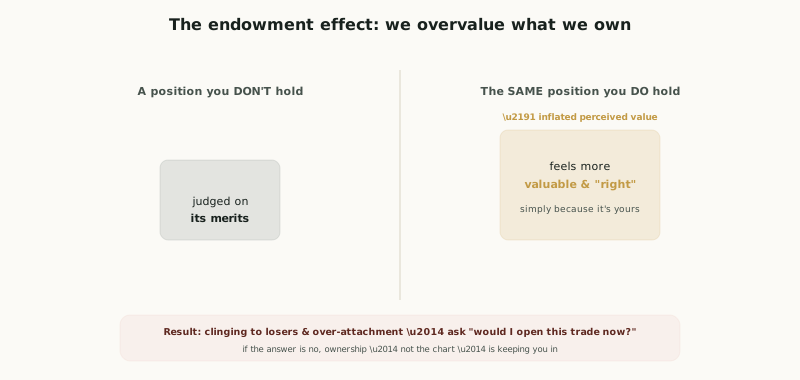
The endowment effect is the tendency to value something more highly simply because you own it. In classic experiments, people given an item (a mug, say) demand far more to give it up than they'd have been willing to pay to acquire the identical item moments earlier — the only thing that changed is ownership, yet the perceived value jumped. Ownership itself inflates value. In trading, this means you tend to view your own positions — and even your own analysis and market views — as more valuable, more correct, and harder to let go of than they objectively are. The position you hold feels different from the identical position you don't hold: once it's "yours," you grant it a benefit of the doubt, an emotional premium, a reluctance to part with it, that you'd never extend to the same trade if you were evaluating it fresh. This is irrational — the market doesn't care who owns a position, and a trade's merits are identical whether you hold it or not — but the bias is deep and automatic: we're wired to value what's ours, a tendency that served our ancestors but quietly distorts a trader's judgement, attaching feeling to what should be a cold, ongoing assessment of whether a position still deserves to be held.
How it affects traders, and the cure
The endowment effect makes you attached to your positions, and that attachment biases you toward inaction — keeping what you have rather than objectively reassessing it. You become reluctant to close trades you "own," overvaluing them and defending them against contrary evidence: the chart deteriorates, the reasons for the trade weaken, but because the position is yours, you find reasons to hold rather than cut. This contributes directly to holding losers too long (the position feels more valuable than the market says it is, so you can't accept selling it "cheap") and to growing emotionally invested in being right (compounding with ego and the sunk-cost fallacy). It can also make you over-attached to your own market view or analysis — your forecast, your thesis — since that too feels like something you "own" and have invested in, making you slow to update it when the evidence shifts (reinforcing confirmation bias). In every case, the effect quietly tilts you toward keeping — the position, the view, the trade — simply because it's already yours, rather than judging it neutrally on its current merits. It's a major hidden contributor to the broader, account-damaging habit of clinging to what you hold instead of acting on what the market is actually telling you.
The cure is elegant and worth memorising: ask the clarifying question — "If I didn't already hold this position, would I open it right now, at this price?" If the honest answer is no, then it's only ownership — not the merits — keeping you in, and you should seriously consider closing it. This question is powerful because it reframes the decision: from "should I give up what's mine?" (which the endowment effect distorts, making the position feel too valuable to surrender) to a neutral "is this a trade I'd take today?" (which strips away the ownership premium and forces an objective assessment). By mentally resetting to a position of not owning the trade, you sidestep the bias entirely and judge the position as a fresh decision. The same question works for your market views: "if I had no opinion yet, what would the evidence tell me now?" — detaching your analysis from your ego. Practically, this means treating each open position as a fresh decision each day (hold only what you'd open today), following your rules (which are made without the ownership bias and don't care that the position is "yours"), and noticing the feeling of attachment as a signal to apply the question. As with all cognitive biases, you can't delete the endowment effect — the pull to overvalue what's yours is automatic — but you can manage it with the simple discipline of asking, repeatedly, whether you'd open the trade fresh. The honest framing: the endowment effect is valuing something more just because you own it — in trading, you overvalue your own positions and views, making you cling to losers, defend them against the evidence, and grow attached to being right, all biasing you toward keeping rather than reassessing. Break it with one question: "if I didn't hold this, would I open it now?" If no, only ownership is keeping you in — so treat each position as a fresh decision, follow your rules, and use the feeling of attachment as your cue to ask.
The family of attachment biases
The endowment effect is so powerful in trading because it rarely acts alone — it's part of a tight family of attachment biases that reinforce one another, all pulling you to cling to what you hold. Loss aversion means losses hurt roughly twice as much as equivalent gains feel good, so closing a losing position (locking in that painful loss) feels far worse than the numbers justify — and the endowment effect adds to this by making the position feel more valuable than it is. The sunk-cost fallacy adds the weight of past investment ("I've already committed to this trade, I can't abandon it now"). The disposition effect — the documented tendency to sell winners too early and hold losers too long — is essentially these biases in action. And ego ties it all together: the position represents your judgement, so letting it go (especially at a loss) feels like admitting you were wrong, which the ego resists fiercely.
Together, these form an attachment cluster that makes letting go of a position genuinely hard — several deep, automatic biases all whispering "hold on" at once. This is why simply knowing about the endowment effect isn't enough to beat it (the pull is emotional, not logical), and why the meta-cure is structural: externalise the decision to rules that don't care about ownership. A predefined stop-loss closes the position mechanically when your thesis is invalidated, bypassing the whole attachment cluster — the rule, set when you were unattached, simply executes. Pre-committed exits (deciding your exit criteria before you own the trade, when no attachment exists) work the same way. And the "would I open this now?" question resets you to a state of non-ownership to neutralise the bias in the moment. The unifying principle across all the attachment biases is the same: because owning a position warps your judgement of it, the defence is to let pre-made rules decide rather than your attached, in-the-moment self — the recurring lesson that disciplined trading means protecting yourself from your own predictable psychology. The honest reminder: the endowment effect rarely acts alone — it combines with loss aversion (losses hurt ~2×), the sunk-cost fallacy (past investment), the disposition effect (sell winners/hold losers) and ego (the position is your judgement) into an attachment cluster that makes letting go hard; knowing about it isn't enough, so the meta-cure is structural — externalise exits to predefined stops and pre-committed rules set before you owned the trade, letting unattached rules decide rather than your attached self.
The endowment effect is valuing something more just because you own it — in trading, you overvalue your own positions and views, making you cling to losers, defend them against the evidence, and grow attached to being right (compounding loss aversion, the disposition effect, ego and the sunk-cost fallacy) — all biasing you toward keeping rather than reassessing. Break it with one question: "If I didn't already hold this, would I open it now at this price?" If no, only ownership — not the merits — is keeping you in, so consider closing it. It reframes "give up what's mine?" into a neutral "is this a trade I'd take today?" — so treat each position as a fresh decision, follow your rules, and let the feeling of attachment be your cue to ask. You can't delete the bias — but you can manage it.