
The Stochastic RSI (StochRSI) is an unusual creature: an indicator built on top of another indicator. Rather than being calculated from price, it applies the Stochastic formula to the RSI — measuring where the RSI itself sits within its recent range. The result is a faster, more sensitive oscillator than the RSI alone, which reaches overbought and oversold extremes far more often. That sensitivity is both its appeal and its danger. This guide explains the Stochastic RSI: how it's built, how to read it, how it compares to the plain RSI, and how to use its sensitivity without being whipsawed by it.
It combines two familiar indicators — the RSI and the Stochastic — and, like them, belongs inside confluence rather than standing alone.
Key takeaways
Q: What is the Stochastic RSI?
A: The Stochastic RSI (StochRSI), developed by Chande and Kroll, is an indicator of an indicator: it applies the Stochastic Oscillator formula to RSI values rather than to price. This measures where the current RSI sits within its own recent range, producing a faster, more sensitive oscillator than the RSI alone, scaled 0 to 1 (or 0 to 100).
Q: How do you read the Stochastic RSI?
A: It oscillates between 0 and 1 (or 0 and 100). Readings above 0.8 (80) indicate overbought and below 0.2 (20) oversold. Traders watch for crosses out of those zones and %K/%D crossovers, much like the Stochastic. It reaches overbought and oversold extremes far more often than the standard RSI.
Q: Is the Stochastic RSI better than the RSI?
A: Not better — just more sensitive. StochRSI generates more frequent signals because it amplifies the RSI's movements, which helps in some conditions but also produces more false signals and whipsaws. It's noisier than the RSI and, being derived from an indicator that's itself derived from price, is twice removed. The extra sensitivity is both its strength and its weakness.
What it is
The Stochastic RSI was developed by Tushar Chande and Stanley Kroll, and the clearest way to understand it is by its name: it's the Stochastic Oscillator formula applied to RSI values (rather than to price). Where the ordinary Stochastic measures where the current close sits within the recent high-low range of price, the StochRSI measures where the current RSI sits within the recent high-low range of the RSI. So it's an indicator of an indicator — a second layer of processing applied to the RSI. The purpose is to address a quirk of the standard RSI: the RSI sometimes drifts in the middle of its range for long stretches without reaching the traditional overbought (70) or oversold (30) extremes. By running the Stochastic formula over the RSI, the StochRSI amplifies the RSI's movements, producing a far more sensitive and responsive oscillator that swings to its extremes much more frequently. It's scaled from 0 to 1 (or, equivalently, 0 to 100), with above 0.8 (80) = overbought and below 0.2 (20) = oversold.
Reading it, and how it compares to the RSI
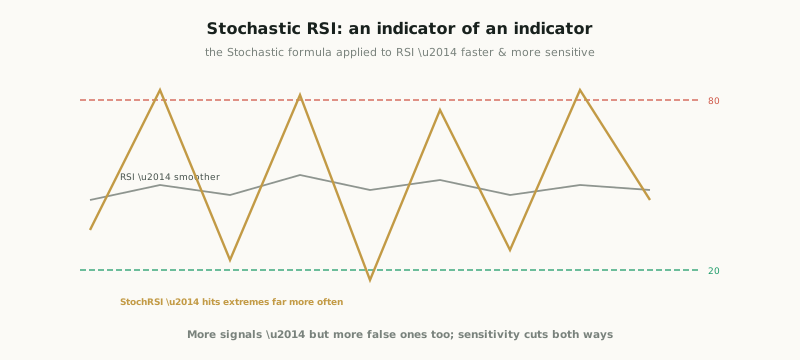
You read the StochRSI much like the Stochastic: overbought above 0.8, oversold below 0.2, with traders watching for the line crossing out of those zones and for %K/%D crossovers as triggers. The defining feature is its frequency: because it's so sensitive, it reaches overbought/oversold readings far more often than the RSI, generating more signals. The table compares the two.
StochRSI vs RSI
| Aspect | Stochastic RSI | RSI |
|---|---|---|
| Calculated from | The RSI (an indicator) | Price |
| Sensitivity | High — fast, amplified | Lower — smoother |
| Signal frequency | Frequent (hits extremes often) | Less frequent |
| Scale | 0–1 (or 0–100); OB 0.8 / OS 0.2 | 0–100; OB 70 / OS 30 |
| Trade-off | More signals, more false ones | Fewer signals, less noise |
The comparison makes the central trade-off clear: the StochRSI's extra sensitivity cuts both ways. More signals can mean catching turns earlier and finding opportunities the RSI misses — but it also means more false signals and whipsaws, since not every swing to an extreme leads to a real move. It's noisier than the RSI, and being doubly derived from price (an indicator of an indicator), it's twice removed from the underlying market. So the StochRSI isn't "better" than the RSI — it's more sensitive, which suits some conditions and traders (those wanting more responsive signals, perhaps for shorter-term timing) and poorly suits others (those who'd be chopped up by the extra noise).
The honest caveats are those of any oscillator, sharpened by the StochRSI's sensitivity. Its overbought/oversold readings can persist in strong trends (an extreme reading isn't an automatic reversal — and with StochRSI hitting extremes so often, this is an especially easy trap). It's noisy, so its many signals need filtering. And it's derived (twice over), confirming rather than predicting. The sensible approach is to use it for responsive momentum and timing signals within trend context, with confirmation from price and other tools, and firm risk management — and to be especially disciplined about not acting on every one of its frequent signals. Many traders find the standard RSI sufficient and the StochRSI's noise not worth it; others value the early, sensitive signals — it's a matter of style and testing. The honest framing: the Stochastic RSI applies the Stochastic formula to RSI values (an indicator of an indicator), producing a more sensitive, faster oscillator (0–1 or 0–100; above 0.8 overbought, below 0.2 oversold) that reaches extremes more often than the RSI. It's useful for more frequent, responsive overbought/oversold and timing signals. But the sensitivity cuts both ways — more signals means more false ones and whipsaws; it's noisier than the RSI, doubly removed from price, and its extremes can persist in trends (not automatic reversals). Use it as a sensitive momentum tool within trend context, confirmation and risk management — not a standalone signal, and with the discipline to ignore its many false readings.
Using the Stochastic RSI well
The StochRSI's defining challenge is its noise, so using it well is largely about filtering its many signals. Start with settings: the standard build uses a 14-period RSI and a 14-period Stochastic applied to it, often with %K and %D smoothing — and increasing the smoothing or lengthening the periods is the simplest way to tame the noise, producing fewer, more reliable signals at the cost of some responsiveness. If you find the default StochRSI impossibly jumpy, slower settings (or simply reverting to the plain RSI) are legitimate responses.
Beyond settings, three filters make the StochRSI workable. First, only trade signals in the direction of the trend: in an uptrend, act on oversold StochRSI signals (buying pullbacks) and ignore the overbought ones; in a downtrend, do the reverse. This single discipline removes most of the damage from its frequent false reversal signals, since (as with every oscillator) extremes persist in trends. Second, use crossovers and zone exits rather than raw extremes: waiting for %K to cross %D, or for the line to cross back out of the overbought/oversold zone, filters out some of the noise of a reading merely touching an extreme. Third, demand confirmation and confluence: a StochRSI signal that lines up with support or resistance, a candlestick signal, or the broader RSI is worth far more than one in isolation — and given how many signals StochRSI fires, the discipline to act only on confirmed, trend-aligned, confluent ones is what separates useful from harmful use. As for who it suits: the StochRSI tends to appeal to shorter-term, more active traders who want responsive, early signals and are willing to filter aggressively; traders who'd be whipsawed by its sensitivity, or who prefer fewer, cleaner signals, are often better served by the standard RSI. There's no shame in deciding the StochRSI's extra sensitivity isn't worth the noise for your style — many successful traders use the plain RSI and never miss it. The honest bottom line: the StochRSI is a sharper, faster instrument than the RSI, and like any sharper tool it can cut you if used carelessly. Filter its signals by trend, crossovers and confluence, manage risk on every trade, and treat its sensitivity as a feature to be disciplined about — not an invitation to trade its every twitch.
A filtered StochRSI signal
To see the filtering discipline in action, imagine a pair in a steady uptrend. Over a single session the StochRSI, being so sensitive, swings into overbought (above 0.8) and back several times — and a trader acting on every one of those overbought readings would short repeatedly into a rising market and be punished. The disciplined approach ignores those overbought signals entirely (they're against the trend) and waits instead for the StochRSI to dip into oversold (below 0.2) during a pullback — the one direction aligned with the uptrend. Even then, they don't fire on the bare reading: they wait for the %K to cross %D and turn up out of oversold, and they want confluence — the pullback holding a support level or the broader RSI also looking supportive. Only when trend, a filtered crossover signal, and confluence line up do they consider a long, with a defined stop and sensible size. Out of the StochRSI's many signals that session, perhaps one survives all the filters — and that's the point. The indicator's job isn't to be obeyed on every twitch but to flag candidate moments that your trend rule, crossover filter and confluence then whittle down to the few worth acting on. Sensitivity is useful only when paired with the discipline to ignore most of what it produces.
The Stochastic RSI (StochRSI), from Chande and Kroll, applies the Stochastic formula to the RSI (an indicator of an indicator), giving a faster, more sensitive oscillator (0–1 or 0–100; above 0.8 = overbought, below 0.2 = oversold) that hits extremes far more often than the RSI. Read it like the Stochastic (crosses out of zones, %K/%D crossovers). Its defining trait is sensitivity, which cuts both ways: more frequent signals, but more false ones and whipsaws — it's noisier than the RSI and doubly removed from price. It's not "better" than the RSI, just more sensitive (suiting some styles, not others). Its extremes persist in strong trends (not auto-reversals — an easy trap given how often it hits them). Use it for responsive momentum/timing within trend context, confirmation and risk management — with the discipline to ignore its many false signals.