When a government spends far more than it raises in taxes, and the country buys more from abroad than it sells, the two gaps often show up together — the so-called twin deficits. The connection between a nation's budget deficit and its external deficit is one of the more debated relationships in macroeconomics, and it carries real implications for a currency, because both deficits ultimately rely on financing from abroad. This guide explains the twin deficits: what they are, the hypothesised link, the currency implications, and the debate.
It connects the worlds of fiscal policy and the current account, and turns on the capital flows that fund both.
Key takeaways
Q: What are the twin deficits?
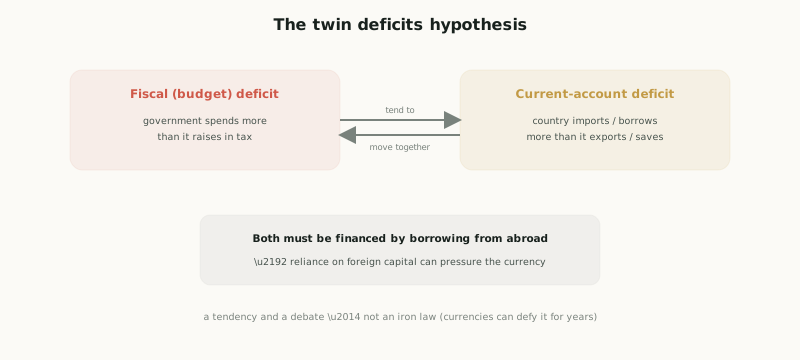
A: The twin deficits are a country's fiscal (budget) deficit — where the government spends more than it raises in taxes — and its current-account deficit — where the country imports more goods, services and income than it exports. The 'twin deficits hypothesis' holds that these two tend to move together, because a larger budget deficit can reduce national saving and widen the external deficit.
Q: Why do the twin deficits matter for a currency?
A: Because both deficits must be financed by borrowing from abroad — the government sells bonds to foreign investors, and the current-account deficit means the country is a net borrower from the rest of the world. This creates reliance on continued foreign capital inflows. If that reliance grows large or foreign appetite wanes, it can pressure the currency lower, all else equal.
Q: Is the twin deficits hypothesis always true?
A: No — it's a tendency and an ongoing economic debate, not an iron law. The link can be weak or absent depending on private saving, capital flows and other factors, and a currency can defy the implied pressure for years — especially a reserve currency that the world is happy to fund. The twin deficits are a useful structural lens on currency vulnerability, not a precise or reliable predictor of exchange rates.
The two deficits and the link between them
The twin deficits are two distinct shortfalls that often appear together. The fiscal (budget) deficit is when a government spends more than it raises in taxes, plugging the gap by borrowing (issuing government bonds). The current-account deficit is when a country as a whole imports more goods, services and income than it exports — meaning it consumes more than it produces and must, in net terms, borrow from the rest of the world to do so. The twin deficits hypothesis holds that these two tend to move together: the reasoning (rooted in national-accounting identities) is that a larger budget deficit can reduce national saving, and with less domestic saving to fund investment and consumption, the country draws more on foreign saving — widening the external deficit. The crucial unifying point for a trader is this: both deficits must be financed by foreign capital. The government sells bonds that foreign investors help buy, and the current-account deficit is, by definition, the country being a net borrower from abroad. So a country running twin deficits is structurally reliant on continued inflows of foreign capital — and anything dependent on the kindness of foreign lenders carries a built-in vulnerability.
Currency implications and the debate
The currency implications flow from that reliance. In the simplest telling, a country running large twin deficits depends on attracting enough foreign capital to fund both the government's borrowing and the external shortfall; if that reliance grows very large, or if foreign investors' appetite wanes (perhaps demanding higher yields or losing confidence), the currency can come under downward pressure, all else equal — either because inflows slow, or because the country must offer more attractive terms (a weaker currency, higher rates) to keep the capital coming. Persistent, growing twin deficits are therefore often viewed as a structural negative for a currency over the long run, a sign of an economy living beyond its means and leaning on foreign funding (the link to sovereign debt concerns is direct). Traders watching a currency's long-term fundamentals keep an eye on the trajectory of both deficits as a gauge of vulnerability.
But — and this caveat is large — the twin deficits are a tendency and an ongoing debate, not an iron law, and certainly not a reliable short-term currency predictor. The empirical link between the two deficits is variable: it can be strong in some periods and weak or absent in others, because private saving behaviour, capital flows, the business cycle and many other factors intervene (economists argue extensively about how tight the connection really is). More importantly for traders, a currency can defy the implied pressure for years — the clearest example being a dominant reserve currency, which the world is willing to fund almost indefinitely because of its unique global demand, allowing its issuer to run large twin deficits without the textbook currency weakness materialising. So the twin deficits are best treated as a structural lens on long-run vulnerability — useful for understanding what could eventually weigh on a currency and why a country depends on foreign capital — rather than a precise or timely trading signal. Like all fundamental relationships, it informs a view without guaranteeing an outcome, and it must be combined with the wider picture and with risk management. The honest framing: the twin deficits are a country's fiscal (budget) deficit and current-account deficit, which the twin-deficits hypothesis says tend to move together (a bigger budget deficit reduces national saving, widening the external gap). They matter because both must be financed by foreign capital, so a country running them relies on continued inflows — and if that reliance grows or foreign appetite wanes, the currency can face downward pressure, a structural long-run negative. But it's a tendency and a debate, not an iron law: the link varies with private saving and capital flows, and a currency (especially a reserve currency) can defy it for years. Use it as a lens on long-run vulnerability, not a precise predictor; manage risk.
The twin deficits in practice
The twin deficits play out very differently depending on which country runs them, and that contrast is the most useful thing for a trader to internalise. The United States is the great exception that proves how much the rules bend for a reserve currency: it has run large twin deficits for decades — a persistent budget deficit and a persistent current-account deficit — yet the dollar has not suffered the textbook collapse, precisely because the world's structural demand for dollars (for trade, reserves and safety) means foreign capital keeps funding those deficits, often eagerly, even at low yields. This "exorbitant privilege" lets the US sustain imbalances that would sink a smaller economy. At the opposite end, emerging-market economies running twin deficits are far more vulnerable: they lack that automatic global demand for their currency, so they depend on fickle foreign capital that can reverse quickly. When global risk appetite sours or US rates rise, capital can flee these "twin-deficit" currencies sharply — a recurring pattern in emerging-market currency stress, where countries with large external financing needs are hit hardest.
This points to what actually matters for a trader: not the mere existence of twin deficits, but their size, trajectory and financeability relative to the country's standing. A widening twin-deficit trajectory in a country without reserve-currency status — especially one increasingly reliant on short-term foreign borrowing — is a structural warning sign, flagging a currency that could be vulnerable if sentiment shifts or funding gets more expensive. A narrowing trajectory, or deficits comfortably financed by stable long-term investment inflows, is far less alarming. Traders therefore use the twin deficits as part of a vulnerability assessment, asking: how large are the deficits relative to GDP, are they growing, who is financing them, and how stable is that financing? — combining the answer with the country's reserve status, growth, rates and the prevailing risk environment. It's a slow-burn, structural input rather than a trade trigger: a currency can carry large twin deficits for years until a catalyst (a risk-off shock, a rate shift, a confidence wobble) suddenly makes the reliance on foreign capital bite. The honest reminder: the twin deficits illuminate where long-run currency vulnerability lies and why a country depends on foreign funding — a valuable lens, especially for distinguishing resilient reserve currencies from fragile deficit-dependent ones — but they're a structural signal, not a precise or timely predictor, and must be combined with the wider picture and risk management.
The savings-investment view
There's a deeper way to see why the twin deficits link up, rooted in a national-accounting identity: a country's current-account balance equals its savings minus its investment. In plain terms, if a nation invests more than it saves, it must borrow the difference from abroad — which is a current-account deficit. A fiscal deficit fits straight into this: when the government runs a deficit, it is dis-saving (spending more than it collects), which lowers national saving; unless private saving rises to fully offset it, total saving falls short of investment, and the gap is filled by foreign capital — widening the external deficit. This is the rigorous backbone of the twin-deficits hypothesis, and it also explains the escape clause: if private saving rises enough to offset the government's dis-saving (as can happen), the current account need not deteriorate, which is partly why the empirical link is loose. For a trader, the identity is a reminder that a current-account deficit is fundamentally a story about a country saving less than it invests and relying on foreigners to bridge the gap — the lens through which currency vulnerability should be read.
The twin deficits are a country's fiscal (budget) deficit (government spends more than it taxes) and its current-account deficit (imports/borrows more than it exports/saves). The twin-deficits hypothesis says they tend to move together — a bigger budget deficit reduces national saving, widening the external gap. They matter for currencies because both must be financed by foreign capital, so the country relies on continued inflows; if that reliance grows or foreign appetite wanes, the currency can face downward pressure — a structural long-run negative. But it's a tendency and a debate, not an iron law: the link varies with private saving and capital flows, and a currency — especially a reserve currency the world will fund — can defy it for years. A lens on long-run vulnerability, not a precise predictor.