
EUR/GBP is the major cross with no dollar in sight — a clean play on the euro versus the pound, the two dominant European currencies. As a cross (a pair without the US dollar), it behaves differently from the dollar majors, and because the Eurozone and UK economies are so closely linked, it tends to be calmer and more range-bound, with a character all its own. Understanding EUR/GBP rounds out a grasp of the major pairs and introduces how crosses behave. This guide profiles it: why it's range-prone and lower-volatility, what drives it, how it differs from the dollar majors, and what beginners should know. (Educational only — a behavioural profile, not a forecast or advice.)
It's the leading example of a cross from forex pairs explained, complements the dollar-major guides like EUR/USD and GBP/USD, and its range-prone character suits range trading.
Key takeaways
Q: What is EUR/GBP and what drives it?
A: EUR/GBP is a major cross — the euro against the British pound, with no US dollar leg. It's driven by the relative strength of the Eurozone versus the UK economy, the policy and rate gap between the European Central Bank and the Bank of England, and UK–EU relations and politics.
Q: Why is EUR/GBP often range-bound?
A: Because the Eurozone and UK economies are closely linked as major trading partners and tend to move somewhat together, EUR/GBP often trades in smaller ranges with lower volatility than the dollar majors or yen pairs — though it can move sharply on significant policy divergences or political events.
Q: What is a currency cross?
A: A currency cross is a pair that doesn't include the US dollar, such as EUR/GBP or EUR/JPY. Crosses let you trade the relative strength of two non-dollar currencies directly, without the influence of broad US dollar moves — useful for expressing a specific view or diversifying away from dollar exposure.
A cross with no dollar leg
The first thing to understand about EUR/GBP is that it's a cross — a currency pair that does not include the US dollar (from the forex-pairs guide). The dollar majors (EUR/USD, GBP/USD, USD/JPY and the rest) all have the dollar on one side, so they're heavily influenced by broad dollar moves — when the dollar strengthens or weakens against everything, the majors move with it. EUR/GBP, by contrast, pits the euro directly against the pound with no dollar involved, so it's a cleaner expression of euro-versus-pound relative strength, largely free of broad-dollar influence.
This "no dollar leg" feature has useful implications. It makes EUR/GBP a direct play on the relative performance of the Eurozone versus the UK — if you have a view that the Eurozone economy or the ECB will outperform/out-hawk the UK and the BoE (or vice versa), EUR/GBP expresses that view directly, without the noise of dollar moves muddying it. It also makes the pair useful for diversifying away from dollar exposure: a trader whose other positions are all dollar pairs can use EUR/GBP to take a position not driven by the dollar, reducing concentration in dollar risk (a correlation-risk consideration). And, mechanically, EUR/GBP is related to EUR/USD and GBP/USD (it's effectively their ratio — the euro's value against the pound, derived from each against the dollar), but it has its own distinct character driven by European, not dollar, factors. So the defining structural feature of EUR/GBP is that it's a pure euro-versus-pound cross — a clean European play, free of the broad-dollar influence that dominates the majors.
Why it's calmer and range-prone
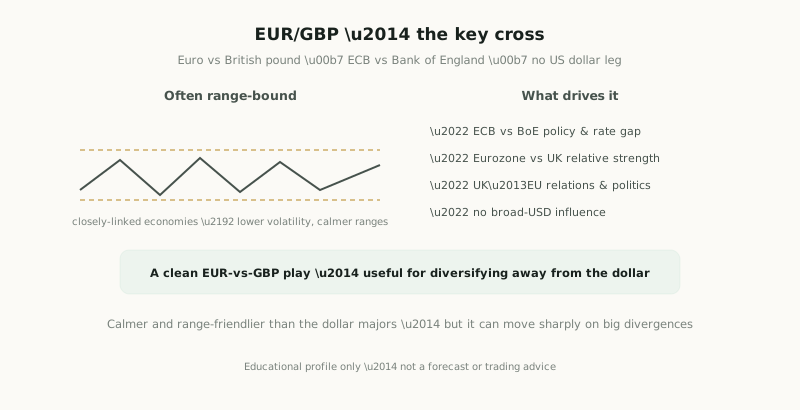
EUR/GBP's most distinctive behavioural feature is that it tends to be calmer, lower-volatility and more range-bound than the dollar majors or the yen pairs. The reason is the close linkage between the Eurozone and UK economies: they're major trading partners, geographically and economically intertwined, and their economic conditions and monetary policies often move somewhat together — so the euro and the pound frequently strengthen or weaken in tandem against the rest of the world, leaving their relative value (which is what EUR/GBP measures) to move in smaller ranges. When two closely-linked economies move together, the pair pricing one against the other tends to drift in tighter ranges rather than trend violently, which is exactly what EUR/GBP often does. The table contrasts its character with the dollar majors.
EUR/GBP cross vs a typical dollar major
| Aspect | EUR/GBP (cross) | Typical dollar major |
|---|---|---|
| Dollar influence | None (no USD leg) | Strong (broad dollar moves) |
| Volatility | Often lower, calmer | Often higher |
| Behaviour | More range-bound | More trending |
| Main read | Eurozone vs UK | Currency vs the dollar |
This calmer, range-prone character makes EUR/GBP relatively well-suited to range-trading approaches (buying near support, selling near resistance within a range — the range-trading guide), and means it generally lacks the large, sustained trends that dollar majors can produce. However — an important caveat — EUR/GBP can move sharply when there's a significant divergence between the Eurozone and UK: a notable difference in ECB versus BoE policy, a big gap in economic performance, or major political events affecting one side. The Brexit era, for instance, drove large, volatile moves in the pair as UK–EU relations dominated the pound. So while EUR/GBP is usually calmer and range-bound, it's not immune to strong moves when the two economies genuinely diverge. The honest characterisation is: lower-volatility and range-prone most of the time (thanks to the close Eurozone–UK linkage), but capable of sharp moves on real divergence.
Drivers and what to know
EUR/GBP's drivers are, fittingly, European rather than dollar-driven. The ECB versus BoE policy and rate gap is central: the relative monetary policy of the European Central Bank and the Bank of England, and the interest-rate differential between them, drive the pair — a more hawkish ECB relative to the BoE tends to lift EUR/GBP, and vice versa. The relative economic performance of the Eurozone versus the UK matters: stronger Eurozone data relative to UK data tends to support the euro against the pound (lifting EUR/GBP), and the reverse weighs on it. And UK–EU relations and politics have historically been a significant driver (the Brexit period being the prime example), as political developments affecting the UK's relationship with the EU move the pound and thus the pair. In character, as discussed, it's a liquid major cross, usually calmer and more range-bound than the dollar majors, but capable of sharp moves on divergence. For a beginner, the key things to know are: it's a cross (no dollar leg — a clean Eurozone-vs-UK play, useful for diversifying from dollar exposure); it's usually calmer and range-prone (often suited to range approaches, lacking big trends — but watch for sharp moves on real ECB–BoE or economic/political divergence); and its drivers are European (ECB vs BoE, Eurozone vs UK performance, UK–EU politics — not the broad dollar). The honest, educational summary: EUR/GBP — the key euro–pound cross — is a major pair with no dollar leg, a clean play on the Eurozone versus the UK, typically calmer and more range-bound than the dollar majors thanks to the close linkage of the two economies, but able to move sharply on genuine divergence; driven by ECB–BoE policy, relative economic performance and UK–EU relations. It's the natural pair to understand once you know the dollar majors, introducing how crosses behave and offering a distinct, dollar-free way to trade Europe.
Trading the cross in practice
In practice, following EUR/GBP centres on the European session and the two central banks. On timing, the cross is overwhelmingly a European/London-session pair — unsurprisingly, since both the Eurozone and the UK trade in those hours and their data lands then. The London session is its busiest, most liquid window, when Eurozone and UK releases and ECB/BoE communications most move it; outside European hours it tends to be quieter still (per the trading-sessions guide), reinforcing its generally calmer character.
On what to watch, the drivers translate into a focused, European watchlist: the ECB and the Bank of England (rate decisions, statements and the evolving rate gap between them — the central driver); relative Eurozone-versus-UK economic data (inflation, growth, employment on both sides, read against each other); and UK–EU relations and politics, which have at times (the Brexit era most dramatically) dominated the pair through their effect on the pound. The key analytical habit for EUR/GBP is to think in relative terms — not "how is the euro doing?" or "how is the pound doing?" in isolation, but "how is the Eurozone doing versus the UK?" — since the cross measures precisely that relative strength.
A few practical notes. The pair's usually calm, range-bound character makes it relatively well-suited to range-trading approaches and less likely to produce the big sustained trends of the dollar majors — but the crucial caveat is to watch for divergence: when the ECB and BoE genuinely diverge, or a major political event hits, EUR/GBP can break out of its ranges and move sharply, so the "calm" assumption shouldn't be taken for granted around such catalysts. Its lack of a dollar leg makes it useful for diversifying away from dollar exposure — a position whose risk is European rather than dollar-driven — though a trader should remember it's still related to EUR/USD and GBP/USD (effectively their ratio) and account for that in their overall exposure. As always, even a calmer pair's moves warrant sound position sizing and stops, especially around the divergence catalysts that can wake it up. None of this is advice on how to trade the cross; it simply shows how EUR/GBP's dollar-free, Europe-focused, range-prone character shapes what its followers watch and the risks they weigh.
EUR/GBP is the major euro–pound cross — no US dollar leg — so it's a clean play on Eurozone-vs-UK relative strength, free of broad-dollar influence (useful for diversifying away from dollar exposure). Because the Eurozone and UK economies are closely linked and often move together, EUR/GBP tends to be calmer, lower-volatility and more range-bound than the dollar majors (often suiting range-trading, lacking big trends) — but it can move sharply on significant divergence (ECB vs BoE policy, economic gaps, or UK–EU politics, as in the Brexit era). Drivers are European: the ECB–BoE rate gap, relative Eurozone-vs-UK performance, and UK–EU relations. For beginners: know it's a dollar-free cross, usually calmer and range-prone, driven by European not dollar factors. Educational profile only — not a forecast or advice.