
GBP/CHF marries the pound's restless energy to the Swiss franc's safe-haven calm — and the result, unlike its quieter cousin EUR/CHF, tends to move with real conviction. The pound brings volatility and event risk; the franc brings safe-haven behaviour and the ever-present influence of the Swiss National Bank. Put together, GBP/CHF is a volatile cross with a haven's tail risk lurking beneath. This guide explains trading GBP/CHF: what the pair is, what drives it, its character and best sessions.
It's a cross built from the GBP/USD and USD/CHF legs, turning on the franc's safe-haven status and the pound's volatility.
Key takeaways
Q: What is the GBP/CHF pair?
A: GBP/CHF is a cross pair (no US dollar) pitting the British pound against the Swiss franc. It marries the lively, event-driven pound with the safe-haven franc, making it more volatile than EUR/CHF — with wider ranges and spreads — while still carrying the franc's safe-haven and SNB-related tail risk.
Q: What drives GBP/CHF?
A: The interest-rate differential between the Bank of England (BoE) and the Swiss National Bank (SNB); the SNB's ongoing management of the franc; risk sentiment, since the franc is a safe haven that strengthens in fear (pushing GBP/CHF down); and UK-specific factors like BoE policy and British economic and political news, which give the pound — and so the pair — much of its volatility.
Q: Is GBP/CHF more volatile than EUR/CHF?
A: Yes. The pound is a livelier currency than the euro, so pairing it with the franc produces a more volatile cross than EUR/CHF, with wider ranges and bigger swings. GBP/CHF still carries the franc's safe-haven dynamics and SNB-related tail risk, so it combines meaningful day-to-day volatility with the possibility of sharp risk-driven or intervention-driven moves.
The pair at a glance
GBP/CHF is a cross pair (no US dollar) combining the British pound (base) and the Swiss franc (quote). The snapshot below captures its essentials.
GBP/CHF snapshot
GBP/CHF is notably more volatile than EUR/CHF, for one simple reason: the pound is a livelier currency than the euro, prone to sharp moves on UK data, Bank of England decisions and British politics. Pairing that energy with the franc produces a cross with wider ranges and bigger swings than the placid EUR/CHF — while still inheriting the franc's safe-haven dynamics and SNB-related tail risk through the CHF leg. As a cross, it also carries wider spreads than the majors.
What drives it, and when to trade it
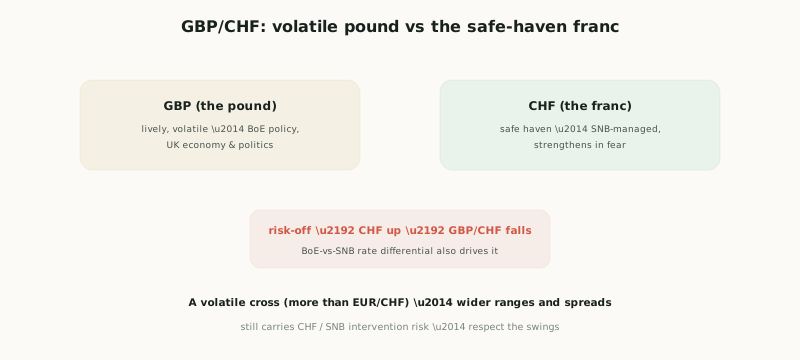
The pair's drivers combine pound and franc forces. The monetary-policy differential between the Bank of England (BoE) and the Swiss National Bank (SNB) — their rates and expectations — is a core driver, alongside the SNB's ongoing management of the franc (the same intervention tendencies that dominate EUR/CHF, since the SNB acts to limit excessive franc strength). Risk sentiment is central: the franc is a classic safe-haven, so in risk-off episodes the franc strengthens and GBP/CHF tends to fall (especially as the pound, with its own mild risk sensitivity, may soften at the same time); in risk-on calm, the reverse. And UK-specific factors — BoE policy, British growth, inflation and political news — drive the pound leg and supply much of the pair's day-to-day volatility, often producing sharp, pound-led moves.
On timing, both currencies are European, so GBP/CHF is most active during the European/London session, when the pound in particular is at its liveliest and the pair's volatility tends to peak. On correlations, GBP/CHF shares the franc leg with EUR/CHF and other CHF pairs (so it tends to fall alongside them in risk-off as the franc strengthens) and the pound leg with GBP pairs (tracking the pound's broader fortunes) — useful for managing correlated exposure (see currency correlations). Two honest cautions apply with extra force here: the pair's volatility means smaller position sizes and disciplined stops, and the franc's tail risk (SNB intervention, the kind of shock seen in EUR/CHF's 2015 crash) means a managed-currency surprise can hit hard — so don't mistake the pair's tradeable volatility for an absence of jump risk. As always, this is the pair's typical character, not a forecast; spreads and volatility vary with conditions and broker. The honest framing: GBP/CHF pits the volatile pound against the Swiss-franc safe haven — driven by the BoE-vs-SNB rate differential, the SNB's franc management, risk sentiment (the franc strengthens in risk-off, so GBP/CHF falls), and the pound's own volatility around UK events. It's a relatively volatile cross (more than EUR/CHF, as the pound is livelier), with wider ranges and spreads, and still carries CHF/SNB tail risk. Best traded in the European/London session. It rewards those wanting movement, but respect the volatility and the franc's intervention risk, and manage risk on every trade.
Approaching GBP/CHF
GBP/CHF occupies an unusual niche: it offers the day-to-day volatility of a lively cross while carrying the safe-haven dynamics and tail risk of a franc pair. That dual character shapes how to trade it. On one hand, the pound's energy gives the pair real movement — wide ranges and trends that intraday and swing traders can work with, often driven by UK events. On the other, the franc leg means GBP/CHF behaves as a risk-sentiment instrument: in fear, the franc strengthens and the pair falls (compounded if the pound softens too), so a trader can use GBP/CHF to express a risk view, with the added twist that the pound's own volatility amplifies the moves. Some traders favour it precisely for this combination — a haven cross that actually moves — but it demands the discipline of both a volatile pair and a managed-currency pair at once.
The fundamental watch-list spans both sides. On the pound: BoE decisions, UK growth, inflation and employment data, and British political developments, any of which can spark sharp, pound-led swings. On the franc: the SNB above all (its management of the franc, communications and any intervention or rate signals), plus the ECB indirectly (since Swiss policy and the franc are tied to the Eurozone backdrop), and broad risk sentiment, which drives the franc's haven behaviour. With event risk on both legs, knowing the calendar and trading cautiously around major releases matters as much here as on GBP/AUD.
The practical cautions stack up, and they're the heart of the matter. Position sizing must respect the volatility — wider stops, smaller positions — exactly as on any big-ranging cross. Cost is a factor: as a cross, GBP/CHF carries wider spreads than the majors and potentially meaningful swap charges, favouring swing over scalping. And critically, the franc's tail risk means that beneath the tradeable volatility lies the same jump risk that produced EUR/CHF's 2015 crash — an SNB shock could gap the pair violently, and "normal" volatility is no guide to that. So the honest approach is to treat GBP/CHF as a volatile cross with a tail: trade its movement with proper sizing and stops, watch both central banks and the risk environment, keep costs in mind, and never let the everyday swings lull you into forgetting the franc's capacity for sudden, ungovernable moves. Combine that risk awareness with technical timing — trend structure, support and resistance, your chosen setups — and GBP/CHF can be a rewarding pair for the experienced; ignore either the volatility or the tail risk, and it can punish quickly. As with every pair, the tendencies described here inform a view but guarantee nothing, and disciplined risk management is the constant.
Who it suits, and who should pass
GBP/CHF sits at an awkward intersection that makes it a poor fit for many traders. It combines the two things that most demand experience: high day-to-day volatility (from the pound) and managed-currency tail risk (from the franc). A beginner gets the worst of both — big swings to mishandle and a hidden jump risk to be blindsided by — so it's not a pair to learn on; quieter floating majors are the right training ground. Even experienced traders should weigh whether the pair earns its place: the franc's tail risk is a genuine reason some traders simply avoid all CHF crosses, preferring markets whose risks are fully transparent, and that's a perfectly defensible choice. The pair suits a specific type: the experienced, risk-aware trader who wants a volatile haven cross to express risk-sentiment and pound-versus-franc views, who sizes for both the volatility and the jump risk, and who accepts the wider spreads and swap costs that come with a cross. If that's not you — if you're still building discipline, or if hidden tail risk makes you uncomfortable — there's no penalty for passing; the major pairs offer ample opportunity without GBP/CHF's particular hazards. Choosing not to trade a pair you don't fully understand or can't properly risk-manage is itself good trading. As always, the tendencies described here inform a view but guarantee nothing, and on a pair this demanding, honest self-assessment about your own readiness matters as much as any analysis of the chart.
GBP/CHF is a cross (no USD) pitting the volatile pound against the safe-haven Swiss franc. It's more volatile than EUR/CHF (the pound is livelier than the euro) — wider ranges and spreads — while still inheriting the franc's safe-haven behaviour and SNB tail risk. Drivers: the BoE-vs-SNB rate differential, the SNB's franc management, risk sentiment (franc strengthens in risk-off → GBP/CHF falls), and UK factors (BoE, British data and politics drive the pound leg's volatility). Most active in the European/London session. It shares the franc leg with EUR/CHF (falling together in risk-off) and the pound leg with GBP pairs. Respect both the volatility (smaller size, disciplined stops) and the franc's intervention/jump risk — tradeable movement is not the absence of tail risk.