
NZD/CAD is an unusual cross: both currencies are commodity-linked and risk-sensitive, but tied to different commodities — New Zealand's dairy versus Canada's oil. That makes the pair a play on the relative performance of two similar-but-not-identical economies, rather than a clash of opposites. This guide covers trading NZD/CAD: what drives each leg, why they often move together, and how their divergence creates the trends worth trading.
It pairs the dairy-and-risk Kiwi of NZD/USD with the oil-linked loonie of USD/CAD, and is a neat study in currency correlation.
Key takeaways
Q: What is NZD/CAD?
A: NZD/CAD is the currency pair pricing the New Zealand dollar (NZD) against the Canadian dollar (CAD) — how many Canadian dollars one New Zealand dollar buys. It's a minor cross uniquely made up of two commodity currencies that are both risk-sensitive but tied to different commodities: New Zealand's soft commodities (notably dairy) versus Canada's oil and energy.
Q: Why do NZD and CAD often move together?
A: Because they're both commodity-linked, risk-on currencies, so they tend to respond similarly to shifts in global risk appetite and the broad commodity cycle — both strengthening in risk-on, commodity-friendly conditions and weakening in risk-off ones. This shared sensitivity means NZD/CAD often stays relatively range-bound, since the two legs move in sympathy; it's when their drivers diverge that the cross develops trends.
Q: What makes NZD/CAD trend?
A: Divergence between the two economies and their specific commodities. If oil prices surge while dairy lags (or vice versa), or if the Reserve Bank of New Zealand and Bank of Canada move on different paths, the usual sympathy between the two currencies breaks and the cross can trend in favour of the stronger side. So NZD/CAD is essentially a play on the relative performance of New Zealand versus Canada.
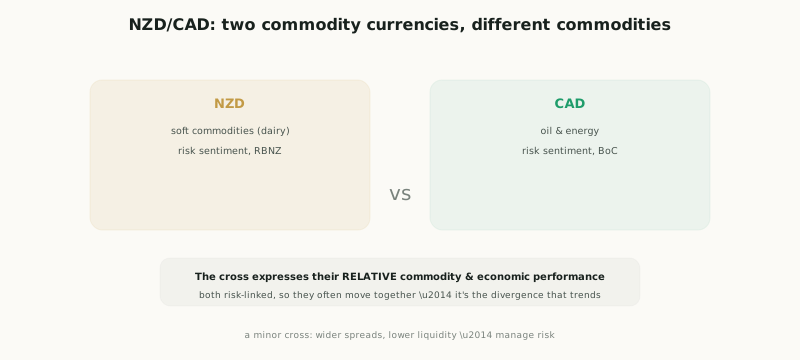
Two commodity currencies compared
The key to NZD/CAD is that its two legs are both commodity currencies — a rare matchup — but driven by different commodities and economies.
| NZD (New Zealand dollar) | CAD (Canadian dollar) | |
|---|---|---|
| Key commodity | Soft commodities (dairy) | Oil & energy |
| Central bank | Reserve Bank of New Zealand | Bank of Canada |
| Risk profile | Risk-on | Risk-on (mild) |
| Also watch | China/Asia-Pacific demand | US economy, oil markets |
Both are risk-on, commodity-linked currencies, but the specifics differ. The New Zealand dollar is tied to soft commodities — especially dairy, a major NZ export — plus the Reserve Bank of New Zealand and demand from China and the Asia-Pacific. The Canadian dollar is tied to oil and energy (Canada being a major oil exporter), the Bank of Canada, and the closely-linked US economy. So while they share a broad commodity-and-risk character, they're sensitive to different underlying drivers — dairy and Asia-Pacific demand on one side, oil and the US on the other.
Range, trend, and how to approach it
This shared-but-different character shapes the pair's behaviour. Because both NZD and CAD are commodity-linked, risk-on currencies, they tend to respond similarly to shifts in global risk appetite and the broad commodity cycle — both strengthening in risk-on, commodity-friendly conditions and both weakening in risk-off ones. This sympathy means the two legs often move together, which tends to keep NZD/CAD relatively range-bound compared to crosses that pit opposites against each other (like a risk-vs-haven pair): when the whole commodity bloc rises or falls, NZD and CAD largely cancel out within the cross. So NZD/CAD frequently lacks the big directional swings of more contrasting pairs — a feature, not a bug, for range-oriented approaches.
What makes the pair trend is divergence between the two sides. When their specific drivers pull apart — oil surges while dairy lags (favouring CAD), or dairy strengthens while oil slumps (favouring NZD), or the RBNZ and BoC move on different policy paths (a divergence story) — the usual sympathy breaks, and the cross can trend in favour of the stronger side. So NZD/CAD is essentially a play on the relative performance of New Zealand versus Canada: range-bound when their fortunes track each other, trending when they diverge. Trading it well means watching both commodity stories (dairy/Asia vs oil/US) and both central banks, and forming a view on which side is relatively stronger — a genuinely relative-value mindset. The usual minor-cross caveats apply: wider spreads and lower liquidity than the majors (raising costs and warranting conservative sizing). Both currencies are most active across the Asia-Pacific (NZD) into North American (CAD) hours, so liquidity varies through the day. As always, the pair offers a useful lens — here, relative commodity/economic performance — but no inherent edge; the edge is in reading the two sides and managing risk. The honest framing: NZD/CAD is a minor cross of two commodity, risk-on currencies tied to different commodities — NZD to dairy (and RBNZ, China/Asia), CAD to oil (and BoC, the US). Because both are commodity-and-risk-linked, they often move together, keeping the pair relatively range-bound; it trends when their drivers diverge (oil vs dairy, or the two central banks on different paths), making it a play on the relative performance of New Zealand vs Canada. Watch both commodity stories and both central banks, mind the wider-spread, lower-liquidity minor-cross traits, and manage risk.
Trading the relative-value spread
The most useful frame for NZD/CAD is relative value: because both legs are commodity-and-risk-linked and tend to move together, the pair behaves like a spread between two similar things, and the opportunity lies in judging which side is relatively stronger. This gives two distinct modes. In range mode — when New Zealand and Canada's fortunes are tracking each other (the usual state) — the pair oscillates in a relatively contained band, suiting range/mean-reversion approaches: fading the extremes back toward the middle, on the logic that the two commodity currencies will keep moving in sympathy and the spread will revert. In trend mode — when their drivers diverge — the pair breaks out and trends in favour of the stronger side, suiting a trend approach. Recognising which mode you're in is half the battle: NZD/CAD spends much of its time ranging (so trend signals here are more prone to false breaks than on a naturally trendy pair), and trends emerge specifically from a genuine divergence in the two stories.
So the practical work is comparing the two sides. On the NZD side: dairy prices (the regular dairy auctions), the Reserve Bank of New Zealand, and China/Asia-Pacific demand. On the CAD side: oil and energy prices, the Bank of Canada, and the US economy. A trade thesis amounts to "is dairy/NZ outperforming oil/Canada, or vice versa, and are the RBNZ and BoC diverging?" — then positioning for the stronger side. A crucial nuance: because both NZD and CAD are risk-on currencies, a broad risk shift tends to move them together and largely cancel within the cross — which is why NZD/CAD is a relatively pure play on their relative (rather than absolute) performance, and why it's less of a risk barometer than a CHF or JPY cross. On correlations, both legs correlate with broad commodity/risk and with the Aussie, so NZD/CAD can be correlated with other commodity-currency positions (see correlations) — check your aggregate exposure. The usual minor-cross caveats apply throughout: wider spreads and lower liquidity raise costs and warrant conservative sizing, and liquidity varies across the Asia-Pacific (NZD) into North American (CAD) hours. The honest reminder: trade NZD/CAD as a relative-value spread — range/mean-reversion when the two commodity stories track each other (the usual state), trend when they diverge (oil vs dairy, or RBNZ vs BoC); compare the two sides directly, remember broad risk moves cancel within the cross (so it's a relative play), watch for correlated commodity exposure elsewhere, and size conservatively for the thin liquidity.
Where it fits
NZD/CAD occupies a particular niche, and knowing it helps you decide when the pair is worth your attention. Its relatively range-bound, low-drama tendency (versus contrasting crosses) makes it appealing to traders who prefer ranging conditions and mean-reversion setups, and who want to express a specific relative view on New Zealand versus Canada rather than a directional bet on the broad market. It's a more analytical, relative-value pair than a momentum vehicle — which suits a methodical trader with a genuine thesis on the two economies' relative commodity and policy paths, but offers little to someone hunting big trending moves (for which the more volatile crosses, or the majors in a strong USD trend, are better suited). It's not a typical beginner pair either — not because it's especially wild (it's calmer than the GBP crosses), but because trading it well requires understanding two commodity economies and the relative-value concept, and because its thinner liquidity and wider spread quietly raise the bar; newcomers are better served by liquid majors first.
Pulling it together, the pair rewards a clear process: assess the dairy/NZ picture and the oil/Canada picture, gauge whether they're tracking (range) or diverging (trend), check the RBNZ vs BoC stance, confirm you're not unknowingly stacking correlated commodity-currency risk elsewhere, size conservatively for the thinner liquidity, and trade the mode you're actually in. Do that, and NZD/CAD is a clean, characterful relative-value cross; treat it as a directional momentum pair and you'll likely just pay the spread while it ranges. As with every pair, the edge is in the understanding and the risk management, never in the pair itself.
NZD/CAD is a minor cross of two commodity, risk-on currencies tied to different commodities — NZD to dairy (plus RBNZ, China/Asia), CAD to oil (plus BoC, the US). Because both are commodity-and-risk-linked, they often move together, keeping the pair relatively range-bound; it trends when their drivers diverge — oil vs dairy, or the two central banks on different paths (divergence) — making it a play on the relative performance of New Zealand vs Canada. Trade it with a relative-value mindset: watch both commodity stories and both central banks, judging which side is stronger. Mind the usual minor-cross wider spreads and lower liquidity, size conservatively, and manage risk.