
The Swiss franc — "the Swissy" — gives USD/CHF a distinctive character: it pairs the world's reserve currency (USD) against its quintessential safe haven (CHF) — two safe havens in a single pair. Add a near-mirror relationship with EUR/USD and a central bank famous for dramatic intervention, and USD/CHF becomes one of forex's more interesting majors to understand. This guide profiles the pair: the safe-haven nature of the franc, the strong negative correlation with EUR/USD, the SNB intervention risk, and what beginners should know. (Educational only — a behavioural profile, not a forecast or advice.)
It's a major-pair guide (see the major currency pairs), the near-mirror of EUR/USD, and brings together safe-haven flows and SNB intervention.
Key takeaways
Q: What drives the USD/CHF exchange rate?
A: USD/CHF is driven by global risk sentiment and safe-haven flows (the Swiss franc is a major safe haven), its strong negative correlation with EUR/USD, the policy of the Swiss National Bank (SNB) versus the Federal Reserve, and broad US dollar strength.
Q: Why is the Swiss franc a safe-haven currency?
A: Because of Switzerland's long-standing political stability, neutrality, sound public finances and strong financial system, the franc is seen as a reliable store of value in turbulent times. In risk-off, fearful conditions, capital tends to flow into the franc, strengthening it.
Q: Why is USD/CHF negatively correlated with EUR/USD?
A: Because of the close relationship between the euro and the franc and the shared US dollar leg positioned oppositely in the two pairs, USD/CHF and EUR/USD typically move in opposite directions — a strong, well-known negative correlation that traders watch closely.
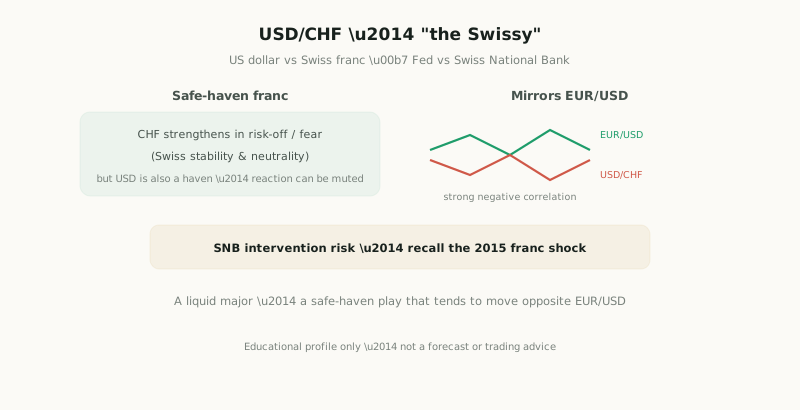
The safe-haven franc
The franc's defining feature is its status as a major safe-haven currency. Switzerland's long-standing political stability, neutrality, sound public finances and strong, trusted financial system make the franc a reliable store of value in turbulent times — so in risk-off, fearful conditions, capital tends to flow into the franc, strengthening it (the geopolitics-and-currencies and risk-on/risk-off guides cover safe-haven dynamics). The franc sits alongside the US dollar and the Japanese yen as one of the classic safe havens that benefit when markets are gripped by fear.
This creates an unusual situation in USD/CHF, because both currencies in the pair are safe havens. In a typical risk-off episode, the franc strengthens — which, since CHF is the quote currency, would push USD/CHF down — but the US dollar also strengthens as a safe haven, pulling the other way. The net effect on USD/CHF therefore depends on the relative safe-haven demand for the two currencies, and the pair's reaction to risk-off can be muted or ambiguous compared with a pair of a safe haven against a risk currency (like AUD/USD). This is a subtle but important point: USD/CHF doesn't react to risk sentiment as cleanly as pairs that pit a haven against a risk-on currency, because it has a haven on both sides. That said, the franc's safe-haven nature remains central to the pair, and shifts in the relative appeal of the dollar versus the franc as havens — along with the other drivers below — shape its moves. Understanding that USD/CHF is a "haven versus haven" pair, where risk-off strengthens both sides, is key to reading its sometimes-muted reactions.
The EUR/USD mirror and SNB intervention
The single most useful relationship to know about USD/CHF is its strong negative correlation with EUR/USD — the two pairs typically move in opposite directions, almost as mirror images. This arises from the close economic relationship between the euro and the franc (Switzerland's economy is deeply tied to the neighbouring Eurozone) and from the shared US dollar leg positioned oppositely in the two pairs (USD is the quote in EUR/USD but the base in USD/CHF). The practical upshot is that when EUR/USD rises, USD/CHF tends to fall, and vice versa — a relationship so reliable that USD/CHF is often treated almost as an inverse of EUR/USD.
Because USD/CHF tends to move opposite to EUR/USD, the two are effectively related expressions of dollar-versus-Europe sentiment. This matters for correlation risk: being long EUR/USD and short USD/CHF is roughly a doubled bet on the same theme (a weaker dollar against Europe), not a diversified position — if it goes wrong, both lose together. Treat EUR/USD and USD/CHF as closely related, not independent.
The other distinctive factor in USD/CHF is the Swiss National Bank (SNB) and its history of intervention. The SNB has actively intervened to influence the franc — most famously, it long defended a cap on the franc's strength against the euro before abruptly abandoning it in 2015, causing a violent franc surge that shook the market (the currency-intervention guide uses this as its classic case). The lesson for USD/CHF traders is that the franc carries intervention risk: the SNB may act (or signal) to influence the franc, potentially causing sudden, sharp moves, so it's a risk to be aware of, particularly at extreme levels. Beyond these, USD/CHF is shaped by the SNB–Fed rate gap and by broad US dollar strength (it's a dollar pair). In character, it's a liquid major whose moves are tightly (inversely) linked to EUR/USD, with a safe-haven franc and a meaningful (if occasional) SNB intervention risk. For a beginner, the key things to know are: understand the franc as a safe haven (but remember USD is one too, so risk-off reactions can be muted); watch EUR/USD (USD/CHF tends to mirror it — and don't unknowingly double up by trading both); and be aware of SNB intervention risk (the franc can move sharply on SNB action). The honest, educational summary: USD/CHF — the Swissy — is a liquid major featuring the safe-haven Swiss franc, a strong negative correlation with EUR/USD (effectively a mirror, with correlation-risk implications), SNB intervention risk, and the usual rate-gap and broad-dollar influences. Its "haven versus haven" nature and EUR/USD mirror give it a character all its own among the majors.
Watching and trading the Swissy
In practice, following USD/CHF leans heavily on watching EUR/USD and the risk environment. On timing, the Swissy is most active during the European/London session, given Switzerland's location and the franc's close ties to the Eurozone — European hours, when Eurozone and Swiss data land and EUR/USD is most active, tend to be the pair's busiest window (per the trading-sessions guide), with further moves in the New York session on US data driving the dollar side.
On what to watch, USD/CHF's profile points to a clear set of inputs. EUR/USD is, unusually, near the top of the list: because USD/CHF tends to mirror EUR/USD (strong negative correlation), watching EUR/USD and the euro-versus-dollar story effectively tells you much of what's driving the Swissy — many traders read USD/CHF partly through EUR/USD. Global risk sentiment matters given the franc's safe-haven status, though (as noted) the dollar's own haven status can mute the pair's risk-off reaction. The Swiss National Bank is a special watch item: SNB communications, policy and any hint of intervention can move the franc sharply, so SNB events carry outsized importance and intervention risk. And the broad US dollar and Fed policy drive the dollar side, as for any dollar pair.
A few practical notes. The EUR/USD mirror is the defining practical fact: it makes USD/CHF closely related to EUR/USD rather than independent, so a trader must avoid unknowingly doubling a euro-versus-dollar bet across the two pairs (the correlation-risk point), and can use EUR/USD's behaviour as a guide to the Swissy. The intervention risk deserves genuine respect — the franc's history (the 2015 shock above all) shows it can make violent, sudden moves on SNB action, a tail risk to keep in mind especially at extreme levels, managed with sound position sizing and stops. And the "haven versus haven" nature means USD/CHF won't always behave like a clean safe-haven play, so its reactions to risk events can be less predictable than, say, a haven-versus-risk-currency pair. None of this is a recommendation on trading the pair; it's how the Swissy's mirror-of-EUR/USD, safe-haven, intervention-prone character shapes what its followers watch and the risks they weigh.
The franc's modern history and what it teaches
The franc's recent history illuminates its character and the risks of trading USD/CHF. For an extended period, the Swiss National Bank pursued unconventional measures to manage the franc's persistent strength — most famously maintaining a cap (a floor on EUR/CHF) to prevent the safe-haven franc from appreciating too far and harming Swiss exporters, and at times employing negative interest rates to discourage capital from flooding into the franc. The episode that every trader should know is the SNB's abrupt removal of that cap in 2015, which sent the franc surging violently and inflicted heavy losses on those positioned against it — the canonical example of intervention's limits and of a currency's capacity for sudden, extreme moves (covered in the currency-intervention guide).
The lessons for USD/CHF are clear and enduring. The franc is a currency whose own central bank actively works to manage its (often upward) pressure, so SNB policy and stance are central to the pair, and the possibility of intervention — or of an abrupt policy shift — is a real tail risk, especially at levels the SNB might find uncomfortable. The franc's deep-seated tendency to strengthen (its safe-haven appeal drawing capital in) is the very thing the SNB has historically fought, which is why the pair's behaviour can't be read through pure market forces alone — the central bank is an ever-present actor. For a trader, this reinforces the practical posture: respect the franc's intervention and policy risk, size and stop sensibly given its capacity for sudden moves, and read USD/CHF with the SNB always in the picture. The franc's history is a vivid reminder that a currency can be shaped as much by its central bank's will as by the market — and that even a major can move with shocking speed when that will shifts.
USD/CHF ("the Swissy") is a major with a distinctive profile. The Swiss franc is a major safe haven (Swiss stability, neutrality, sound finances), strengthening in risk-off — but since the US dollar is also a haven, USD/CHF's reaction to risk-off can be muted (haven versus haven). Its key relationship: a strong negative correlation with EUR/USD — the two move oppositely, almost mirror images, so being long EUR/USD and short USD/CHF is a doubled bet, not diversification (correlation risk). Watch for SNB intervention risk (recall the 2015 franc shock — the franc can move sharply on SNB action). Also driven by the SNB–Fed rate gap and broad US dollar strength. For beginners: understand the safe-haven franc, watch EUR/USD (it mirrors it), and mind SNB intervention. Educational profile only — not a forecast or advice.