Not all forex brokers handle your orders the same way. Some take the other side of your trade themselves; others pass it straight to the market. This "dealing desk vs no-dealing-desk" distinction shapes your costs, your execution, and whether your broker profits when you lose — and while it's less important than regulation, it's worth understanding before you choose. This guide explains the types of forex brokers: how each model executes your orders, the potential conflict of interest, and why the label matters less than the broker's integrity.
It builds on how forex brokers work, affects your trading costs, and should always be weighed alongside regulation.
Key takeaways
Q: What's the difference between a dealing desk and a no-dealing-desk broker?
A: A dealing desk broker (also called a market maker) takes the other side of your trade itself — it's your counterparty, effectively creating the market you trade against, often with fixed spreads. A no-dealing-desk broker (STP or ECN) passes your order through to external liquidity providers or the wider market, typically charging variable spreads plus a commission. The core difference is whether the broker is on the other side of your trade or routing it elsewhere.
Q: Do market-maker brokers profit when I lose?
A: Potentially, yes — that's the often-cited concern. Because a dealing desk broker is your counterparty, your loss can be its gain, creating a potential conflict of interest. In practice many market makers hedge their net exposure and aim to profit from spreads and order flow rather than individual clients' losses, and a well-run regulated market maker can be perfectly legitimate. But the structural conflict is real, which is why understanding the model — and choosing a regulated broker — matters.
Q: Which type of broker is best?
A: Neither is automatically best — both models can be run well or badly. No-dealing-desk (ECN/STP) brokers avoid the direct conflict of interest and can offer tighter raw spreads, but charge commissions and aren't immune to other issues. Market makers can offer fixed spreads and simplicity. Crucially, the labels 'ECN' and 'no conflict' are also marketing terms, sometimes misused. Regulation, reputation, transparent costs and reliable withdrawals matter far more than the execution-model badge.
The two models
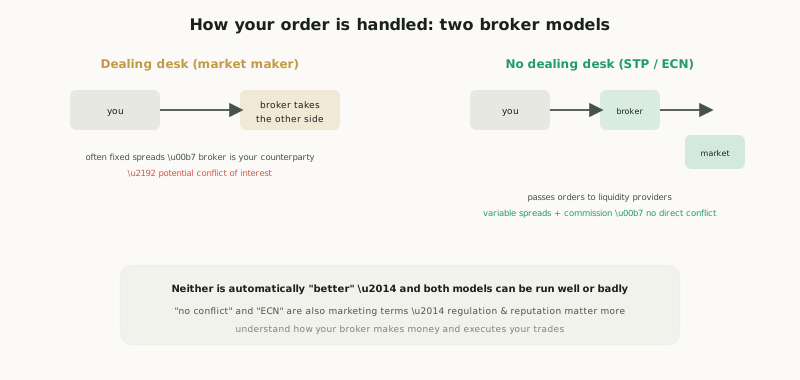
Brokers broadly fall into two execution models. A dealing desk broker (also called a market maker) takes the other side of your trade itself — it is your counterparty, effectively creating the market you trade against, often quoting fixed spreads. A no-dealing-desk broker (STP — Straight Through Processing — or ECN — Electronic Communication Network) instead passes your order through to external liquidity providers or the wider market, typically charging variable spreads plus a commission. The core difference is simply whether the broker is on the other side of your trade, or routing it elsewhere:
| Feature | Dealing desk (market maker) | No-dealing-desk (STP/ECN) |
|---|---|---|
| Your counterparty | The broker itself | External market / liquidity providers |
| Spreads | Often fixed | Variable (can be very tight) + commission |
| Conflict of interest | Potential — your loss can be its gain | No direct conflict (routes your order out) |
| Typical appeal | Fixed spreads, simplicity | Tighter raw spreads, no direct conflict |
The conflict, and what really matters
The most-discussed issue is the potential conflict of interest with market makers. Because a dealing desk broker is your counterparty, your loss can be its gain — which sounds alarming, and is the reason many traders prefer no-dealing-desk brokers. It's important to be balanced and accurate here, though. In practice, many market makers hedge their net exposure (offsetting clients' combined positions in the real market) and aim to profit from spreads and order flow rather than from any individual client's losses — and a well-run, regulated market maker can be perfectly legitimate (this model is widespread and not inherently a scam). But the structural conflict is real: the incentive exists, and a poorly-run or unregulated market maker could abuse it (through requotes, manipulated pricing, or trading against clients), which is exactly why understanding the model — and choosing a regulated broker that's accountable — matters. The no-dealing-desk model avoids this direct conflict by routing your order out, which is genuinely appealing, but it isn't a magic guarantee of fairness either.
This leads to the most important takeaway, which cuts against a lot of broker marketing: neither type is automatically "best," and both can be run well or badly. No-dealing-desk (ECN/STP) brokers avoid the direct conflict of interest and can offer tighter raw spreads, but they charge commissions and aren't immune to other problems (poor execution, withdrawal issues, weak regulation). Market makers can offer fixed spreads and simplicity that some traders prefer, and the better ones are reputable and regulated. Crucially, "ECN" and "no conflict of interest" are themselves marketing terms — widely used, sometimes loosely or misleadingly (some brokers labelled "ECN" aren't really, and a market maker can dress itself up). So don't choose a broker on the execution-model badge alone. What matters far more is the genuinely decisive stuff: regulation by a reputable authority (see regulation), a solid reputation, transparent costs (see the cost of trading), and reliable withdrawals. A regulated, reputable market maker is a far safer home for your money than an unregulated broker claiming to be "ECN." Understand the models so you know how your broker makes money and executes your trades — and then weight your decision toward regulation, reputation and transparency rather than the label. The honest framing: forex brokers are broadly dealing desk (market makers, who take the other side of your trade, often with fixed spreads and a potential conflict of interest) or no-dealing-desk (STP/ECN, who route your order to the market with variable spreads plus commission and no direct conflict). The market-maker conflict is real but often managed by hedging, and a regulated market maker can be legitimate; neither model is automatically best, both can be run well or badly, and "ECN"/"no conflict" are also marketing terms. Regulation, reputation, transparent costs and reliable withdrawals matter far more than the execution-model label.
Hybrid models, A-book/B-book, and what to actually check
Reality is messier than a clean two-way split: many brokers are hybrids. A common arrangement is to route some flow one way and some the other — often described as A-book vs B-book. A-book means the broker passes your trade through to the real market / liquidity providers (no conflict; it earns the spread/commission). B-book means the broker keeps your trade in-house as the counterparty (the market-maker model). Many brokers run both, deciding per-client or per-trade which book to use — commonly B-booking smaller or consistently-losing retail flow (where being the counterparty is profitable) while A-booking larger or consistently-winning clients (whose trades they'd rather hedge out). It's a normal industry practice, not inherently sinister, but it means the tidy "dealing desk vs ECN" labels often don't fully capture what's actually happening with your orders.
The practical upshot is liberating: since you usually can't fully know or verify which book you're on (brokers don't disclose it per-trade), don't agonise over the execution-model label — focus instead on the things you can assess and that actually protect you. The checklist that matters: strong regulation (a reputable authority holding the broker accountable however it books trades), execution quality (do you get fair fills without excessive slippage, requotes or suspicious spikes?), transparent costs (clear spreads and commissions, no hidden charges), a solid reputation (track record, reviews, time in business), and — the ultimate test — reliable withdrawals. A well-regulated, reputable broker with good execution, transparent costs and smooth withdrawals is a safe home for your money regardless of whether it's technically market-maker, STP, ECN or a hybrid; an unregulated broker with a flashy "ECN" badge is not. Understand the models so you grasp how brokers operate — then judge a broker on accountability and behaviour, not the label it markets itself with. The honest reminder: many brokers are hybrids running both A-book (passing trades to the market) and B-book (keeping them in-house), often deciding per-client, so the clean "dealing desk vs ECN" labels don't fully capture what happens to your orders — and you usually can't verify which book you're on; so don't fixate on the label, and judge a broker on what actually protects you: strong regulation, execution quality, transparent costs, reputation and reliable withdrawals.
The reassuring conclusion for a beginner is that you don't need to become an expert in execution plumbing to choose well. The industry can make broker models sound complex and important, but the decision actually rests on a few simple, verifiable things — is it properly regulated, does it have a clean reputation, are the costs transparent, and can people get their money out? Nail those, and whether the broker is technically a market maker or an ECN becomes a footnote. Judge brokers by their accountability and behaviour, and the label sorts itself out.
In the end, the best broker is simply a trustworthy, accountable one that executes fairly and pays you reliably — a standard that any honest broker of any model can meet, and that no amount of clever labelling can substitute for.
Forex brokers are broadly dealing desk (market makers — they take the other side of your trade, often fixed spreads, a potential conflict of interest) or no-dealing-desk (STP/ECN — they route your order to the market, variable spreads + commission, no direct conflict). The market-maker conflict is real but often managed by hedging, and a regulated market maker can be perfectly legitimate. Neither model is automatically best — both can be run well or badly — and "ECN"/"no conflict" are also marketing terms, sometimes misused. So don't choose on the label: regulation, reputation, transparent costs, and reliable withdrawals matter far more. Understand how your broker makes money and executes your orders — then weight the decision toward accountability, not the badge.