
Value at Risk (VaR) distils the risk of a portfolio into a single, reassuring number — which is exactly why banks, funds and regulators embraced it, and exactly why it's so dangerous when trusted blindly. VaR tells you the threshold you probably won't breach, and then stays conveniently silent about how catastrophic things get when you do. Understanding both what it measures and what it deliberately ignores is essential, because VaR's blind spot is precisely where ruin lives. This guide explains Value at Risk: what it is, its three components, its famous limitations, and the better measure that addresses them.
Its blind spot is the domain of black swans and tail risk, and the losses it underestimates are exactly those that drive risk of ruin.
Key takeaways
Q: What is Value at Risk (VaR)?
A: Value at Risk is a statistical risk metric that estimates the maximum loss expected over a given time horizon at a given confidence level, under normal market conditions. For example, a 1-day 95% VaR of £1,000 means that, under normal conditions, there's a 95% chance you won't lose more than £1,000 in a day — and a 5% chance you'll lose more. It summarises portfolio risk in a single number.
Q: What are the limitations of VaR?
A: The biggest is that VaR tells you the threshold you won't exceed most of the time, but says nothing about how bad the loss is when you do exceed it — the tail beyond VaR could be catastrophic. It also typically assumes near-normal conditions and underestimates fat tails and extreme events, which famously gave institutions false comfort before the 2008 crisis. It's backward-looking and can create a dangerous illusion of precision.
Q: What is Expected Shortfall?
A: Expected Shortfall (also called Conditional VaR or CVaR) addresses VaR's biggest weakness by measuring the average loss in the cases where the VaR threshold is breached — in other words, how bad things get in the tail beyond VaR. Because it captures the severity of extreme losses rather than ignoring them, it's increasingly preferred to VaR as a more honest measure of tail risk.
What VaR is
Value at Risk (VaR) estimates the maximum loss expected over a given time horizon at a given confidence level, under normal market conditions. The classic phrasing: a "1-day 95% VaR of £1,000" means that, under normal conditions, there's a 95% chance you won't lose more than £1,000 in a day — and, by implication, a 5% chance you'll lose more. It packages portfolio risk into one intuitive figure, which is the source of both its appeal and its danger. It has three components.
The three components of VaR
VaR can be computed a few ways — the historical method (using the actual past distribution of returns), the parametric or variance-covariance method (assuming a distribution, usually normal, and using the mean and standard deviation), or via Monte Carlo simulation — but the interpretation is the same regardless of method. It's used heavily by institutions to gauge and compare risk across portfolios and to set risk limits, and its single-number simplicity is why it became an industry and regulatory standard.
The blind spot, and a better measure
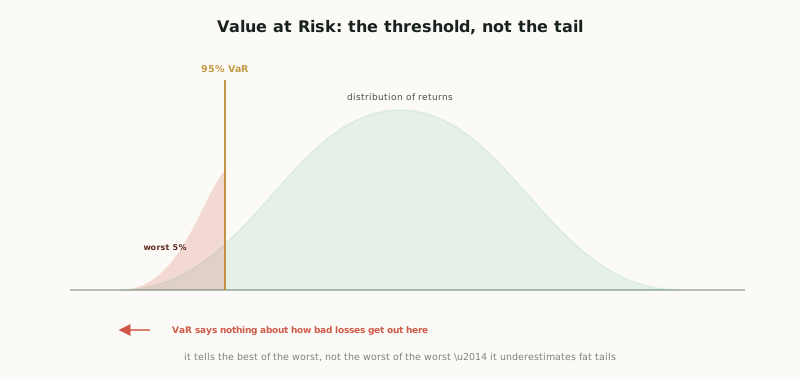
VaR's limitations are not academic quibbles — they're the heart of why it can be dangerous, and they centre on one devastating omission. VaR tells you the threshold you won't exceed X% of the time, but it says nothing whatsoever about how bad the loss is when you do exceed it. The 5% (or 1%) of the time you breach a 95% (or 99%) VaR, the loss could be slightly over the threshold — or it could be catastrophic, many times larger. VaR is silent on this. As the memorable critique puts it, VaR tells you the "best of the worst, not the worst of the worst": it describes the edge of the bad region but not the depths beyond it, which is precisely where account-ending losses live. Compounding this, VaR typically assumes normal-ish conditions and distributions, so it underestimates fat tails — the extreme, supposedly "rare" events that financial markets produce far more often than a normal distribution implies. This failing was laid bare in the 2008 financial crisis, when institutions reassured by their VaR figures suffered losses that dwarfed them — a vivid lesson that VaR can lull users into a false sense of security, offering precise-looking comfort about exactly the wrong thing. It's also backward-looking (built on historical data or assumptions) and can be gamed or distorted, lending a dangerous illusion of precision.
The better measure that addresses the core flaw is Expected Shortfall (also called Conditional VaR or CVaR): rather than stopping at the threshold, it measures the average loss in the cases where VaR is breached — in other words, how bad things get in the tail beyond VaR. By capturing the severity of extreme losses instead of ignoring them, Expected Shortfall is a more honest gauge of tail risk and is increasingly preferred to plain VaR. For the individual forex trader, VaR is more an institutional tool than a daily necessity, but the concept is useful — thinking probabilistically about potential losses over a horizon — provided you internalise the vital lesson: never let a reassuring risk number lull you, because the danger that matters most (the tail) is exactly what VaR leaves out. This connects directly to tail risk and risk of ruin: survival is determined by the worst case, not the typical one. The honest framing: VaR estimates the maximum expected loss over a horizon at a confidence level under normal conditions (e.g. "1-day 95% VaR of £1,000" = 95% chance of losing no more than £1,000 in a day). Three components: horizon, confidence level, loss amount. It's a single intuitive risk number widely used by institutions. But its famous limitations are critical: it tells you the threshold you won't breach X% of the time but nothing about how bad losses are when you do (the tail beyond VaR — "the best of the worst, not the worst of the worst"); it typically assumes near-normal conditions and underestimates fat tails/black swans (notoriously giving false comfort before 2008); and it's backward-looking and falsely precise. Expected Shortfall (CVaR — the average loss beyond VaR) addresses the tail and is often preferred. A useful summary metric — dangerous if trusted blindly, because it ignores exactly where ruin lives.
Beyond the number: using VaR wisely
For the individual trader, the practical question is how to take something useful from VaR without inheriting its dangers. The useful part is the habit of thinking probabilistically about potential loss — framing risk as "over this horizon, how much could I lose, and with what likelihood?" is a healthy discipline that pushes you beyond vague hoping. But the way to use VaR wisely is to treat its headline number as the beginning of the risk conversation, not the end — and to deliberately focus on the part it omits. That means stress testing as an essential complement: rather than asking only "what's my likely worst day under normal conditions?", ask "what happens in a 2008, a 2015 franc shock, a flash crash — the conditions VaR explicitly excludes?" Scenario and stress analysis directly probe the tail that VaR ignores, and pairing the two gives a far more honest view.
The deeper lesson — and the reason VaR is worth understanding even if you never compute one — is a cautionary one about false confidence. VaR's greatest real-world damage has come not from the maths but from the psychology it induces: a precise-looking number breeds a sense of control that lulls users into complacency about exactly the rare, catastrophic events that actually destroy capital. The history is littered with examples — from the 1998 collapse of Long-Term Capital Management to the institutions whose VaR models gave comfort right up to the 2008 crisis — of sophisticated players ruined by losses their risk models had deemed all but impossible. The takeaway for a trader isn't to compute VaR religiously; it's to internalise its blind spot as a general principle: survival is determined by the worst case, not the typical one, and any risk measure that describes the typical case while ignoring the tail is describing the wrong thing. This is why the site keeps returning to tail risk, risk of ruin and surviving the rare event — because that, not the comfortable 95% of the time, is where the game is truly won or lost. Use VaR, if at all, as one limited lens; trust the lesson of its failures far more than the reassurance of its number.
Should a retail trader use VaR?
For most individual forex traders, the honest answer is: not as a daily tool. VaR is built for multi-asset institutional portfolios and carries enough caveats that, used casually, it's more likely to mislead than to help. The simpler disciplines this site returns to again and again — sensible position sizing, a fixed small risk per trade, sound stops, and limits on total exposure — protect a retail account far more reliably than any VaR figure, and without the false precision. The real value of learning VaR isn't the metric; it's the lesson its failures teach — that a comfortable risk number which ignores the tail is describing the wrong thing, and that survival hinges on the worst case, not the typical one. Take that lesson; leave the daily computation to the institutions.
Value at Risk (VaR) estimates the maximum likely loss over a time horizon at a confidence level under normal conditions (e.g. "1-day 95% VaR of £1,000" = 95% chance of losing ≤ £1,000 that day; 5% chance of more). Three components: horizon, confidence level, loss amount. It's a tidy, widely used institutional risk number — but its fatal blind spot is that it says nothing about how bad losses get when you breach it (the tail beyond VaR — "the best of the worst, not the worst of the worst"). It assumes near-normal conditions and underestimates fat tails, infamously giving false comfort before 2008; it's also backward-looking and falsely precise. Expected Shortfall (CVaR) — the average loss beyond VaR — captures the tail and is often preferred. Useful as a summary, dangerous if trusted blindly: it ignores exactly where ruin lives.