Forex signals promise ready-made trade ideas — just copy the buy or sell call and profit. It's a tempting shortcut for beginners who don't yet feel confident analysing the market themselves. But signals range from genuinely useful to outright scams, and even the good ones come with a catch: you never actually learn to trade, and the risk is always yours. This guide explains forex signals: what they are, how they work, why quality varies so wildly, and why they're no real substitute for competence.
It's a topic to approach with a scam-aware eye and realistic expectations; the related copy trading automates the same idea.
Key takeaways
Q: What are forex signals?
A: Forex signals are trade recommendations — typically specifying a pair, a direction (buy or sell), an entry price, a stop-loss and a take-profit — produced by a person (an analyst or 'signal provider') or an automated system, and sent to subscribers who can copy them. The idea is that you don't need to analyse the market yourself; you just follow the calls. They're delivered by messaging apps, email, dedicated services or within trading platforms.
Q: Are forex signals reliable?
A: Quality varies enormously, from genuinely skilled analysts to worthless or fraudulent services. Many signal providers are unverified, show cherry-picked or fabricated results, lack any real edge, or are outright scams designed to collect subscription fees. Even legitimate signals can't guarantee profits — the market is uncertain — and you typically can't see the reasoning or react when a trade goes wrong. Treat all signals with heavy scepticism and verify rigorously.
Q: Should beginners use forex signals?
A: Generally, signals are no substitute for learning to trade. Blindly copying calls means you never develop your own skill, can't judge a signal's quality, bear all the risk while the provider bears none, and remain dependent on someone else. If used at all, signals are best as a learning aid — studying the reasoning behind calls — rather than a money-making shortcut, and only from rigorously vetted, transparent sources. The real edge comes from your own competence.
What they are
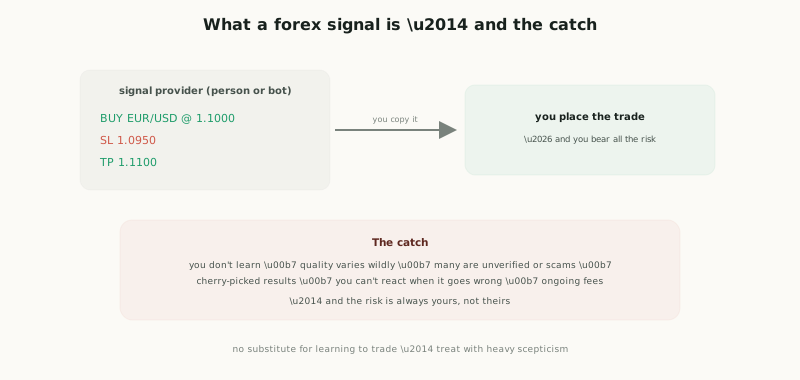
Forex signals are trade recommendations — typically specifying a pair, a direction (buy or sell), an entry price, a stop-loss and a take-profit — produced by a person (an analyst or "signal provider") or an automated system, and sent to subscribers who can copy them.
Forex signals at a glance
The pitch is that you don't need to analyse the market yourself — you just follow the calls as they arrive (by messaging app, email, a dedicated service, or within some trading platforms). For a beginner overwhelmed by charts and analysis, the appeal of simply being told what to trade is obvious. The automated cousin of this is copy trading, where another trader's positions are mirrored in your account automatically rather than sent as calls for you to place. Either way, the core idea is the same: outsource the decisions to someone (or something) else.
Why quality varies — and the catch
The first hard truth is that signal quality varies enormously, from genuinely skilled analysts sharing real ideas to worthless or fraudulent services. The space is rife with problems: many providers are unverified (no independent, audited record of their actual results), show cherry-picked or outright fabricated track records (only the wins, or made-up screenshots), have no real edge at all, or are outright scams designed simply to collect subscription fees from a churn of hopeful beginners (a classic pattern flagged in common forex scams — sometimes paired with fake "results," affiliate-driven hype, or pump-style schemes). Because forex is genuinely uncertain, even a legitimate, skilled signal provider cannot guarantee profits — a good analyst still has losing trades and losing periods — so any service promising consistent wins is, by that promise alone, not to be trusted. Verifying a signal service rigorously (independently audited results over a long period, transparency about losses, a logical basis) is hard, and most don't withstand scrutiny.
But even setting scams aside, there's a deeper catch that applies to all signals, including good ones. You never learn to trade. Blindly copying calls means you don't develop your own skill, your own understanding of why a trade makes sense — so you can't judge whether a given signal is any good, you can't adapt when conditions change, and you remain permanently dependent on someone else. You typically can't see the reasoning behind a call, so when a trade starts going wrong you have no basis to decide whether to hold, adjust or exit — you're flying blind. And, most pointedly, the risk is always yours, not theirs: it's your money on the line when you place the trade, while the provider collects their fee regardless of whether you win or lose — a fundamental misalignment of incentives (they're paid for signals, not for your profitability). This is why, for beginners especially, signals are no substitute for learning to trade. If used at all, the sensible role for signals is as a learning aid — studying the reasoning behind calls (where it's provided) to develop your own analysis — rather than a money-making shortcut to follow blindly, and only from rigorously vetted, transparent sources whose claims you've genuinely verified. The real, durable edge in trading comes from your own competence: a tested approach you understand, discipline, and risk management. No signal service can give you that — and the ones promising they can are precisely the ones to avoid. The honest framing: forex signals are trade calls (pair, direction, entry, stop, target) from a person or bot that you copy. Quality varies wildly — many are unverified, cherry-picked, edgeless or outright scams collecting fees — and even legitimate ones can't guarantee profits in an uncertain market. The deeper catch applies to all signals: you never learn to trade, can't see the reasoning or react when trades go wrong, stay dependent, and bear all the risk while the provider is paid regardless. Treat signals with heavy scepticism; at best use them as a learning aid from rigorously vetted sources — the real edge is your own competence, not someone else's calls.
If you use them: vetting and the right role
If, despite the catches, you decide to engage with signals, rigorous vetting is essential — and most services will fail it, which is itself informative. Demand an independently verified track record: results audited or tracked by a credible third party (not screenshots the provider made themselves), covering a long period through different market conditions, and — critically — including the losing trades and losing months, because any record showing only wins is cherry-picked or fake. Insist on transparency of reasoning: a provider who explains why each trade makes sense is far more credible (and more useful) than one issuing bald calls, and the reasoning is the only part with lasting value to you. Be deeply suspicious of any guarantee of profits or "X% win rate" claims — in an uncertain market, those promises are red flags, not selling points. Weigh the cost realistically against the (uncertain) benefit, and remember that free signals are often loss-leaders to funnel you toward a paid product, a broker affiliate arrangement (the "provider" earns from your trading volume, win or lose), or a pump scheme — "free" rarely means disinterested.
The right role for signals, if any, is as a learning aid, not a money machine. Used to study the reasoning behind trades — treating a transparent provider almost like a tutor whose logic you analyse, question and learn from — signals can modestly support your development toward trading independently. Used as a crutch to copy blindly, they keep you dependent, unskilled and exposed. The far better investment for almost every beginner is in your own education: learning analysis, building a trading plan, practising on a demo, and developing the competence that no subscription can supply. That path is slower and harder than the fantasy of following profitable calls — but it's the only one that actually builds a durable, transferable skill, and it doesn't leave you at the mercy of a provider whose incentives aren't aligned with yours. When the choice is "pay someone for calls I can't evaluate and bear all the risk" versus "learn to do this myself," the second wins for anyone serious about lasting in this game. The honest reminder: if you use signals at all, vet ruthlessly — demand an independently verified long-term record including losses, transparent reasoning, and no profit guarantees, and be wary of "free" signals tied to broker affiliates or upsells; use them only as a learning aid (studying the reasoning), never a blind crutch, because investing in your own education — analysis, a plan, demo practice — builds the durable, aligned competence that no signal service can.
Forex signals are trade calls (pair, direction, entry, stop, target) from a person or bot that you copy. Quality varies wildly — many providers are unverified, show cherry-picked or fabricated results, have no edge, or are outright scams collecting subscription fees (see scams) — and even legitimate ones can't guarantee profits in an uncertain market. The deeper catch applies to all signals: you never learn to trade, can't see the reasoning or react when a trade goes wrong, stay dependent, and bear all the risk while the provider is paid regardless (misaligned incentives). Treat signals with heavy scepticism; at best use them as a learning aid (studying the reasoning) from rigorously vetted, transparent sources — never a blind shortcut. The real, durable edge is your own competence, not someone else's calls.