Keltner channels wrap a moving average in volatility-based bands — much like the more famous Bollinger Bands, but built from the Average True Range (ATR) rather than standard deviation. The result is a smoother envelope around price that traders use to read trend, time pullbacks, gauge overextension and spot breakouts. This guide explains Keltner channels: how they're constructed, how they differ from Bollinger Bands, and how they're used in practice.
They're a close cousin of Bollinger Bands, powered by the ATR, and pair naturally with Donchian channels as the other major channel tools.
Key takeaways
Q: What are Keltner channels?
A: Keltner channels are a volatility-based indicator consisting of three lines: a middle line (typically an exponential moving average), and upper and lower bands set a multiple of the Average True Range (ATR) above and below it. The bands widen when volatility rises and narrow when it falls, creating an envelope around price that traders use to gauge trend, overextension and breakouts.
Q: What's the difference between Keltner channels and Bollinger Bands?
A: Both place bands around a moving average, but they measure volatility differently. Bollinger Bands use standard deviation of price, while Keltner channels use the Average True Range (ATR). Because ATR is smoother than standard deviation, Keltner channels tend to be smoother and less reactive to sudden price spikes, and they typically use an EMA centre line rather than Bollinger's SMA. The two are often used together, for example in the 'squeeze'.
Q: How do traders use Keltner channels?
A: Common uses include identifying trend (price holding the upper half in uptrends, lower half in downtrends), timing pullback entries toward the EMA middle line within a trend, spotting overextension when price reaches a band, and trading breakouts when price closes decisively beyond a band. They're also combined with Bollinger Bands to detect low-volatility 'squeezes' that often precede big moves. Like all indicators, they need confirmation.
How they're built
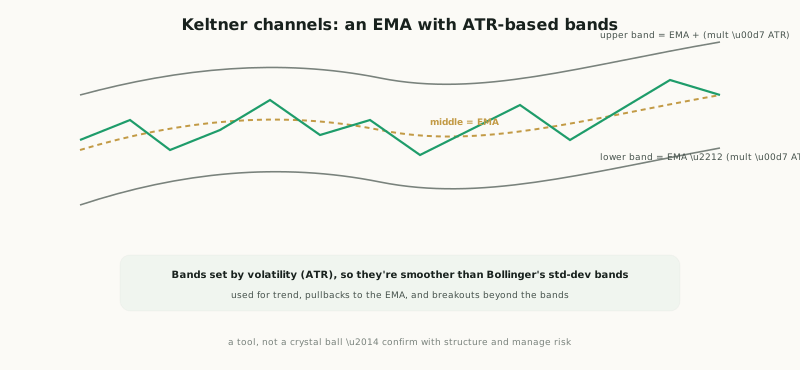
A Keltner channel has three lines. The middle line is typically an exponential moving average (EMA) of price — commonly 20 periods. The upper and lower bands are placed a multiple of the ATR above and below that EMA — a common setting being the EMA ± (2 × ATR). Because the band distance is governed by the ATR (a measure of recent volatility), the channel widens when volatility rises and narrows when it falls, breathing with the market to form a dynamic envelope around price. The settings (EMA length, ATR period, multiplier) can be tuned, but the principle is constant: a central trend line, with volatility-scaled bands either side.
Keltner vs Bollinger Bands
Because Keltner channels look so similar to Bollinger Bands, the key is understanding the difference, which comes down to how each measures volatility.
| Keltner channels | Bollinger Bands | |
|---|---|---|
| Volatility measure | Average True Range (ATR) | Standard deviation of price |
| Middle line | Usually an EMA | Usually an SMA |
| Band behaviour | Smoother, less reactive | More reactive to price spikes |
| Common use | Trend, pullbacks, breakouts | Volatility, mean-reversion, squeezes |
Both tools place bands around a moving average, but Bollinger Bands use the standard deviation of price while Keltner channels use the ATR. Since ATR is generally smoother than standard deviation, Keltner channels tend to be smoother and less reactive to sudden price spikes — a sharp one-bar spike balloons Bollinger Bands more than Keltner channels, because standard deviation jumps on the outlier while ATR responds more gradually. Keltner channels also typically use an EMA centre line (more responsive to recent price) versus Bollinger's traditional SMA. In practice this makes Keltner channels feel a touch more stable and trend-oriented, and Bollinger Bands a touch more reactive and volatility-oriented — differences of degree, not kind. Far from competitors, the two are often used together: the popular "squeeze" setup watches for Bollinger Bands contracting inside the Keltner channels (a sign of unusually low volatility that often precedes a large move), combining both tools' information.
How traders use them
Keltner channels lend themselves to several uses. For trend: when price persistently holds the upper half of the channel (riding the upper band, EMA acting as support), it signals a healthy uptrend; holding the lower half signals a downtrend — a quick read of trend direction and strength. For pullback entries: within an established trend, a pullback toward the middle EMA can offer a lower-risk entry in the trend's direction, with the channel framing where price has tended to find support/resistance. For overextension: a touch or push of the outer band shows price has stretched a volatility-multiple from its mean, flagging possible exhaustion (though in strong trends price can ride a band for a long time, so a band touch is not an automatic reversal signal — a classic beginner error). For breakouts: a decisive close beyond a band, especially after a squeeze, can signal a volatility expansion and the start of a directional move.
As with every indicator on this site, the essential caveats apply. Keltner channels are a lagging, derived tool — built from past price and ATR — so they describe and contextualise price rather than predict it, and they do not work in isolation. A band touch isn't a trade, a breakout can be false, and the channel says nothing about why price is moving. They're at their best combined with market structure, support and resistance, and confirmation from price action or other tools — and, like all channels, they perform very differently in trending versus ranging conditions, so context matters. Used as a volatility-aware framing device for trend, pullbacks and breakouts — not a standalone signal generator — and always with proper risk management, Keltner channels are a clean, useful addition to a technical toolkit. The honest framing: Keltner channels are three lines — a middle EMA with upper/lower bands set a multiple of ATR away — forming a volatility envelope that widens and narrows with the ATR. They differ from Bollinger Bands by using ATR (vs standard deviation) and usually an EMA (vs SMA), making them smoother and less reactive; the two combine in the "squeeze." Traders use them for trend (which half price holds), pullback entries to the EMA, overextension at the bands (not an automatic reversal — price can ride a band in strong trends), and breakouts on a decisive close beyond a band. They're lagging and derived, so confirm with structure and manage risk.
Settings and practical tips
The standard Keltner setup uses a 20-period EMA with bands at 2 × a 10-period ATR, but the parameters can be adjusted to taste — and understanding what each does helps. A longer EMA makes the centre line smoother and slower (better for higher-timeframe trend), a shorter one more responsive. A larger ATR multiplier widens the bands so price touches them less often (fewer, stronger overextension signals), while a smaller multiplier tightens them (more frequent touches). As always, the temptation to over-optimise these settings to past data is a trap — pick sensible, robust values and resist curve-fitting the multiplier to make a backtest look perfect, since settings tuned to history rarely hold up live. Many traders simply keep the defaults, which are perfectly serviceable.
A few practical applications are worth spelling out. The squeeze deserves elaboration because it's Keltner's most celebrated use: when the Bollinger Bands contract inside the Keltner channels, it signals an unusually low-volatility period — a coiled, quiet market — which often precedes a large directional move; traders watch for the bands to expand back outside the Keltner channel and for price to break out, taking the breakout's direction as the cue. It's a clever combination because Bollinger (standard deviation) reacts faster than Keltner (ATR), so the moment Bollinger slips inside Keltner is a clean, objective low-volatility flag. For trend-pullback trading, a useful routine is to establish trend from which half of the channel price holds, then look to enter on a pullback toward the EMA middle line in the trend's direction, placing a stop beyond the opposite band. And the perennial reminder: a band touch is not a reversal signal — in strong trends price rides the outer band for extended runs, so fading every band touch (a classic beginner mistake) gets you repeatedly run over; treat the bands as context, and require confirmation (a reversal candle, a structure break) before acting on an apparent overextension. Combined thoughtfully with structure and confirmation, and traded with risk management, Keltner channels reward sensible settings far more than over-tuned ones. The honest reminder: standard settings (20 EMA, 2× ATR) work well — adjust the EMA length and ATR multiplier to change responsiveness/band width, but don't over-optimise; use the Bollinger-inside-Keltner "squeeze" to spot low-volatility setups before breakouts, enter trend pullbacks toward the EMA, and never fade a band touch without confirmation, since price rides bands in strong trends.
In the broader toolkit, Keltner channels fill a useful niche: a smoother, more trend-friendly volatility envelope than Bollinger Bands, with the ATR basis giving a stable, market-aware read on where price sits relative to its recent range. Many traders run both — Keltner for the steadier trend/pullback picture and the squeeze, Bollinger for faster volatility signals — since the two complement rather than compete. Whichever you favour, the channel is context, not command: it frames where price is stretched or supported, and your job is to combine that framing with structure, confirmation and risk control to make an actual decision.
Keltner channels are three lines — a middle EMA with upper/lower bands set a multiple of ATR away — forming a volatility envelope that widens and narrows with volatility. They differ from Bollinger Bands by using ATR (not standard deviation) and usually an EMA (not SMA), making them smoother and less reactive; the two combine in the "squeeze" (Bollinger contracting inside Keltner before a move). Traders use them for trend (which half price holds), pullback entries toward the EMA, overextension at the bands — but a band touch is not an automatic reversal, as price can ride a band in strong trends — and breakouts on a decisive close beyond a band. Like all indicators they're lagging and derived: confirm with structure and price action, mind trending-vs-ranging context, and manage risk.