One of the oldest and simplest indicators in technical analysis does something almost trivially plain: it plots the highest high and lowest low over a set number of periods. That modest idea — the Donchian channel, developed by Richard Donchian — powered the legendary Turtle Traders and still anchors breakout trading today. Its strength is its simplicity. This guide explains Donchian channels: how they're built, how they're used (especially for breakouts), and their well-known whipsaw weakness.
They're the breakout-oriented counterpart to the volatility-based Keltner channels, closely tied to support and resistance and the risk of false breakouts.
Key takeaways
Q: What are Donchian channels?
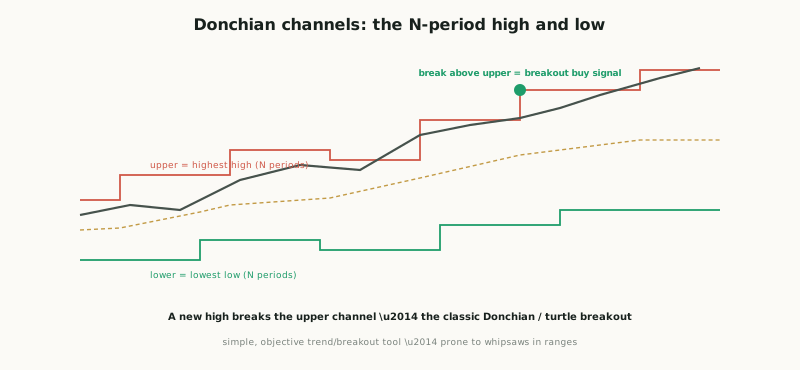
A: Donchian channels are a simple indicator made of three lines: an upper band marking the highest high over the last N periods, a lower band marking the lowest low over the last N periods, and a middle line that is the average of the two. Developed by Richard Donchian, they show the recent trading range and are most associated with breakout trading — price making a new N-period high or low.
Q: How are Donchian channels used in trading?
A: Primarily for breakouts: when price rises above the upper channel it has made a new N-period high (a potential buy signal), and when it falls below the lower channel a new N-period low (a potential sell signal). They're also used to gauge trend and volatility (a widening channel) and to set trailing exits. The famous Turtle Traders used a Donchian-style breakout system as the core of their approach.
Q: What are the weaknesses of Donchian channels?
A: Their main weakness is whipsaws in ranging or choppy markets: because they trigger on new highs and lows, a sideways market can produce repeated false breakouts that reverse, generating losing trades. They're also lagging and contain no information about why price is moving. They work best in strongly trending conditions and need filters, confirmation and risk management to avoid being chopped up in ranges.
How they're built
A Donchian channel could hardly be simpler — three lines derived directly from recent highs and lows.
Donchian channel components
The upper band simply marks the highest high reached over the last N periods; the lower band the lowest low; and the middle line is the average of the two. With a common setting of N = 20, the channel shows the highest high and lowest low of the past 20 bars, mapping the recent trading range. The bands form a stepped, staircase-like shape (they only change when a new high or low is made within the lookback), and the channel widens when the range expands (rising volatility) and narrows when price consolidates. There are no moving-average or standard-deviation calculations — just "what's the highest and lowest price recently?" — which is exactly what makes the tool so transparent and objective.
Breakouts and the Turtles
Donchian channels are most associated with breakout trading, and the logic is direct: when price rises above the upper channel, it has made a new N-period high — a sign of upside strength and a potential buy signal; when it falls below the lower channel, a new N-period low — a potential sell signal. The appeal is objectivity: "is price at a new 20-day high?" is a clear, unambiguous, mechanical question, with none of the interpretation that fuzzier tools require. This made Donchian breakouts ideal for systematic trading, most famously the Turtle Traders — the group taught in the 1980s by Richard Dennis and William Eckhardt — whose celebrated trend-following system used Donchian-style breakouts (e.g. entering on a 20-day breakout, exiting on a shorter-period breakout in the opposite direction) as its core. The Turtles' success became a famous demonstration that a simple, rules-based breakout approach, applied with discipline and rigorous risk management, could be highly profitable. Beyond breakouts, Donchian channels also serve as a quick read on trend (a rising channel making higher highs and lows), volatility (channel width), and as trailing exits (exiting when price breaks the opposite, shorter-period channel).
The whipsaw weakness
The flip side of breakout simplicity is the channel's defining weakness: whipsaws in ranging or choppy markets. Because the tool triggers on new highs and lows, a sideways market — where price oscillates within a range, repeatedly poking marginally above the recent high then reversing — generates a stream of false breakouts that fail and reverse, producing a frustrating run of small losing trades (the same false-breakout dynamic that traps breakout traders generally). Donchian channels work beautifully in strongly trending conditions (catching and riding the trend via successive new highs) but get chopped up in ranges — the classic trend-following trade-off of taking many small losses in choppy periods while waiting for the big trends that pay for them all. They're also, like every channel, lagging (built entirely from past highs/lows) and carry no information about why price is moving.
So the sensible use respects both sides. Lean on Donchian channels in trending environments, where their breakout signals shine; be wary in ranges, where they whipsaw — ideally using a trend filter (only taking breakouts in the direction of a higher-timeframe trend or when a trend indicator like ADX confirms a trend) to avoid trading breakouts in dead, sideways conditions. Combine them with market structure and confirmation rather than trading every channel break blindly, accept that false breakouts are an inherent cost of the approach (managed by sizing and stops, not eliminated), and — as the Turtles themselves proved — pair the simple signals with strict risk management, which is what actually made the system work. Used that way, the humble Donchian channel remains one of the cleanest, most honest trend/breakout tools available. The honest framing: Donchian channels plot the highest high (upper) and lowest low (lower) over N periods (commonly 20), with a midline between — a simple, objective map of the recent range developed by Richard Donchian. They're mainly used for breakouts (a new N-period high/low as a buy/sell signal), famously by the Turtle Traders, and also for reading trend, volatility and trailing exits. Their weakness is whipsaws in ranging markets, where new-high/low triggers produce false breakouts; they excel in strong trends but get chopped in ranges. Use a trend filter, confirm with structure, accept false breakouts as a managed cost, and — as the Turtles showed — pair with strict risk management.
Variations and practical use
Beyond the basic single-period channel, Donchian channels are often used with different periods for entry and exit, which is how the famous turtle system worked and remains a sound template. The classic approach uses a longer channel to enter (e.g. a 20- or 55-period breakout to get into a new trend) and a shorter channel to exit (e.g. a 10-period breakout in the opposite direction to leave). The logic is elegant: you need a significant new high to justify entering (a longer lookback), but you want to exit more quickly when the trend turns (a shorter lookback), so the shorter exit channel trails the trade and gets you out on the first meaningful counter-move. This entry/exit asymmetry lets winners run while cutting losers and giving back less profit on reversals — a robust, fully mechanical framework. The middle line (the channel average) can also serve as a dynamic support/resistance or a secondary exit reference, and some traders use a break back through the midline as an earlier exit than waiting for the full opposite channel.
The practical keys to trading Donchian channels well centre on managing the whipsaw problem. The single most valuable addition is a trend filter: rather than taking every channel breakout, only take breakouts aligned with a higher-timeframe trend or confirmed by a trend-strength measure like ADX — this filters out many of the false breakouts that occur in ranging conditions, which is where Donchian bleeds. Stop placement is natural with this tool: a logical stop sits beyond the opposite side of a shorter channel, or beyond the midline, defining where the breakout has clearly failed. Position sizing matters enormously — because breakout systems take many small losses (the whipsaws) punctuated by occasional big trend wins, you must size each trade small (the turtles were famously strict on risk per trade) so the inevitable string of false breakouts doesn't damage you while you wait for the trends that pay. And expectation management: accept that a low win rate with large average wins is normal and fine for this style — you'll be wrong often on individual breakouts but right big on the trends, and the expectancy can be strongly positive despite frequent small losses. Donchian channels reward traders who embrace that trend-following reality rather than fighting it. The honest reminder: use longer channels to enter and shorter ones to exit (the turtle template) so winners run and reversals cost less, use the midline as a secondary reference, and tame whipsaws with a trend filter, logical stops beyond the opposite channel, small position sizing, and acceptance of a low win rate with large wins.
Donchian channels plot the highest high (upper band) and lowest low (lower band) over the last N periods (commonly 20), with a midline between — a simple, objective map of the recent range, developed by Richard Donchian. They're used mainly for breakouts (a new N-period high/low = potential buy/sell), famously by the Turtle Traders, and also for reading trend, volatility (channel width) and trailing exits. Their key weakness is whipsaws in ranging markets: new-high/low triggers produce false breakouts, so they excel in strong trends but get chopped in ranges. Use a trend filter (e.g. higher-timeframe trend or ADX), confirm with structure, accept false breakouts as a managed cost (sizing and stops), and — as the Turtles proved — pair the simple signals with strict risk management.