Every trade has a peak it reaches in your favour before you close it — its maximum favorable excursion (MFE). Studying it across many trades reveals whether you're leaving profit on the table or exiting about right. Paired with its mirror image, MAE, it turns your trade history into a concrete guide for setting better targets and exits — grounded in what your trades actually do, not guesswork. This guide explains MFE: what it is, how it differs from MAE, and how to use it (without over-optimising).
It's the profit-side counterpart to maximum adverse excursion, it directly informs take-profit targets and trailing stops, and it's powered by a good trading journal.
Key takeaways
Q: What is maximum favorable excursion (MFE)?
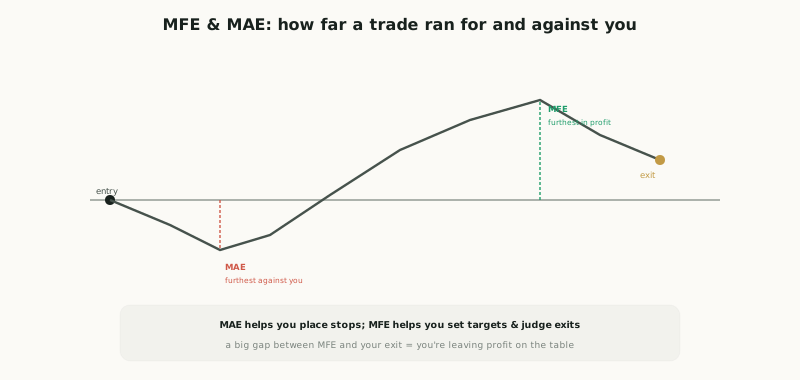
A: Maximum favorable excursion is the furthest a trade moved in your favour (into profit) at any point while it was open, before you closed it. For example, if a trade was up 40 pips at its best point but you exited at 15 pips, the MFE was 40 pips. Analysing MFE across many trades shows how much potential profit your trades typically reach — useful for judging whether your profit targets and exits are well-placed.
Q: How does MFE differ from MAE?
A: They're mirror images. Maximum adverse excursion (MAE) is the furthest a trade moved against you (into loss) before resolving — it informs stop placement. Maximum favorable excursion (MFE) is the furthest it moved in your favour — it informs target placement and exit timing. MAE answers 'how much heat did winning trades take?' (so you don't set stops too tight); MFE answers 'how much profit was available?' (so you don't exit too early or set targets you rarely reach).
Q: How do you use MFE to improve exits?
A: By comparing your actual exits with the MFE your trades reached. If trades regularly run far beyond where you exit (high MFE, modest realised profit), you may be exiting too early and leaving money on the table — a case for wider targets or trailing stops. If trades rarely reach your fixed target (your target sits well above typical MFE), the target may be unrealistic. The aim is to align targets and exits with what your trades actually do — without over-fitting to past data.
What it is, and how it differs from MAE
Maximum favorable excursion is the furthest a trade moved in your favour (into profit) at any point while it was open, before you closed it. If a trade was up 40 pips at its best point but you exited at 15, its MFE was 40 pips — you captured 15 of the 40 that were, at some moment, available. Analysing MFE across many trades shows how much potential profit your trades typically reach, which is invaluable for judging whether your profit targets and exits are well-placed. MFE and MAE are mirror images that together describe the full "envelope" of a trade:
| Metric | Measures | Informs |
|---|---|---|
| MAE (adverse) | Furthest a trade went against you | Stop placement (how much heat to allow) |
| MFE (favorable) | Furthest a trade went for you | Target placement & exit timing |
So MAE answers "how much heat did my (winning) trades take before working out?" — so you don't set stops so tight you're shaken out of trades that would have won. MFE answers "how much profit was actually available?" — so you don't exit too early or set targets you rarely reach. One studies the downside path, the other the upside path, and together they map how your trades behave between entry and resolution.
How to use it (and the trap)
The practical power of MFE is in comparing your actual exits with the MFE your trades reached, which exposes systematic exit problems you can't see trade-by-trade. If your trades regularly run far beyond where you exit — high MFE but only modest realised profit — you're likely exiting too early and leaving money on the table, which argues for wider targets, a trailing stop (to ride more of the move), or scaling out (banking some, letting some run). Conversely, if your trades rarely reach your fixed target — your target sits well above the typical MFE — the target may be unrealistic, causing you to give back open profit waiting for a level the trade seldom hits; pulling the target closer to where trades actually peak would bank more. MFE analysis can also reveal patterns: perhaps trades in a certain session, setup, or direction reach much higher MFE than others, hinting where to let winners run versus take quick profits. Combined with MAE, you can even sketch the ideal envelope for your strategy — stops placed beyond typical adverse heat, targets placed near where favourable moves typically stall — turning your journal into a data-driven exit-optimisation tool. This is exactly the kind of edge in execution that separates disciplined traders: the entry might be fine, but poor exits (too early, or targets never hit) quietly bleed away the strategy's potential, and MFE makes that leak visible and fixable.
The essential caveat is the over-optimisation trap. Because MFE is measured with hindsight (you only know a trade's peak after it's happened), it's dangerously easy to over-fit — to look back and conclude "if only I'd exited at the exact MFE every time," which is a fantasy no one can execute in real time (you never know in the moment that this is the peak). The goal is not to chase the theoretical maximum but to make systematic, realistic improvements: shifting targets or adopting trailing stops to capture a larger share of typical MFE, not all of it. Beware too of curve-fitting targets to a small or unrepresentative sample — a target tuned to a handful of past trades' MFE may fail going forward; you need a meaningful sample and should expect the future to differ. And remember MFE is just one lens: a high-MFE trade that you exited early wasn't necessarily a mistake if your rules said exit (consistency matters more than capturing every peak), and chasing MFE shouldn't tempt you into holding too long and giving back profit (the opposite error). Used well — as a diagnostic across a solid sample to align targets and exits with what your trades genuinely do, while respecting that you can't capture the hindsight maximum — MFE is a powerful complement to MAE and a real route to better exits. The honest framing: maximum favorable excursion is the furthest a trade ran in your favour before you closed it; analysed across many trades it shows how much profit was available, the mirror of MAE (which informs stops, while MFE informs targets and exits). Compare your actual exits to typical MFE: if trades run far past your exits you're leaving money on the table (widen targets, trail, or scale out); if they rarely reach your target it's unrealistic. But MFE is hindsight — don't over-fit to capture the impossible maximum; make systematic, realistic improvements on a meaningful sample, and treat it as one diagnostic among your rules.
Trade efficiency and capture rate
MFE becomes even more useful when you turn it into a ratio rather than a raw number. The key derived metric is trade efficiency (or "capture rate") — the percentage of the available MFE you actually captured: if a trade reached an MFE of 40 pips and you banked 20, your efficiency on that trade was 50%. Tracked across many trades, your average capture rate tells you, in a single figure, how well your exits convert available profit into realised profit. A consistently low capture rate (say you routinely bank only a small fraction of the move available) is strong evidence your exits are too early or your targets too tight; a capture rate near 100% might sound ideal but often means you're holding too long for the exact top (and giving back profit on the trades that don't reach it). The sweet spot is a healthy, sustainable capture rate, not a perfect one.
Two related ideas sharpen this further. The MFE/MAE ratio per setup gauges setup quality: trades that typically reach a large MFE relative to the MAE (adverse heat) they took are higher-quality setups worth pressing, while setups where MAE rivals MFE are marginal. Some traders formalise this as an "edge ratio" (e-ratio) — comparing average favourable to average adverse excursion, normalised — to rank which setups, sessions or conditions genuinely offer the best reward-to-heat. Practically, this analysis feeds two exit improvements: it tells you where to place targets (near where favourable moves typically stall, so you bank a high share of MFE) and it makes a strong case for scaling out — taking partial profit as the move develops while letting a runner chase the higher MFE — which mathematically lifts your capture rate while protecting gains. The whole point is to convert the diagnostic (capture rate, MFE/MAE) into concrete, rule-based exit changes, tested across a meaningful sample. The honest reminder: turn MFE into trade efficiency (the % of available MFE you captured) to see in one number how well your exits convert potential into realised profit — a low capture rate means you exit too early, near-100% often means you hold too long; use the MFE/MAE (edge) ratio to rank setup quality, and act on it via better-placed targets and scaling out, always tested on a solid sample.
Maximum favorable excursion (MFE) is the furthest a trade ran in your favour before you closed it; across many trades it shows how much profit was available — the mirror of MAE (which informs stops, while MFE informs targets and exits). Compare your actual exits to typical MFE: if trades run far past your exits, you're leaving money on the table (widen targets, add a trailing stop, or scale out); if they rarely reach your target, it's unrealistic. But MFE is measured with hindsight — don't over-fit chasing the impossible exact maximum; make systematic, realistic improvements on a meaningful sample via your journal, and treat it as one diagnostic alongside your rules (consistency beats capturing every peak).