While GDP tells you where the economy has been, surveys like the PMI hint at where it's going. These timely, forward-looking gauges of business activity and sentiment are among the very first clues traders get about the economy's direction — which is exactly why markets react to them. This guide explains PMIs and business surveys: what they measure, the all-important 50 line, why they're prized as leading indicators, and how they move currencies.
They're a key part of the economic indicators toolkit, complement the coincident reads of GDP and employment, and help anticipate the business cycle.
Key takeaways
Q: What is the PMI?
A: The PMI (Purchasing Managers' Index) is a survey-based economic indicator that gauges business activity by polling purchasing managers at firms about new orders, output, employment and more. It's a diffusion index: a reading above 50 signals expansion, below 50 contraction, and the distance from 50 indicates the pace. Manufacturing, services and composite PMIs are released monthly and quickly.
Q: Why are PMIs called leading indicators?
A: Because they signal the economy's direction ahead of hard data. PMIs are timely (released soon after month-end) and forward-looking (managers report on orders and activity), so they tend to move before coincident indicators like GDP and employment, and well before lagging ones like inflation. This early read makes them valuable for anticipating economic turns.
Q: How do PMIs affect forex?
A: A PMI that beats or misses expectations can move the currency: a stronger-than-expected reading signals economic strength and can support the currency (and rate-hike expectations), while a weak one does the opposite. Crucially, markets price in the consensus forecast beforehand, so it's the surprise relative to expectations — not the absolute number — that drives the reaction.
What PMIs and surveys measure
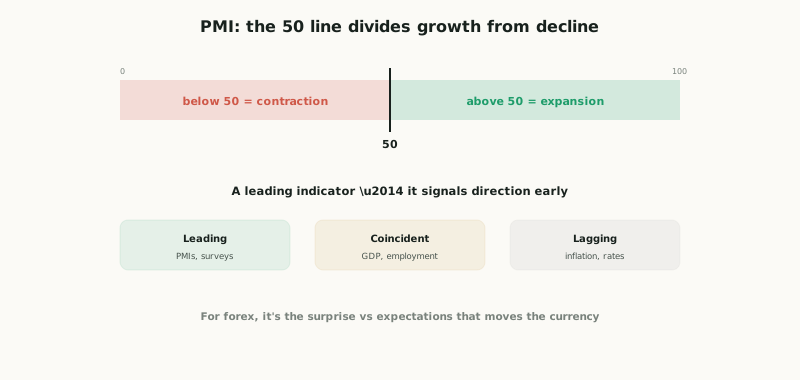
The PMI (Purchasing Managers' Index) surveys purchasing managers at firms about new orders, output, employment, supplier deliveries and inventories — the people who see business conditions first-hand and early. It's a diffusion index with a simple, powerful reading: above 50 signals expansion, below 50 contraction, and the distance from 50 indicates the pace (a reading of 55 is solid growth; 47 a meaningful contraction). Separate PMIs cover manufacturing, services and a composite, and the best-known are the S&P Global (formerly Markit) PMIs and, in the US, the ISM manufacturing and services indices. Two features make PMIs especially valuable: they're timely (released monthly, very soon after the period they cover, unlike GDP which lags by months) and forward-looking (orders and activity point to what's coming). That combination makes the PMI a prized leading indicator — it signals the economy's direction ahead of the hard data, often turning before GDP and employment do, which is why traders and central banks watch it so closely.
Beyond the PMI, a family of related business and consumer surveys serves a similar purpose: consumer confidence indices, business confidence surveys (such as Germany's well-known Ifo and ZEW gauges), and others. These measure sentiment — how optimistic or pessimistic businesses and consumers feel — which matters because sentiment drives the spending, hiring and investment decisions that shape future activity. Like the PMI, they tend to be timely and forward-looking, offering early reads on the economic mood.
Leading, coincident and lagging
PMIs and surveys are best understood within the broader framework of indicator timing. Leading indicators (PMIs, business and consumer surveys, building permits, the stock market, and the yield curve) tend to move ahead of the economy, signalling turns early. Coincident indicators (GDP, employment) move with the economy, confirming its current state. Lagging indicators (the unemployment rate often, inflation, interest rates) confirm trends after they're established. PMIs' value lies precisely in being leading — they give the early warning, which is more useful for anticipating where the economy (and policy) is headed than confirmation that arrives once the move is already underway. Reading leading, coincident and lagging indicators together gives a fuller, time-aware picture than any one alone.
For forex, PMI and survey releases can move currencies sharply. A reading that beats expectations signals economic strength and can support the currency — partly directly (a stronger economy), partly via implications for monetary policy (strength supports rate-hike expectations); a miss does the opposite. As leading indicators, they also shape the market's expectations of future growth and policy, which is what gets priced. But the crucial point — true of all data releases — is that it's the surprise relative to expectations that moves markets, not the absolute number: because the market prices in the consensus forecast beforehand, a "good" PMI that's nonetheless below what was expected can weaken the currency, and vice versa (the same dynamic covered in economic indicators). The honest caveats: surveys measure sentiment and can be noisy or revised, a single month's reading can mislead (watch the trend), and they're one input among many — leading indicators signal tendencies, not certainties. The honest framing: PMIs and business/consumer surveys are timely, survey-based indicators of activity and sentiment — the PMI (above 50 = expansion, below = contraction) is a valued leading indicator that signals the economy's direction ahead of the hard data (GDP, employment — coincident; inflation, rates — lagging). For forex, beats or misses versus expectations move currencies (strength is supportive, via growth and rate-hike expectations) and shape the future-policy expectations markets price. But they're surveys (sentiment, noisy, revised), it's the surprise versus consensus that moves markets (not the absolute level), and they're one input among many. A valuable early read on economic direction — used alongside other data, against expectations, and with an eye on the trend.
Using PMIs and surveys in practice
For a trader, PMIs and surveys matter chiefly as scheduled events on the economic calendar that can move currencies, and as trend signals that shape the macro view. On the event side, the key discipline is the one true of all data: trade the surprise, not the number. The market prices in the consensus forecast ahead of the release, so the currency reacts to the gap between actual and expected — a reading of 52 is "good," but if the market expected 54, the currency may fall; a weak-looking 49 that beats an expected 47 can lift it. Knowing the consensus and the prior reading is therefore essential to interpreting the reaction, and the moments around major PMI releases (especially flagship ones like the US ISM) can bring sharp volatility and widened spreads — something to manage with care, as with any news event.
Several refinements deepen the read. Manufacturing versus services PMIs tell different stories — in service-dominated economies the services PMI often matters more, while manufacturing PMIs are sensitive bellwethers of global trade and the industrial cycle; the composite blends them. Looking inside the report at sub-components (new orders as a forward signal, prices-paid as an inflation clue, employment) adds nuance beyond the headline. Above all, watch the trend rather than a single month: a PMI sliding from 55 toward 50 over several months tells a clearer story (momentum fading) than any one print, and crossing the 50 line in either direction is a notable signal of the economy shifting between expansion and contraction. Finally, PMIs are most powerful combined with other data: as leading indicators they're best read alongside coincident data (GDP, employment) and the policy picture — a run of strong PMIs that points to firming growth and possible rate hikes builds a coherent, currency-supportive narrative far more reliably than an isolated beat. The honest discipline is to treat surveys as an early, sentiment-based read on direction — valuable precisely because it's early, but noisy and best confirmed by the trend and by harder data — and to remember that for trading the reaction, expectations are everything.
Which surveys to watch
A few releases carry outsized market weight, and it's worth knowing the main ones. In the US, the ISM manufacturing and services indices are heavyweight movers, as are the S&P Global US PMIs. Globally, the S&P Global "flash" PMIs for major economies are closely watched precisely because they're among the earliest reads on a given month — "flash" estimates are released before the "final" figures, so they often produce the bigger market reaction (the flash sets expectations; the final, arriving later with little new information, usually moves markets less). In Europe, surveys like Germany's Ifo business-climate index and the ZEW sentiment gauge are influential for the euro, and consumer confidence readings (such as the University of Michigan and Conference Board surveys in the US) round out the sentiment picture. The practical point isn't to memorise an exhaustive list but to know which surveys your traded currencies respond to, to mark the flash PMIs and flagship ISM releases on your calendar, and to remember that the earliest, most surprising reads tend to move markets most — always relative to what was expected.
Why the early signal is worth so much
It's worth appreciating why markets prize these survey-based reads despite their noise. In trading, being early is everything: by the time GDP confirms a slowdown or employment data rolls over, the move in currencies, rates and risk assets is often well advanced. Leading indicators like the PMI offer a glimpse of the turn before it's confirmed by the hard data — and markets, which trade on expectations of the future rather than the confirmed past, react accordingly. A run of deteriorating PMIs can shift rate-cut expectations and pressure a currency weeks before any official recession call. That early-warning quality is precisely what makes a noisy sentiment survey valuable: you accept some false signals in exchange for an earlier read, then confirm the picture with the trend and the harder data as it arrives.
PMIs (Purchasing Managers' Indices) and business/consumer surveys are timely, survey-based gauges of activity and sentiment. The PMI is a diffusion index: above 50 = expansion, below 50 = contraction, distance from 50 = pace (manufacturing, services, composite; S&P Global and ISM are key). They're prized as leading indicators — timely and forward-looking, signalling the economy's direction ahead of coincident data (GDP, employment) and lagging data (inflation, rates). For forex, beats/misses move currencies (strength supports the currency and rate-hike expectations) and shape priced-in policy expectations — but it's the surprise vs consensus that moves markets, not the absolute number. Caveats: they're sentiment surveys (noisy, revised), watch the trend not one month, and they're one input among many — leading indicators signal tendencies, not certainties.