
Few charts are watched as closely, by economists and traders alike, as the yield curve. By plotting the yields of bonds across different maturities, it distils the market's collective expectations of growth, inflation and interest rates into a single, telling shape — and its most famous configuration, the inversion, has a striking record of warning that recession lies ahead. This guide explains the yield curve: what it is, what its shapes mean, why inversion matters, and how it all feeds into forex.
It's the bigger picture behind individual bond yields, an expression of interest-rate expectations, and a read on the business cycle.
Key takeaways
Q: What is the yield curve?
A: The yield curve is a line plotting the yields of bonds of the same credit quality (usually government bonds like US Treasuries) across different maturities — from short-term (3-month, 2-year) to long-term (10-year, 30-year). Its shape shows the relationship between yield and time to maturity, and reflects the market's expectations of future interest rates, growth and inflation.
Q: What does an inverted yield curve mean?
A: An inverted yield curve is when short-term yields are higher than long-term yields — unusual, because investors normally demand more yield for longer commitments. It reflects expectations that interest rates (and growth/inflation) will fall in future, often because a slowdown is anticipated. Inversion has preceded most US recessions, making it a famous — though not infallible — recession signal.
Q: How does the yield curve affect forex?
A: The curve reflects interest-rate expectations, which drive currencies. A steepening curve or rising long yields (growth/rate-hike expectations) can support a currency, while inversion and expected rate cuts can weigh on it. Cross-country yield differentials drive capital flows and carry trades, and recession fears from inversion trigger risk-off moves and safe-haven flows.
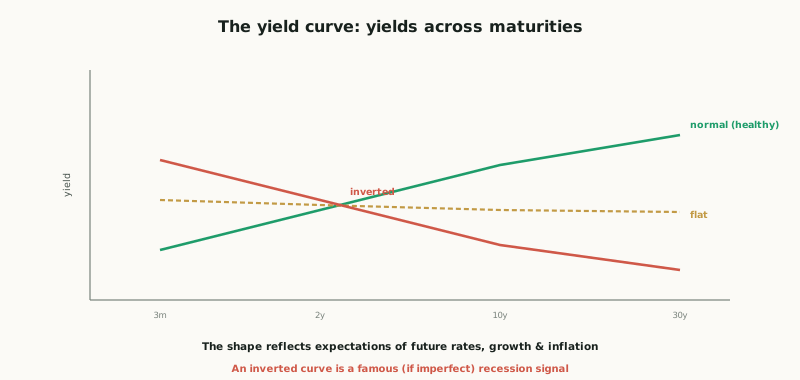
What the yield curve is
The yield curve is a line plotting the yields (interest rates) of bonds of the same credit quality — typically government bonds, such as US Treasuries — across different maturities, from short-term (3-month, 2-year) out to long-term (10-year, 30-year). It shows the relationship between how much yield you earn and how long you commit your money. Crucially, the curve's shape is a window into market expectations: because longer-dated yields embed the market's views on future short-term rates, growth and inflation, the curve's slope tells you what investors collectively expect the economic future to hold. It's less a forecast handed down by experts than a real-time aggregation of the bond market's bets.
The shapes and what they mean
The curve takes a few characteristic shapes, each carrying a message.
Yield curve shapes
A normal (upward-sloping) curve, where longer maturities yield more than shorter ones, is the usual, healthy state — investors demand extra yield to compensate for the time and uncertainty of lending longer, and the shape reflects expectations of ongoing growth. A steep curve (long yields much higher than short) signals expectations of strong growth, inflation, or rate hikes. A flat curve (short and long yields similar) suggests transition or uncertainty. And the notable one — an inverted (downward-sloping) curve, where short-term yields exceed long-term yields — is unusual and significant: it reflects market expectations that interest rates (and likely growth and inflation) will fall in the future, typically because investors anticipate the central bank cutting rates in response to a slowing economy. Because investors are willing to lock in lower long-term yields (expecting even lower rates ahead), the curve inverts.
Why inversion matters, and forex implications
The reason inversion commands so much attention is its track record as a recession predictor. An inverted curve — commonly measured as the 10-year yield minus the 2-year, or the 10-year minus the 3-month — has preceded most US recessions of recent decades, making it one of the most-watched leading indicators in all of macroeconomics. The logic is intuitive: inversion reflects the market collectively expecting the economy to weaken enough that the central bank will have to cut rates. That said — and this is the honest caveat — it is a strong but imperfect signal: the timing between inversion and any recession varies widely (often many months), there have been false or borderline signals, and like all such indicators it can be distorted by unusual conditions (heavy central-bank bond buying, for instance, can suppress long yields). It signals an expectation, not a certainty.
For forex, the yield curve matters because it reflects the interest-rate expectations that are among the most powerful drivers of currencies. A steepening curve or rising long yields — signalling growth and rate-hike expectations — can support a currency, while an inverting curve and expected rate cuts can weigh on it. Cross-country comparisons matter too: yield differentials between countries' curves drive capital flows and carry trades, as money chases higher relative yields. And the curve's role as a recession barometer ties it to risk sentiment: an inversion that stokes recession fears can trigger risk-off moves and flows into safe-haven currencies. As always, these are tendencies, not mechanical rules — the curve is one powerful gauge of expectations to read alongside the rest of the fundamental and technical picture. The honest framing: the yield curve plots bond yields across maturities, reflecting market expectations of future rates, growth and inflation — a normal (upward) curve signals health/growth, flat signals uncertainty, and inverted (short above long yields) signals expected falling rates/recession (a famous but imperfect recession predictor, with variable timing). For forex, the curve's shape and shifts reflect rate expectations that drive currencies, cross-country yield differentials drive flows, and inversion-driven recession fears trigger risk-off and safe-haven moves. But it signals expectations and tendencies, not certainties — read it as a key macro gauge alongside other fundamentals, not as a precise predictor.
How traders use the yield curve
For a forex trader, the yield curve is less a trading signal in itself than a macro context tool — a way to read where rate expectations, growth and risk sentiment are heading, which then informs how you view a currency. Several uses stand out. First, watching the curve's shifts: a curve that's steepening (long yields rising relative to short) often reflects firming growth and rate-hike expectations, a backdrop that tends to favour the currency; a curve that's flattening or inverting warns of slowing growth and expected cuts, a headwind. Tracking these shifts over time gives an evolving read on the macro narrative driving a currency. Second, cross-country comparison: because currencies trade in pairs, what matters is the curve and rate expectations of one country relative to another. Widening yield differentials — one country's curve rising while another's falls — drive capital flows toward the higher-yielding currency and underpin carry trades, so comparing the two currencies' curves (and the expectations baked into them) is often more useful than looking at either alone.
Third, the curve is a window into central-bank expectations. The short end of the curve closely tracks expected policy rates, so the curve effectively shows what the market thinks the central bank will do — and since currencies are so sensitive to rate expectations, shifts in the curve frequently precede or accompany currency moves. Fourth, as a risk barometer: a sharply inverting curve that stokes recession fears can foreshadow risk-off episodes and flows into safe havens, useful context for positioning. The honest caveats temper all of this. The curve reflects expectations, which can be wrong or change; its recession signal has variable, sometimes long, lead times; and modern curves can be distorted by heavy central-bank bond-buying (which suppresses long yields and can muddy the inversion signal). So use the yield curve as one valuable input into your macro view — reading expectations, differentials and risk — rather than as a mechanical buy/sell trigger, and combine it with the rest of your fundamental and technical analysis. Read this way, it's among the most information-rich gauges available, distilling the bond market's collective wisdom into a shape you can learn to interpret at a glance.
What the curve can't tell you
For all its information value, the yield curve has real blind spots worth respecting. It reflects the market's collective expectations — and the market is frequently wrong, so the curve can signal a recession that never arrives, or fail to flag one that does. Its famous inversion signal comes with highly variable lead times: a recession might follow inversion by six months or by two years, which makes it useless for precise timing even when it's ultimately "right." Modern curves are also prone to distortion: years of large-scale central-bank bond-buying (quantitative easing) have at times suppressed long-term yields artificially, flattening or inverting the curve for reasons unrelated to growth expectations and muddying the traditional signal. And the curve says nothing about what will trigger a turn or how severe it might be. So treat the yield curve as a rich gauge of expectations and direction — one of the best macro context tools available — while holding it loosely: it informs your view of where rates, growth and risk are heading, but it neither predicts the future reliably nor substitutes for watching the actual data and policy as they unfold.
The yield curve plots bond yields (usually government bonds) across maturities — its shape reflects market expectations of future rates, growth and inflation. Normal (upward, long > short) = healthy/growth; steep = strong growth/inflation expected; flat = uncertainty; inverted (short > long) = expected falling rates/recession — a famous recession signal (10y−2y or 10y−3m), though imperfect (variable timing, false signals, distortions). For forex: the curve reflects rate expectations that drive currencies (steepening/rising long yields can support a currency; inversion/expected cuts weigh on it), cross-country yield differentials drive flows and carry, and inversion-driven recession fears trigger risk-off and safe-haven moves. It signals expectations and tendencies, not certainties — a key macro gauge to read alongside other analysis.