
Prop firms promise to fund you with large trading capital if you can pass an evaluation — an appealing pitch for traders short on capital. The model is real and works for some, but it's wrapped in heavy marketing and stacked with strict rules, so it pays to understand it clearly before paying the fee. This guide explains forex prop firms: how they and their challenges work, the profit split, the realistic odds, and how to approach them with appropriate caution.
It's a topic where realistic expectations and a scam-aware eye matter, and where you still need genuine risk management and a tested plan.
Key takeaways
Q: What is a forex prop firm?
A: A proprietary ('prop') trading firm gives traders access to the firm's capital to trade, sharing the profits. In the modern retail model, you typically pay a fee to take an 'evaluation' or 'challenge' — demonstrating you can hit a profit target without breaching risk rules — and if you pass, you get a 'funded' account trading the firm's money, keeping an agreed share (the profit split) of any profits you make.
Q: How do prop firm challenges work?
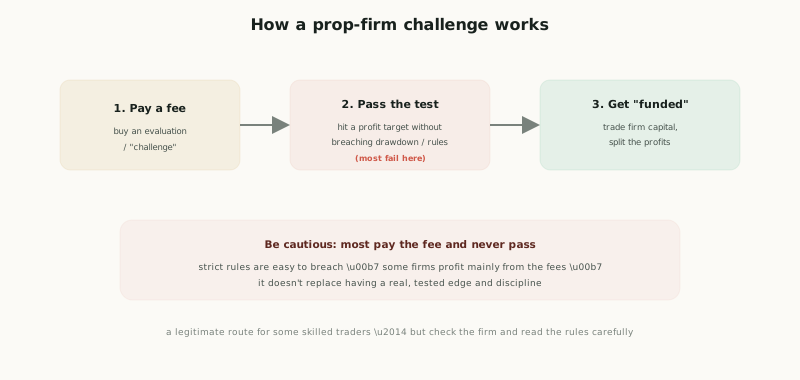
A: You pay an upfront fee for an evaluation with a set profit target (say, reach 8-10% profit) and strict risk rules — typically a maximum overall drawdown and a maximum daily loss — that you must not breach. Pass within the rules and you're 'funded' (often after one or two evaluation phases); breach a rule and you fail, losing the fee. Funded traders then split profits with the firm, commonly keeping the larger share, while the firm's risk rules still apply.
Q: Are prop firms worth it?
A: It depends, and caution is warranted. For a genuinely skilled, disciplined trader short on capital, a reputable prop firm can be a legitimate route to trade larger size. But most people fail the challenge — the rules are strict and easy to breach — so many simply lose the fee, and some firms profit largely from those fees. A prop account doesn't create an edge; you still need a real, tested strategy and discipline. Research the firm carefully and read the rules.
How they work
A proprietary ("prop") trading firm gives traders access to the firm's capital to trade, sharing the profits. In the modern retail prop model that has exploded in popularity, the mechanism is an evaluation (or "challenge"): you pay an upfront fee to attempt it, you must hit a profit target (say, reach 8–10% profit on a simulated account) without breaching strict risk rules — typically a maximum overall drawdown and a maximum daily loss you must never exceed — and if you pass (sometimes after one or two evaluation phases), you receive a "funded" account to trade the firm's money. As a funded trader, you then split the profits with the firm — commonly keeping the larger share (e.g. 70–90%) — while the firm's risk rules continue to apply (breach them and you can lose the funded account). The appeal is obvious: trade much larger size than your own capital would allow, with the firm absorbing the downside risk, in exchange for a slice of the upside and the cost of the evaluation. For a trader with skill but limited capital, that's a genuinely attractive proposition — which is exactly why the model has boomed.
The realistic picture, and how to approach it
Before paying any fee, understand the realistic picture. Most people fail the challenge. The risk rules — especially the maximum drawdown and daily-loss limits — are strict and easy to breach, particularly for the very traders (under-capitalised, often inexperienced) most attracted to the pitch; a couple of losing trades or one bad day can end the attempt. So the common outcome is simply losing the fee — and, crucially, some firms profit largely from those fees rather than from funded traders' market profits, which means their business model can be aligned with people failing and re-attempting, not succeeding. (This isn't true of every firm — reputable ones do genuinely fund and pay skilled traders — but it's a structural risk to be aware of.) A funded account also does not create an edge: passing a challenge and trading firm capital doesn't make you profitable — you still need a real, tested strategy, solid risk management and discipline, and the firm's tight rules actually demand more discipline than trading your own account, not less. There's also a scam-adjacent fringe: the space has attracted some firms with predatory terms, unrealistic rules designed to be failed, payout difficulties, or outright dishonesty — so a scam-aware eye is essential. None of this means prop firms are bad — for a genuinely skilled, disciplined, under-capitalised trader, a reputable firm can be a legitimate, useful route to trade larger size — but it does mean approaching them with clear eyes rather than the dream the marketing sells.
If you do consider a prop firm, a sensible approach follows directly. Research the firm carefully: look for an established track record, genuine evidence of payouts to funded traders, transparent terms, and reviews from real traders (treating glowing testimonials with the usual survivorship-bias skepticism). Read the rules in detail before paying — understand the exact profit target, the drawdown and daily-loss limits, how drawdown is calculated, any time limits, restricted strategies (some ban news trading or certain styles), and the precise profit split and payout process; the rules are where the difficulty (and any traps) live. Have a real edge first: don't treat a challenge as a way to get a strategy — you should already have a tested, profitable approach and the discipline to follow it under strict rules, ideally proven on your own account or a long demo. Set realistic expectations: assume you may well fail the first attempt, treat the fee as at risk, and don't pour money into repeated re-attempts chasing the funded dream. And remember the fee is a real cost — factor it against the capital you'd otherwise be risking (for some, simply trading a modest amount of their own capital is more sensible than repeated challenge fees — see how much to start with). Used wisely by a prepared, skilled trader, a reputable prop firm is a legitimate tool; entered naively as a shortcut to riches, it's usually just a series of lost fees. The honest framing: a prop firm funds you with its capital for a profit split, typically via a paid evaluation — hit a profit target without breaching strict drawdown/daily-loss rules, then trade funded and keep the larger share. But most fail the challenge (the rules are strict and easy to breach), so many just lose the fee, and some firms profit mainly from fees; a funded account doesn't create an edge, and the space has a scam-adjacent fringe. For a skilled, disciplined, under-capitalised trader a reputable firm is a legitimate route — so research the firm, read the rules, have a real tested edge first, set realistic expectations, and treat the fee as at risk.
Models, terms and red flags
Prop offerings vary, and the details decide whether one is fair or a trap. On models: most common is the evaluation (challenge) model — sometimes one phase, sometimes two (a tougher first target, then a second confirmation phase) — while some firms advertise "instant funding" (skip the evaluation for a higher fee), which sounds appealing but usually comes with its own strict rules and often worse terms. The terms to scrutinise carefully before paying: the exact profit target; the maximum drawdown and crucially how it's measured — a static drawdown (a fixed floor) is far more forgiving than a trailing drawdown (a floor that ratchets up as your balance rises, which can stop you out even after you've been profitable); the daily loss limit; any consistency rules (some firms require your profits to be spread evenly and disallow one big winning trade); time limits; restricted strategies (some ban news trading or holding over weekends); and the payout schedule and split (how often you can withdraw, and the exact process).
The red flags that mark a firm to avoid: unrealistic profit targets paired with very tight drawdowns (designed to be failed); opaque or contradictory terms, or rules buried in fine print; complaints about payouts (funded traders unable to actually withdraw their profits — the single most damning sign); aggressive, too-good-to-be-true marketing (lambo-and-lifestyle hype, affiliate-driven promotion, guarantees of easy funding); a very short or anonymous track record; and any sign the firm's revenue comes overwhelmingly from challenge fees rather than real funded-trader performance. Cross-reference independent reviews (with the usual survivorship-aware skepticism), and treat the whole thing as you would any financial commitment with a scam-aware eye. A reputable prop firm has transparent, fair terms, a real history of paying funded traders, and rules that are strict but achievable for a genuinely skilled trader — if you can't clearly confirm those, keep your fee. The honest reminder: know the model (one/two-phase evaluation vs pricier instant funding), and scrutinise the terms — especially static vs trailing drawdown, daily loss limits, consistency rules and the payout process; avoid red flags like unrealistic targets with tight drawdowns, opaque terms, payout complaints, too-good marketing and fee-driven business models, cross-checking independent reviews before committing.
A prop firm funds you with its capital for a profit split, typically via a paid evaluation: hit a profit target without breaching strict drawdown / daily-loss rules, then trade "funded" and keep the larger share. But most fail the challenge — the rules are strict and easy to breach — so many simply lose the fee, and some firms profit mainly from fees; a funded account doesn't create an edge (you still need a real, tested strategy, risk management and discipline), and the space has a scam-adjacent fringe. For a genuinely skilled, disciplined, under-capitalised trader a reputable firm is a legitimate route — so research the firm, read the rules, have a real edge first, set realistic expectations, and treat the fee as at risk. A tool for the prepared — not a shortcut to riches.