
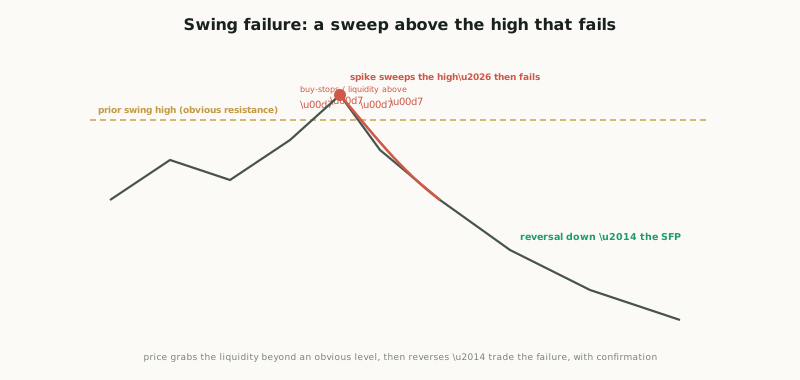
Price spikes just above an obvious high, triggering a wave of stop-losses and breakout buyers — then snaps back below and reverses hard, leaving those latecomers trapped. That's a swing failure pattern (SFP): a liquidity grab dressed up as a breakout, and a favourite setup of traders who watch where the crowd gets trapped. It's one of the more sophisticated price-action reads, rooted in the idea that markets hunt the liquidity sitting beyond obvious levels. This guide explains the SFP: what it is, how to trade it, and its real risks.
It's an application of liquidity concepts and a close relative of the false breakout and stop-loss hunting.
Key takeaways
Q: What is a swing failure pattern?
A: A swing failure pattern (SFP) occurs when price briefly pushes beyond a prior swing high or low — sweeping the stop-losses and breakout orders clustered there — but fails to hold, snapping back and closing on the other side of that level. It signals that the move beyond the level was a liquidity grab rather than a genuine breakout, and often precedes a reversal. It's closely tied to smart-money and liquidity concepts.
Q: How do you trade a swing failure pattern?
A: After price sweeps a prior high/low and reverses back through it (ideally closing back inside on the candle), traders enter in the reversal direction — short after a swept high, long after a swept low — with a stop just beyond the wick of the sweep (where the pattern would be invalidated) and a target at a logical level or opposite liquidity. Confirmation that price has reclaimed the level is key; entering on the spike itself is dangerous.
Q: What are the risks of trading the SFP?
A: The main risk is that what looks like a failed breakout is actually a genuine breakout that briefly pulls back before continuing — so the 'sweep' keeps going and your reversal trade is wrong. SFPs also require judgement about which swing points hold meaningful liquidity, and they work better in some contexts (clear ranges, obvious levels) than others. As always, confirmation, sensible stops and risk management are essential.
What it is
A swing failure pattern occurs when price briefly pushes beyond a prior swing high (or low), sweeps the orders clustered there, but fails to hold — snapping back and closing on the other side of the level. To see why this matters, recall where liquidity sits: just beyond obvious swing highs and lows lie clusters of stop-losses (from traders positioned the other way) and breakout orders (from traders betting on a break) — a pool of resting liquidity (see liquidity and stop-loss hunting). In an SFP, price spikes into that pool — tripping the stops and breakout buys above a high — but then, instead of continuing, rejects and reverses back below the level. The interpretation is that the move beyond the level was not a genuine breakout but a liquidity grab: larger participants (or simply the market's mechanics) reached up to fill orders against the trapped crowd, and once that liquidity was taken, there was nothing left to push price higher, so it reversed. The trapped breakout buyers, now offside, add fuel to the reversal as they bail out. This is why the SFP is so closely tied to smart-money concepts: it's the visible footprint of liquidity being swept beyond an obvious level, and it often precedes a reversal — making the failed breakout itself a high-quality trade signal for those who recognise it.
How to trade it, and the risks
Trading an SFP means fading the failed breakout — entering in the reversal direction after the sweep. For a bearish SFP (a swept high): wait for price to spike above the prior swing high and then reverse back below it — ideally closing back inside (below the level) on the candle, which confirms the breakout has failed rather than merely paused. Then enter short, place a stop just beyond the wick of the sweep (above the spike's high — the point where the pattern is invalidated and a real breakout is underway), and target a logical level: a prior structure point, the opposite side of the range, or the next pool of liquidity (e.g. a swing low whose stops could be the next target). The bullish SFP mirrors this at a swept low (spike below a prior low, reverse back above, go long, stop below the wick). The defining discipline is confirmation: you must wait for price to reclaim the level (close back inside) before entering — entering on the spike itself is dangerous, because at that instant you cannot yet tell a failed breakout from a real one. Patience for the close-back-inside is what separates an SFP trade from catching a falling knife.
The risks are real and worth stating plainly. The central risk is the mirror image of the setup's logic: what looks like a failed breakout may actually be a genuine breakout that briefly pulled back before continuing — in which case the "sweep" keeps going, your reversal trade is wrong, and you're now the trapped one. There is no certain way to distinguish the two in real time, which is exactly why the stop beyond the wick (and proper sizing) is non-negotiable. The SFP also requires judgement about which swing points hold meaningful liquidity — not every minor high is worth watching; the best SFPs occur at obvious, significant levels where lots of stops genuinely cluster (major swing highs/lows, range extremes, round numbers). And like all setups, it works better in some contexts than others — it's particularly suited to ranges and clear levels, and trickier in strong trends (where breakouts more often succeed). So the honest stance: the SFP is a powerful, logically-grounded reversal setup for traders who understand liquidity, but it is not a guarantee — it requires confirmation (the reclaim/close back inside), good level selection, a tight stop beyond the sweep, sensible sizing, and acceptance that some "failures" are real breakouts in disguise. Used with that discipline, it turns the crowd's trapped liquidity into a clean, well-defined edge; used recklessly (fading every spike without confirmation), it's a fast way to get run over. The honest framing: a swing failure pattern is when price sweeps beyond a prior swing high/low — grabbing the stops and breakout orders (liquidity) there — then fails to hold and closes back on the other side, revealing a liquidity grab rather than a real breakout, often before a reversal. Trade it by fading the failed breakout after price reclaims the level (closes back inside): short a swept high / long a swept low, stop just beyond the sweep's wick, target logical levels or opposite liquidity. The key risk is a genuine breakout masquerading as a failure, so confirmation, good level selection and risk management are essential — never enter on the spike itself.
Context, levels and refinements
The SFP rewards careful attention to which levels you watch and how you confirm. The best levels are those holding genuine, obvious liquidity: significant swing highs and lows, prior-day or prior-week highs/lows, session highs/lows, round numbers, and especially equal highs or equal lows (two or more swings at the same level, where stops pile up particularly thickly — a magnet for a sweep). A spike through a level that everyone can see, holding lots of stops, is a far better SFP candidate than one through a minor, obscure swing. Higher-timeframe alignment sharpens it further: an SFP that sweeps a level and reverses in the direction of the higher-timeframe trend or bias is more reliable than one fighting it — so the ideal is a sweep of liquidity against the larger trend's direction, which then resumes that larger trend (a low-risk re-entry). Combining the SFP with other smart-money tools — a fair value gap or a break of structure confirming the reversal — adds confluence.
On confirmation, the detail matters: the cleanest SFP closes back inside the level on the signal candle (the wick pokes through and rejects, the body closes back on the original side), which is the visual proof the breakout failed rather than succeeded. Waiting for that close — rather than reacting to the live spike — is the single most important discipline, because it's the only thing that distinguishes (after the fact) a failed breakout from a real one. Some traders add a further wait for a lower-timeframe reversal structure after the sweep before entering, trading confirmation over immediacy. The hardest judgement remains distinguishing an SFP from a genuine breakout in real time, and the honest answer is that you can't with certainty — which is precisely why the stop beyond the wick and disciplined sizing are mandatory, so the times you're wrong (a "failure" that was really a breakout, running on without you) cost only a small, controlled amount. The SFP is best understood as a high-quality, liquidity-grounded reversal trigger at well-chosen levels with confirmation — not a license to fade every spike. Selectivity (great levels, higher-timeframe alignment, confirmed close-back-inside) is what makes it shine. The honest reminder: pick levels with real liquidity (significant swings, prior-day/week highs/lows, equal highs/lows, round numbers), prefer SFPs aligned with the higher-timeframe bias, confirm with a close back inside the level (and optionally a lower-timeframe reversal), and accept you can't be certain it's not a real breakout — so the stop beyond the wick and sizing are mandatory.
A swing failure pattern (SFP) is when price sweeps beyond a prior swing high/low — grabbing the stops and breakout orders (liquidity) clustered there — then fails to hold and closes back on the other side, revealing a liquidity grab, not a real breakout, often before a reversal. Trade it by fading the failed breakout once price reclaims the level (closes back inside): short a swept high / long a swept low, stop just beyond the sweep's wick, target logical structure or the opposite liquidity. The key risk is a genuine breakout masquerading as a failure — so confirmation (the close back inside), good level selection (significant highs/lows with real liquidity) and risk management are essential. Never enter on the spike itself. A powerful, liquidity-grounded setup — not a guarantee.