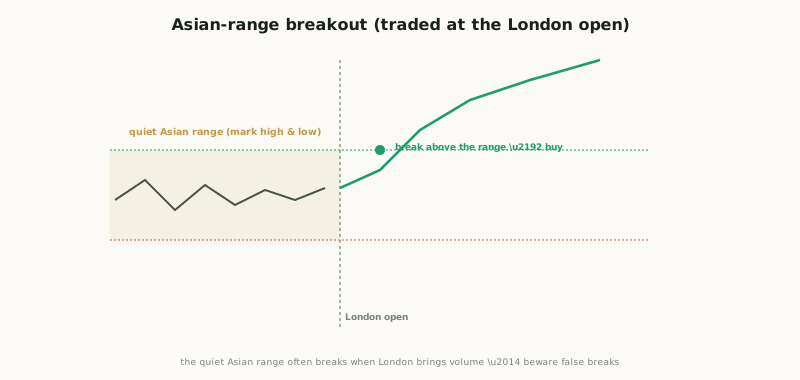
The Asian session is forex's quiet hours — with the major European and US players largely asleep, price often coils into a tight range. Then London wakes up, volume floods in, and that range frequently breaks. Trading that break is one of the classic session-based strategies, exploiting the predictable daily rhythm of when the market is quiet and when it comes alive. This guide explains the Asian session breakout: the setup, its logic, the rules, and how to handle the ever-present false breakout.
It's a close cousin of the London breakout and opening-range breakout, and an application of breakout trading to the session clock.
Key takeaways
Q: What is the Asian session breakout strategy?
A: It's a session-based breakout strategy that uses the typically quiet, range-bound Asian trading session to define a price range (its high and low), then trades a breakout of that range — usually when the more active London session opens and brings volume and volatility. A break above the Asian high signals a long, a break below the Asian low a short, on the idea that the new session's activity drives a directional move.
Q: Why does the Asian range tend to break at the London open?
A: Because liquidity and volatility surge when London opens. The Asian session (Tokyo hours) is generally lower-volume and often consolidates into a tight range, since the major European and US players are largely inactive. When London — the largest forex centre — comes online, the influx of volume frequently pushes price out of that quiet range, creating the breakout the strategy aims to capture.
Q: How do you handle false breakouts in this strategy?
A: False breakouts are the main challenge: price can poke out of the Asian range and reverse. Common defences include waiting for a candle to close beyond the range rather than entering on the first touch, requiring a minimum range or filtering out unusually wide ranges, using a stop on the opposite side of the range, and being aware of news. Some traders even fade failed breakouts. As always, confirmation and risk management are essential.
The setup
The strategy turns the market's daily rhythm into a simple, rules-based plan.
The Asian session breakout
The mechanics are clean. First, mark the Asian range: identify the high and low of price during the Asian session (broadly the Tokyo trading hours), which typically forms a relatively tight, contained range during these lower-volume hours. Second, wait for the London open and trade the break of that range: a break above the Asian high is a long signal, a break below the Asian low a short signal. Place a stop on the opposite side of the range (or just beyond the entry point), and target a sensible level — a multiple of the risk, a prior structure point, or a measured move based on the range's size. The whole idea rests on a clear logic: the quiet Asian range represents a coiled, balanced market, and the surge of activity at the London open often provides the energy to break that balance and start a directional move — so you position to catch that move as it begins.
Why it works — and the false-breakout problem
The why comes down to the forex market's session structure and the daily ebb and flow of liquidity. The Asian session is generally lower-volume: with the big European and American institutions largely inactive, there's less force to drive sustained moves, so price tends to consolidate into a range. When London — the largest forex trading centre — comes online, a wave of volume and volatility floods in, and that fresh participation frequently pushes price out of the overnight range as the day's real positioning begins. The breakout strategy simply aims to be positioned for that recurring quiet-then-active transition. This is the same fundamental logic behind the London breakout strategy (indeed the two overlap heavily) and the broader principle that the session overlaps and opens are when forex moves most.
But the strategy's defining challenge is the false breakout, and it must be respected. Price will often poke out of the Asian range and then reverse back inside — a false breakout that stops out the eager breakout trader before the "real" move (sometimes in the opposite direction). Several defences help. Wait for a candle to close beyond the range rather than entering on the first touch — a close-confirmed break is more reliable than a momentary spike (which may just be a liquidity sweep of the obvious range stops). Filter the range: an unusually wide Asian range may mean the move already happened and offers a poor risk-reward, while a very narrow one may break more cleanly — some traders require the range to be within a sensible size. Mind the news: a scheduled news release around the London open can cause violent, unpredictable spikes, so check the economic calendar. And some traders flip the problem entirely, fading failed breakouts (trading the reversal back into the range when a break fails) — essentially trading the swing-failure version. As with every breakout approach, you cannot eliminate false breakouts; you manage them with confirmation, sizing and stops, accepting them as an inherent cost of catching the genuine breaks. The honest framing applies as ever: the Asian session breakout is a logical, well-defined session strategy, not a holy grail — it works better on some days and pairs than others, false breakouts are common, and its edge lives in disciplined execution and risk management, not the setup alone. The honest framing: the Asian session breakout marks the high and low of the quiet, range-bound Asian session, then trades the break — long above the high, short below the low — typically as the London open floods in volume that pushes price out of the range, with a stop on the opposite side. It works because Asian hours are low-volume and consolidate while London brings the volatility to break out (the same logic as the London breakout). The main challenge is false breakouts: defend with close-confirmed breaks, sensible range filters, news awareness, and stops — or fade failed breaks. Manage false breakouts rather than expecting to avoid them; the edge is in execution and risk management.
Refinements and variations
Turning the basic idea into a workable plan requires nailing down some specifics. Define the Asian window precisely: decide exactly which hours count as the Asian session for your range (broadly the Tokyo session, though traders use slightly different windows), and apply it consistently — a clearly-defined, repeatable range is essential for a rules-based approach. Filter by range size: the width of the Asian range is informative — an unusually wide range may mean a move has already happened (poor risk-reward on a further breakout, and a larger stop), while a tight, well-contained range tends to produce cleaner breaks; many traders only take the trade when the range falls within a sensible band, and use the range's size to set proportionate targets (e.g. projecting the range height beyond the break). Pair selection matters too: pairs that are genuinely quiet during Asian hours and active at the London open (many EUR and GBP crosses) suit the strategy better than pairs that are themselves Asian-driven (JPY and AUD pairs can be active during the Asian session, which can muddy the clean range).
Several variations refine the edge. A time-based exit is common: since the strategy targets the London-driven move, traders often close the trade by the end of the London session or the New York open, rather than holding indefinitely — the session logic that justified the entry also bounds its lifetime. To combat the false breakout, the close-confirmed entry (waiting for a candle to close beyond the range, not just touch it) is the key filter, and some traders explicitly fade failed breaks instead — trading the reversal back into the range when a break is rejected, essentially a swing-failure play on the range extremes (often a strong setup, since the obvious range stops are a liquidity magnet). Adding a directional bias can improve selectivity: only taking breakouts aligned with a higher-timeframe trend or the day's expected direction, rather than every break either way. And news awareness is essential — a major release at the London open can cause violent, unpredictable moves, so check the calendar and consider standing aside. As ever, the strategy is a logical, well-defined framework, not a guarantee: it has good days and bad, false breaks are routine, and the edge lives in consistent rules, the right pairs and sessions, and disciplined risk management. The honest reminder: define the Asian window precisely and apply it consistently, filter by range size, choose pairs that are quiet in Asia and active at the London open, use a time-based exit and close-confirmed entries (or fade failed breaks), add a higher-timeframe bias for selectivity, and always check the news — it's a framework, not a guarantee.
The Asian session breakout: mark the high and low of the quiet, range-bound Asian (Tokyo) session, then trade the break — long above the high, short below the low — typically as the London open brings the volume that pushes price out of the range, with a stop on the opposite side. It works because Asian hours are low-volume and consolidate, while London floods in the volatility to break out (the same logic as the London breakout). The main challenge is the false breakout: defend with close-confirmed breaks (not first-touch spikes), sensible range filters, news awareness, and stops — or fade failed breaks. You manage false breakouts, not avoid them; the edge lives in disciplined execution and risk management, not the setup alone.