
One of the simplest, most powerful risk controls is also one of the most ignored: a daily loss limit. Lose a set amount in a day, and you stop — no exceptions. It exists to save you from the worst version of yourself: the tilted, revenge-driven trader who turns a bad morning into a blown account. It costs nothing, requires no skill, and prevents a huge share of catastrophic days — yet only works if you have the discipline to honour it. This guide explains the daily loss limit: what it is, why it matters, how to set one, and the discipline to stick to it.
It's a specific, practical form of setting risk limits, a direct defence against revenge trading, and an expression of trading discipline.
Key takeaways
Q: What is a daily loss limit?
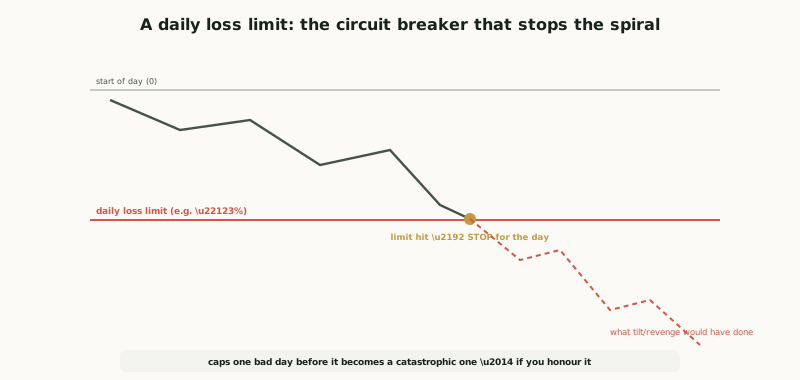
A: A daily loss limit is a predetermined maximum amount you allow yourself to lose in a single trading day. Once your losses for the day reach that limit, you stop trading until the next day — no new positions, no exceptions. It acts as a circuit breaker, capping how much damage a single bad day can do and, crucially, removing you from the screen before emotional, tilt-driven trading can turn a normal losing day into a disaster.
Q: Why is a daily loss limit important?
A: Because the biggest single-day blow-ups usually come not from a few normal losses but from the spiral that follows them — a trader who's down gets frustrated, starts revenge trading, sizes up to 'get it back,' and loses far more than they ever would have from disciplined trading. A daily loss limit stops that spiral at the source by ending the session before tilt takes over. It turns a potentially catastrophic day into merely a bad one.
Q: How do you set and honour a daily loss limit?
A: Set it as a modest percentage of your account or a multiple of your per-trade risk — for example, stopping after losing the equivalent of two or three normal trades (often a few percent of the account at most). The exact number is personal, but it should be small enough that hitting it is survivable and routine. Honouring it is the hard part: it only works if you treat it as an absolute rule and walk away when hit, rather than 'just one more trade.'
What it is, and why it matters
A daily loss limit is a predetermined maximum you allow yourself to lose in a single trading day. Once your losses for the day reach that limit, you stop trading until the next day — no new positions, no exceptions. It acts as a circuit breaker: it caps how much damage a single bad day can do, and — most importantly — it removes you from the screen before emotional, tilt-driven trading can turn a normal losing day into a disaster.
The daily loss limit at a glance
Its importance comes from a hard truth about how traders blow up: the biggest single-day disasters usually come not from a few normal losses but from the spiral that follows them. A trader who's down gets frustrated, starts revenge trading, sizes up to "get it back," makes impulsive trades that abandon the plan, and loses far more than disciplined trading ever would have — a couple of ordinary losses snowball into a day that wipes out weeks of gains. A daily loss limit stops that spiral at the source by ending the session before tilt takes over: you simply aren't there to make the panicked trades that do the real damage. It turns a potentially catastrophic day into merely a bad one — and "merely a bad day" is recoverable, while a tilt-driven blow-up may not be. In effect, it's a pre-commitment device: a rule you set with a calm mind to protect you from the decisions of a rattled one.
How to set one, and how to honour it
Setting a daily loss limit is straightforward: make it a modest amount — commonly a small percentage of your account or a multiple of your per-trade risk. For example, stopping after losing the equivalent of two or three normal trades (so if you risk 1% per trade, a daily limit around 2–3% — a "3-strike" rule of three full losses is a common, intuitive version). The exact number is personal — it depends on your strategy's normal pattern of wins and losses, your trade frequency, and your temperament — but it should be small enough that hitting it is survivable and routine (a normal bad day, not a disaster) and large enough that you're not stopped out by ordinary, expected losing sequences. Many traders also pair it with a daily trade-count limit or a "two losses in a row → take a break" rule, which catch tilt even before the money limit does. The principle is the same: decide in advance, when calm, the point at which you'll walk away.
The genuinely hard part — and the only part that matters — is honouring it. A daily loss limit only works if you treat it as an absolute, non-negotiable rule and actually walk away when hit, rather than telling yourself "just one more trade." This is where most traders fail: the limit is hit, and precisely because they're now down and emotional, they rationalise continuing ("the next setup looks great," "I can feel it turning," "I just need one winner to get back to even") — which is exactly the tilt the limit was designed to stop. The whole value of the rule is that it binds you when your judgement is compromised, so overriding it "just this once" defeats the entire purpose (and "just this once" tends to become a habit). Practical ways to enforce it: physically step away from the screen when hit (close the platform, leave the desk), use broker/platform tools that lock you out after a set loss if available, write the limit into your trading plan and journal each breach, and remind yourself that the market is open tomorrow — there is always another day, and protecting your capital and state of mind to trade it well is worth far more than chasing a lost day. Treat hitting the limit not as a defeat but as the rule doing its job — a successful risk control, not a failure. As with all risk management, the daily loss limit is about survival: it ensures no single day, and no single bout of emotion, can take you out of the game. The honest framing: a daily loss limit is a preset maximum loss for one day, after which you stop — a circuit breaker that caps one bad day and, crucially, removes you before tilt-driven revenge trading turns it into a disaster (most blow-up days come from the spiral after the losses, not the losses themselves). Set it modestly — a few percent of the account or two to three normal trades — small enough to be routine. The hard part is honouring it absolutely: walk away when hit, never "just one more trade," because the rule exists precisely to bind your compromised, emotional judgement. There's always tomorrow.
A fuller circuit-breaker system
The daily loss limit is the most important circuit breaker, but it works best as part of a layered system of self-protective rules. A weekly and even monthly loss limit extends the same logic to longer horizons — if a whole week or month goes badly, a larger limit prompts you to step back and reassess (reducing size or pausing to review) rather than grinding deeper. A maximum-consecutive-losses rule (e.g. "after three losing trades in a row, stop and review") can catch tilt even before the money limit does, since a losing streak often signals either poor conditions or deteriorating focus. And a cooling-off period after any large loss — a mandatory break of an hour, or the rest of the day — forces the emotional heat to dissipate before you trade again. These layers reinforce each other: together they make it very hard for a single bad run, or a single bad mood, to do lasting damage.
It's worth noting that this isn't just personal best-practice — it's institutionalised where the stakes are high. Proprietary trading firms, for instance, typically enforce a hard daily loss limit (and a maximum overall drawdown) as a non-negotiable rule, automatically restricting or closing out a trader who breaches it — precisely because they know, from managing many traders, that uncapped daily losses are how accounts and careers end. That professional norm is a strong endorsement of the principle for individual traders too: the firms with the most experience and the most to lose treat daily loss limits as essential infrastructure, not optional discipline. The unifying idea behind all of it is building rules that protect you from yourself — pre-commitments made by your rational mind to constrain your emotional one. The trader who sets and honours these circuit breakers is, in effect, outsourcing willpower to a system, which is far more reliable than hoping to summon discipline in the heat of a losing streak. The honest reminder: build the daily loss limit into a layered circuit-breaker system — add weekly/monthly loss limits, a max-consecutive-losses rule, and a cooling-off period after big losses; note that prop firms enforce hard daily limits precisely because uncapped losses end accounts, and the unifying principle is creating rules that protect you from yourself, outsourcing willpower to a system rather than relying on in-the-moment discipline.
A daily loss limit is a preset maximum loss for one day, after which you stop — no exceptions: a circuit breaker that caps one bad day and, crucially, removes you before tilt-driven revenge trading turns it into a disaster (most blow-up days come from the spiral after the losses, not the losses themselves). Set it modestly — a few % of the account, or two to three normal trades (a "3-strike" rule) — small enough that hitting it is routine, not catastrophic. The hard part is honouring it absolutely: walk away when hit, never "just one more trade," because the rule exists precisely to bind your compromised, emotional judgement — overriding it defeats the whole purpose. Treat hitting it as the rule working, not failing. There's always tomorrow — it's about survival.