Every trader faces drawdowns — stretches where the account sits below its previous peak. They're normal and unavoidable, an expected part of trading rather than a sign of failure, but how you respond decides whether you recover steadily or dig a deeper hole. The instinct to win it back quickly is almost always the wrong one — and learning to resist it is one of the most valuable skills a trader can build. This guide covers recovering from a drawdown: why they're normal, the disciplined process for climbing back, and why the rush to recover is so dangerous.
It builds on the math of drawdowns, the reality of variance and luck, and guards against revenge trading.
Key takeaways
Q: Are drawdowns normal in trading?
A: Yes — completely normal and unavoidable. Even profitable strategies experience losing streaks and periods below their previous equity peak, simply due to the natural variance of trading. A drawdown isn't necessarily a sign that anything is broken; it's an expected part of the journey. What matters is keeping drawdowns within survivable bounds through sound risk management, and responding to them with discipline rather than panic.
Q: How do you recover from a drawdown?
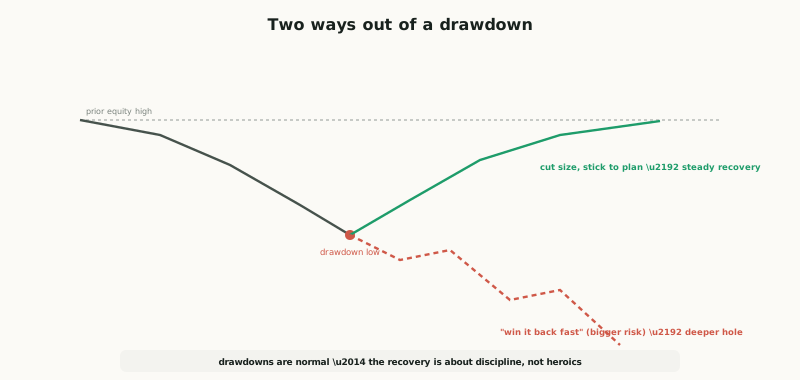
A: By doing the opposite of what panic suggests: stick to your tested plan, consider reducing position size while confidence and conditions are poor (which limits further damage and eases the psychology), avoid trying to 'win it back' with bigger or impulsive trades, and rebuild steadily. Review whether the drawdown is just normal variance or a genuine problem with your edge or execution. The goal is a calm, methodical climb back, not a heroic recovery in a single session.
Q: Why is trying to 'win it back fast' so dangerous?
A: Because it leads to oversized, emotional, revenge-driven trades that abandon your edge — increasing risk exactly when you're most vulnerable. The math is brutal: deeper drawdowns require disproportionately larger gains to recover (a 50% loss needs a 100% gain), so adding reckless risk can turn a recoverable dip into a catastrophic one. Most account-destroying losses come not from the original drawdown but from the panicked attempt to escape it quickly.
Why drawdowns are normal
The first and most important thing to internalise is that drawdowns are completely normal and unavoidable. Even profitable strategies experience losing streaks and periods below their previous equity peak, simply because of the natural variance of trading — wins and losses don't arrive in a smooth, alternating sequence but in clusters, so a string of losses (a drawdown) is a statistical certainty over enough trades, not evidence that something is broken. A trader with a genuine edge will still have drawdowns; the edge plays out over the long run, through the inevitable dips. This reframing matters enormously for your response: if you see a drawdown as a catastrophe or a verdict on your worth, you'll panic and make it worse; if you see it as an expected, survivable part of the process, you can respond calmly. What does matter is keeping drawdowns within survivable bounds through sound position sizing and risk limits in the first place (so no drawdown threatens ruin — see risk of ruin), and then responding to the one you're in with discipline rather than panic. A drawdown handled well is a temporary dip; a drawdown handled badly is how accounts die.
The recovery process — and the trap
Recovering well means doing largely the opposite of what panic suggests. Stick to your tested plan: a drawdown is not the time to abandon your strategy for something new, or to start trading impulsively — if your edge was real before, it's likely still real, and consistency is what lets it reassert itself. Consider reducing position size while confidence and conditions are poor: trading smaller during a drawdown both limits further damage (a smaller stake on a continued bad run does less harm) and eases the psychology (smaller positions are less stressful, helping you trade clearly), and you can scale back up as you stabilise — this is a gentle, sensible response, the near-opposite of the destructive instinct to size up. Rebuild steadily, accepting that recovery is a methodical climb, not a single heroic session. And review honestly whether the drawdown is just normal variance (in which case, carry on with discipline) or a sign of a genuine problem — a broken edge, changed market conditions, or sloppy execution (in which case, address the real issue, perhaps pausing to reassess); your journal and equity-curve analysis help you tell the difference. The goal throughout is a calm, methodical recovery, protecting capital and psychology while your edge does its work.
The single most dangerous response to a drawdown is the urge to win it back quickly, and resisting it is the heart of recovery. This urge leads to oversized, emotional, revenge-driven trades that abandon your edge — increasing risk exactly when you're most vulnerable (already down, and now trading badly). The math makes it brutal: deeper drawdowns require disproportionately larger gains to recover — a 20% loss needs a 25% gain, a 50% loss needs a 100% gain, a 75% loss needs a 300% gain — so adding reckless risk in a bid to escape fast can turn a recoverable dip into a catastrophic, possibly unrecoverable one. The cruel irony is that most account-destroying losses come not from the original drawdown but from the panicked attempt to escape it: the trader was down a survivable amount, then — desperate to get back to even — doubled their size, averaged down into losers, chased revenge trades, or reached for a martingale, and that behaviour, not the initial losses, blew up the account. The emotional logic ("I need to make this back now") is precisely backwards: the way back is slower and smaller, not faster and bigger. If you feel the pull to win it back fast, treat it as a red flag demanding the opposite action — smaller size, a break, a return to the plan — because that feeling has destroyed more accounts than any market move ever has.
A final, human note: drawdowns are emotionally hard, and that's normal too — being below your peak is uncomfortable, and the discomfort itself can push you toward bad decisions. Managing the psychology is therefore part of managing the drawdown: keep perspective (this is an expected phase, not a personal failing), reduce size to lower the stress, take a break if you're tilting or trading emotionally, and lean on your process (your plan, your rules, your journal) to anchor you when feelings run high. Protecting your state of mind and your capital are the same task during a drawdown. Treated this way — as a normal, survivable phase met with discipline, smaller size, an honest review, and firm resistance to the win-it-back urge — most drawdowns become temporary dips on a long equity curve. The honest framing: drawdowns are normal and unavoidable, even with a real edge — keep them survivable with sound risk management, then recover by sticking to your tested plan, reducing size while conditions are poor, rebuilding steadily, and honestly reviewing whether it's variance or a real problem. Above all, resist the urge to win it back fast: oversized, revenge-driven trades increase risk when you're most vulnerable, and because deeper drawdowns need disproportionately larger gains, that panic is what turns a recoverable dip into a catastrophe. Recover with discipline and patience, not heroics, and mind the psychology as much as the capital.
Diagnosing the drawdown
A vital part of recovering well is correctly diagnosing what kind of drawdown you're in, because the right response differs completely. The central question: is this normal variance, or has your edge broken? The most useful reference is your strategy's expected behaviour — if you know (from backtesting and, ideally, Monte Carlo simulation) your strategy's typical and worst-case drawdown depth and the length of losing streaks it can produce, you can judge whether the current drawdown is within the range a sound strategy normally generates (in which case it's almost certainly just variance — keep going with discipline) or beyond anything the strategy historically produced (a red flag that something may have genuinely changed). A drawdown that's painful but within expectations is not a reason to abandon ship; a drawdown that exceeds your tested worst case warrants serious attention.
Beyond the depth, check the causes. Has your execution slipped — are you deviating from your rules, over-trading, or making sloppy entries (a you problem, fixable by tightening discipline)? Have market conditions changed — has the regime shifted in a way that no longer suits your edge (a strategy-fit problem, perhaps needing you to stand aside until conditions return or to adapt)? Or is the edge itself degrading (a deeper problem requiring genuine reassessment)? Your trading journal and equity-curve analysis are the tools that let you answer honestly rather than guess. The resulting decision tree is simple: within expectations and clean execution → continue with discipline (and perhaps reduced size for comfort); beyond expectations, or broken edge/execution → reduce size, slow down, and reassess before risking more. This diagnosis protects you from both errors — abandoning a good strategy during normal variance, and stubbornly persisting with a broken one. The honest reminder: diagnose the drawdown — compare its depth to your strategy's expected/worst-case (from backtesting and Monte Carlo) to judge variance vs a broken edge, and check whether execution has slipped or conditions have changed; if it's within expectations with clean execution, continue with discipline, but if it's beyond your tested worst case or the edge/execution is broken, reduce size and reassess before risking more.
Drawdowns are normal and unavoidable — even a real edge has losing streaks (it's variance, not failure) — so keep them survivable with sound sizing and risk limits, then recover by sticking to your tested plan, reducing size while conditions are poor, rebuilding steadily, and honestly reviewing whether it's variance or a genuine problem (using your journal). Above all, resist the urge to win it back fast: oversized, revenge-driven trades raise risk when you're most vulnerable, and because deeper drawdowns need disproportionately larger gains (a 50% loss needs 100%), that panic turns a recoverable dip into a catastrophe. Recover with discipline and patience, not heroics — and mind the psychology as much as the capital.