Here's the single most important idea in trading economic data: markets don't move on whether the news is good or bad — they move on whether it beats or misses what was expected. An economic surprise index turns that idea into a tool, tracking whether a whole economy's data is topping or undershooting forecasts. Grasp this and you'll stop being baffled by "great data" that sinks a currency — and start reading releases the way the market actually does. This guide explains the economic surprise index: why surprises (not data) move markets, what the index is, and how traders use it.
It's the unifying principle beneath all the economic indicators — from retail sales to jobs to inflation — and closely tied to how expectations drive price.
Key takeaways
Q: What is an economic surprise index?
A: An economic surprise index measures how a region's economic data is performing relative to forecasts — aggregating whether releases are beating or missing economists' expectations. The best-known is the Citi Economic Surprise Index. When data consistently beats forecasts, the index rises; when data disappoints, it falls. It distills a stream of individual data surprises into a single gauge of whether an economy is, on balance, exceeding or falling short of what the market expected.
Q: Why do markets react to surprises rather than the data itself?
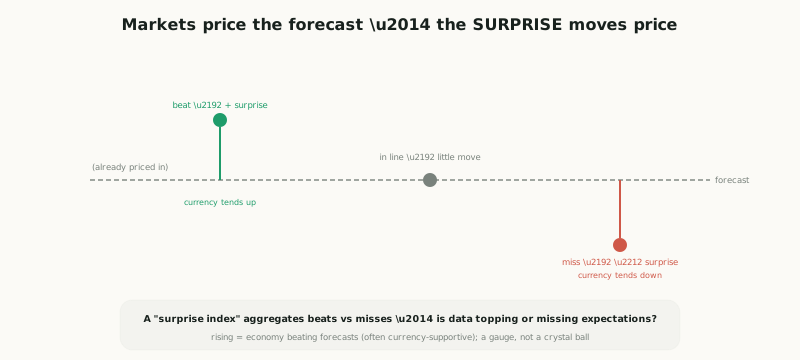
A: Because expectations are priced in ahead of time. Before any release, forecasts are public and already reflected in prices, so the expected outcome holds little new information. What's genuinely new — and therefore what moves prices — is the deviation from expectations: the surprise. A strong number that was fully expected may not move a currency, while an unexpected beat or miss can move it sharply. Markets trade the gap between reality and expectation, not the headline level.
Q: How do traders use a surprise index?
A: As a gauge of data momentum relative to expectations, which can support or undermine a currency. A rising surprise index suggests an economy is beating forecasts, which is often currency-supportive and may prompt markets to price firmer policy; a falling one suggests disappointment. Traders use it to sense whether the recent run of data backs a bullish or bearish view of a currency. Like any indicator, it's a contextual tool, not a standalone trading signal.
Why surprises, not data, move markets
Markets react to surprises rather than the data itself because expectations are priced in ahead of time. Before any release, economists' forecasts are public and already reflected in prices — the market has, in effect, already bet on the expected outcome. So when the data confirms what was expected, it carries little new information, and prices barely budge. What's genuinely new — and therefore what moves prices — is the deviation from expectations: the surprise. This is why a strong number that was fully expected may not move a currency at all (the strength was already priced), while an unexpected beat or miss can move it sharply (it forces the market to re-price). The mental model to lock in: markets trade the gap between reality and expectation, not the headline level. A GDP figure of 3% is neither "good" nor "bad" for the currency in isolation — it's bullish if the market expected 2%, bearish if it expected 4%. This single insight explains the endless confusion beginners feel when "good news" tanks a currency or "bad news" lifts it: the news wasn't being judged against good/bad, it was being judged against expected. Once you see every release through the lens of "versus forecast," the market's reactions stop looking random and start making sense.
The index, and how traders use it
An economic surprise index takes this principle and makes it measurable across a whole economy. It measures how a region's economic data is performing relative to forecasts — aggregating whether the stream of releases is, on balance, beating or missing economists' expectations. The best-known is the Citi Economic Surprise Index (CESI), published for major economies. The mechanism is intuitive: when data consistently beats forecasts, the index rises; when data disappoints, it falls; and it tends to mean-revert (because forecasters adjust — a run of beats leads economists to raise their forecasts, making future beats harder, so the index oscillates rather than trending forever). In essence, it distills a stream of individual data surprises into a single gauge of whether an economy is, overall, exceeding or falling short of what the market expected — a tidy summary of "is the news, net, better or worse than people thought?"
Traders use a surprise index as a gauge of data momentum relative to expectations, which can support or undermine a currency. A rising surprise index suggests an economy is beating forecasts — which is often currency-supportive and may prompt markets to price firmer policy (better-than-expected data nudges rate expectations up, lifting the currency); a falling index suggests disappointment, which can weigh on the currency. So traders use it to sense whether the recent run of data backs a bullish or bearish view of a currency: if you're considering a long on a currency and its economy's surprise index is rising (data keeps beating), that's supporting context; if the index is falling while you're bullish, the data momentum is against you. It can also help explain currency moves after the fact (a currency drifting higher on a steady drumbeat of beats) and flag when sentiment may be stretched (an extremely high surprise index is hard to keep beating, hinting the easy upside surprises may be behind it). Crucially, though — as with any indicator on this site — it's a contextual tool, not a standalone trading signal: a rising surprise index supports a bullish case but doesn't make a trade, it can mean-revert abruptly, and it must be combined with the rest of your fundamental and risk picture. Used well, it's a neat way to keep score of the thing that actually moves macro markets — reality versus expectations — across an entire economy at a glance. The honest framing: markets move on surprises, not data, because forecasts are already priced in — so it's the deviation from expectations (the surprise) that re-prices a currency, which is why "good" data can fall a currency if it merely met an already-strong forecast. An economic surprise index (like Citi's CESI) aggregates whether a region's releases are beating or missing forecasts, rising on beats and falling on misses (and tending to mean-revert). Traders use it to gauge whether data momentum supports a bullish or bearish currency view — a rising index is often currency-supportive — but it's a contextual tool, not a standalone signal.
Nuances and pitfalls
A few nuances keep you from misusing the surprise concept. First, surprise indices mean-revert, and understanding why matters: a run of beats leads forecasters to raise their forecasts, which makes future beats harder to achieve, so the index tends to peak and roll over rather than rise forever (and vice versa at the lows). An extreme reading is therefore often a sign the run of surprises is near exhaustion, not that it will continue — the opposite of naive momentum thinking. Second, a surprise index measures surprise, not level: an economy can be slowing while its surprise index rises (if it's slowing less than feared), and booming while the index falls (if the boom is less than the lofty expectations) — so it tells you about expectations versus reality, never the absolute health of the economy.
Third, and most importantly, the currency reaction to surprises is itself regime-dependent. Usually a positive surprise is currency-supportive (better data → firmer policy expectations → stronger currency), but in a "good news is bad news" regime, strong data can hurt risk sentiment (by implying more rate hikes) and produce counterintuitive moves — so the sign of the surprise doesn't mechanically dictate the currency's direction; you still have to read it through the current market narrative. Fourth, the index's correlation with the currency (or with bond yields) is loose and variable, not a reliable one-to-one driver — it's a contextual gauge, useful for sensing whether the data flow is, on balance, helping or hurting your view, but it should never be traded mechanically (buying a currency just because its surprise index ticked up is naive). Used properly — as a barometer of data momentum versus expectations, read with awareness of mean reversion, the surprise-not-level distinction, and the prevailing regime — it adds genuine context; used mechanically, it misleads like any single indicator. The honest reminder: mind the nuances — surprise indices mean-revert (forecasters adjust, so extreme readings often signal exhaustion, not continuation), they measure surprise not level (an economy can slow while its index rises), the currency reaction is regime-dependent (a positive surprise can even hurt in a "good news is bad news" regime), and the correlation with the currency is loose — so use it as a contextual barometer of data momentum versus expectations, never as a mechanical signal.
Markets move on surprises, not data — because forecasts are already priced in, so it's the deviation from expectations (the surprise) that re-prices a currency. This is why "good" data can sink a currency if it merely met an already-strong forecast: the market trades reality versus expectation, not the headline level. An economic surprise index (e.g. Citi's CESI) aggregates whether a region's data is beating or missing forecasts — rising on beats, falling on misses, and tending to mean-revert (forecasters adjust). Traders use it to gauge whether data momentum supports a bullish or bearish view (a rising index is often currency-supportive). But it's a contextual tool, not a standalone signal — read every release "versus forecast," and combine the index with your wider fundamental and risk picture.